
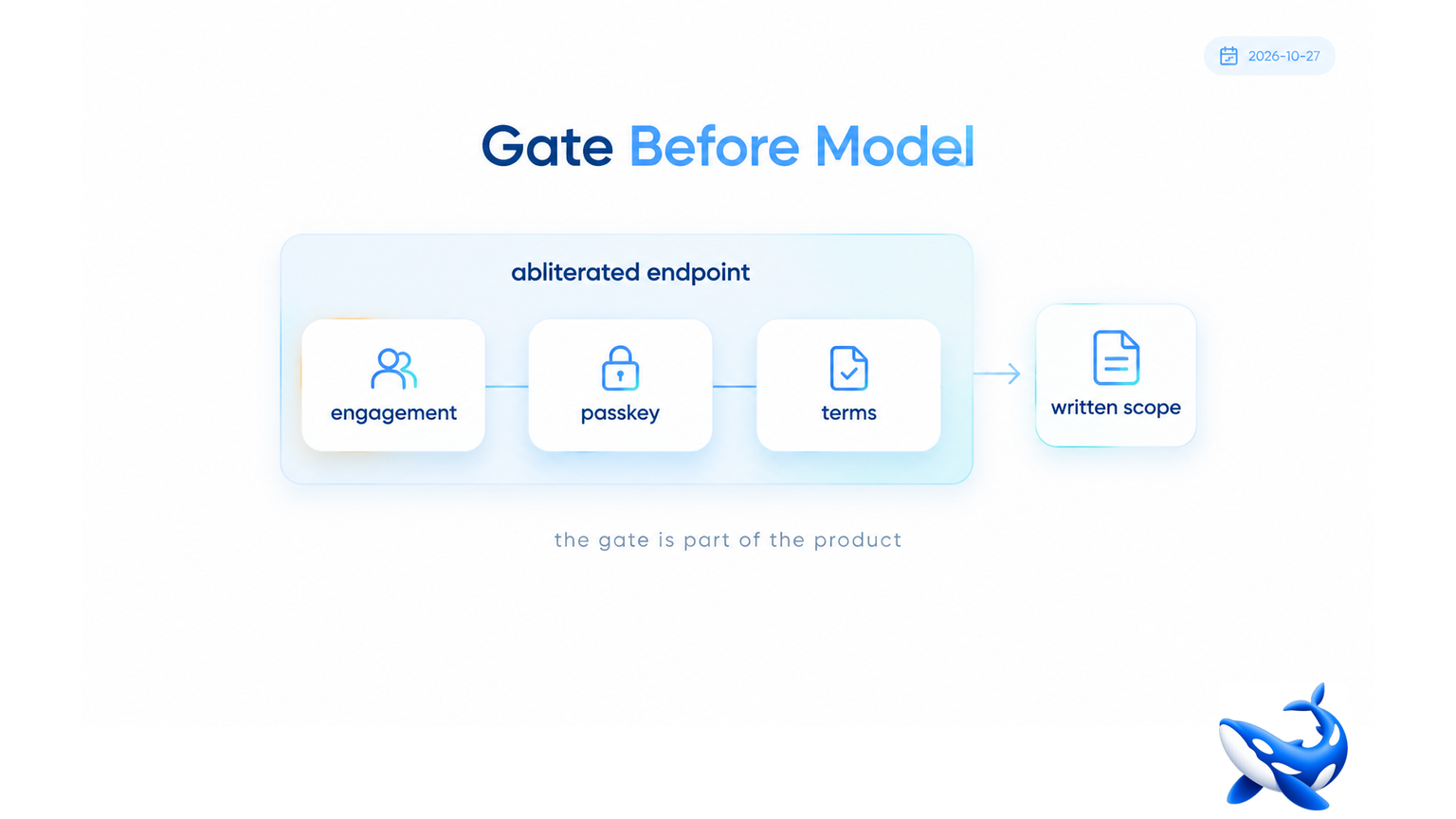
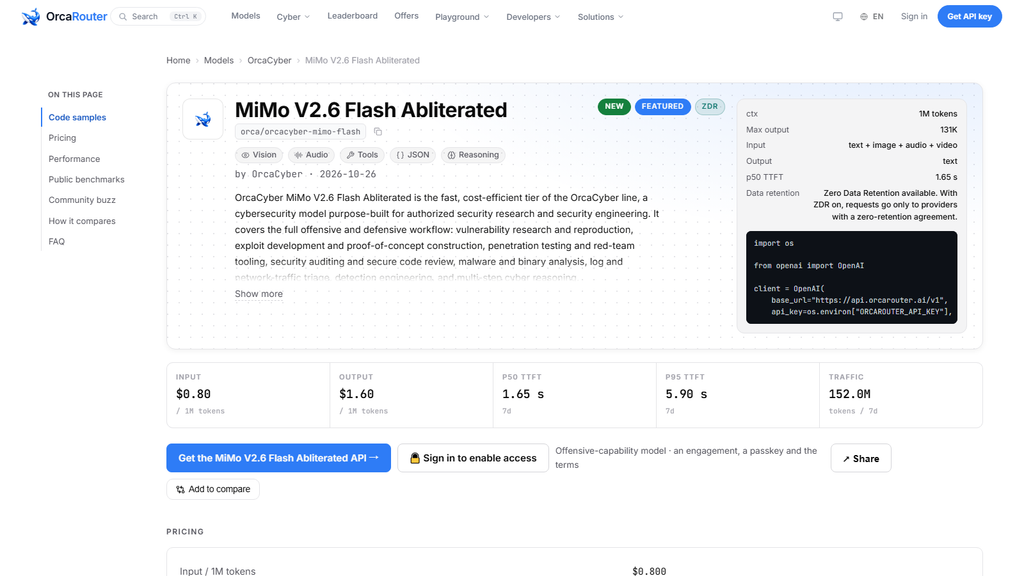
Through OrcaRouter the Xiaomi MiMo abliterated API is not a self-serve endpoint, and that is the most operationally significant fact about it. Before the first request is served, the OrcaCyber line requires an engagement, a passkey and acceptance of the terms [OURS]. The card is priced at $0.80 in and $1.60 out per million, but price is the second thing you negotiate.
The gate changes what kind of product this is, and it changes what a team has to have in place before buying it.
Why a gate exists on a refusal-free model
A general assistant declines certain requests. That behaviour is a safety property of the model, and removing it moves the responsibility for appropriate use to whoever operates the endpoint.
A gate is the structural answer. It establishes, before any traffic flows, that the operator has a stated purpose, an identified party, and an agreement about what the endpoint is for. The model itself no longer carries that context; the paperwork does.
Three consequences for a buyer.
The gate is not bureaucracy to route around. It is the mechanism by which the endpoint is legitimate for its intended work.
It has a calendar. An engagement takes time to put in place, and a passkey has to be provisioned and rotated like any other secret.
It scopes the use. Whatever the engagement says is what the endpoint is for, and engineering should read it before designing the pipeline.
What “authorized” looks like in practice
Four properties, and a real engagement has all of them.
A defined target. Systems you own, or systems you have written permission to test, named explicitly.
A defined purpose. Vulnerability research, red-team exercise, incident response, malware analysis — not “general use”.
A defined window. Engagements end, and pipelines should be built to pause when they do.
A named owner. Someone accountable for what the endpoint is asked to do.
None of this is unusual in security procurement. What is unusual is that an AI endpoint asks for it, which tells you something about how the vendor is positioning the product.
Where the model’s capabilities meet the scope
The card accepts text, images, audio and video and operates with tools [OURS]. Those capabilities are what make it useful on live engagements and what make scope discipline matter.
A recording of a client’s call, analysed to understand a social-engineering attempt, is within a normal engagement. The same recording, re-used after the engagement closes, is a data-handling problem that has nothing to do with the model.
The practical rule: treat evidence sent to the endpoint as disclosed to a third party, and prefer the shortest segment that contains the finding.
What the gate does not do
Three things it cannot substitute for.
It does not validate your purpose. It records it. Whether the work is authorized remains your organisation’s judgement.
It does not constrain the model’s output. The endpoint will produce what it produces; review is still yours.
It does not make the model safe for arbitrary use. The documentation is explicit that the card is for authorized security work, and the gate exists because that sentence needs a counterparty.
The procurement timeline
Three steps, and they run in parallel.
1. Engagement. The longest pole. Start it before the technical evaluation, not after.
2. Passkey. Provisioned after the engagement; needs a place in your secret store and a rotation policy.
3. Terms. Reviewed by whoever owns compliance, with the specific use case named.
A team that starts all three on day one can be running in a week or two. A team that discovers the gate when its client is ready to deploy is three weeks late.
What to tell the person signing
One paragraph, in plain language: what the endpoint does, what data will be sent to it, what the engagement authorises, and what happens to the data afterwards.
If that paragraph cannot be written, the pipeline is not ready. The gate is a good forcing function for exactly that conversation.
Keeping the gate’s promises operationally
An engagement is a document. A pipeline is a set of behaviours. Three of them turn the document into practice.
Data minimisation. Send the segment that contains the finding, not the whole recording. It is cheaper, and it is what the terms likely require.
Retention discipline. If the endpoint offers zero-data-retention, use it, and log that you did. If it does not, know how long prompts persist before you send a client recording.
Access logging. Every request that carries third-party data should be attributable to a person or a job. This is the difference between an auditable engagement and a story about one.
None of this is exotic. All of it is easier to build at the start than to retrofit after an auditor asks.
Working alongside the scope
Two habits keep a live engagement inside its boundaries.
Tag requests by engagement. A header or a metadata field naming the engagement makes every log entry self-explaining.
Expire credentials with the engagement. A passkey that outlives its engagement is a standing permission nobody is watching.
Both are cheap. Both prevent the failure mode where a perfectly legitimate tool ends up used for something the paperwork never covered.
A third habit, worth more than the other two: rehearse the close. Decide in advance what happens to logs, passkeys and retained evidence when the engagement ends, and put it in the runbook rather than in someone’s memory.
The takeaway
The access gate is part of the product, not an obstacle in front of it. It defines who may use a refusal-free endpoint, for what, and under whose accountability.
Plan the engagement alongside the evaluation, read the terms before designing the pipeline, and treat the gate as the moment your use case becomes explicit.
That is a slower start and a shorter path to a deployable system, which is usually the right trade in security work.
The gate is also, quietly, a filter on vendors. A provider that asks for an engagement is a provider that has thought about who its customers are, and that is a reasonable proxy for whether it has thought about anything else either.
Sourcing note: the access gate, pricing, modalities and capabilities are from the OrcaRouter model page, checked 2026-10-27 [OURS]. This article describes procurement and scope practice; it makes no claim about the legality of any specific use beyond the engagement terms. No benchmark or telemetry figures are used.
