
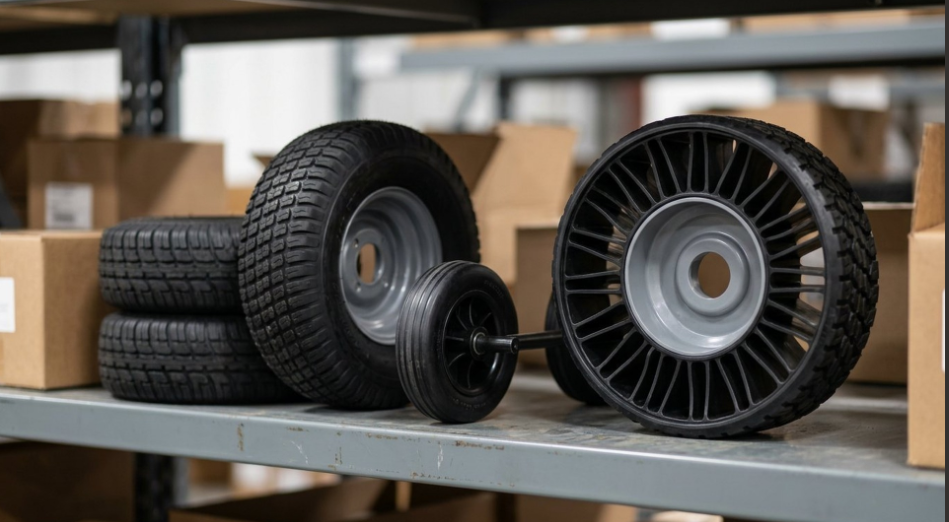
Mower tires are one of those parts nobody thinks about until one fails, and then the whole job stops. A flat tire, a cracked sidewall, or a worn tread can put a riding mower out of service at exactly the worst moment, which is why knowing how to buy the right replacement matters. When you search for lawn mower tires for sale, you will find everything from simple push-mower wheels to heavy turf tires and airless tweels, and the choice is rarely obvious without a little knowledge. This guide explains the tire types, how to read mower tire sizes, what to match when replacing, and how a parts specialist such as AG Lawn fits into the picture.
Why the Right Tire Matters More Than You Expect
A tire seems like a simple component, but it affects how the entire mower behaves, and the wrong choice shows up quickly.
The tire is the mower’s only contact with the ground. Consequently, its size, tread, and construction determine traction, ride quality, and whether the mower leaves ruts or scuffs in the lawn. A drive tire with the wrong diameter changes the mower’s speed and cut consistency, because the wheels are part of how the machine moves across the turf. Meanwhile, a worn or mismatched tire can strain the deck, tear the grass, or leave the mower sitting in the shed until a replacement arrives.
For this reason, buying the right tire is not a matter of grabbing the cheapest one that looks similar. It is a matter of matching the tire to the mower’s model, the job it does, and the surface it runs on. That matching process is the heart of this guide.
The Types of Mower Tires and Wheels
The term “mower tires” actually covers several distinct components, and knowing the categories is the first step to buying correctly.
Drive tires are the large rear tires on a riding mower that provide traction and carry the machine’s weight. They are usually turf-style tires with a shallow, non-aggressive tread designed to grip without tearing the lawn. Steering tires, the smaller front tires, are typically smooth or lightly treaded for easy turning.
Deck and gauge wheels are the small wheels mounted on the mower deck that keep the cutting height consistent across uneven ground. They wear down over time and are among the most frequently replaced parts, because they drag across the grass constantly. Push mower wheels are simpler still, lightweight wheels that keep a walk-behind mower rolling at the right height.
Beyond wheels, the category includes rims and hubs, tire stems, and inner tubes, the supporting components that fail alongside the tires themselves. A tire that goes flat is often only half the problem; the tube, stem, or rim may be the part that actually needs replacing.
Airless Tweels and Why They Are Popular
One of the most significant changes in mower tires in recent years is the rise of airless options, and they are worth understanding.
Traditional pneumatic tires ride on air and require tubes or tubeless sealing, which means they can go flat. An airless tire, often sold under names like Tweel, replaces the air with a flexible spoke structure that supports the load. As a result, the tire cannot go flat, which removes the single most common failure mode in mower tires entirely.
The trade-off is cost and feel. Airless tires are typically more expensive up front, and their ride characteristics differ slightly from pneumatic tires. However, for commercial mowers, zero-turn machines, and anyone tired of flat tires interrupting work, the elimination of downtime is often worth the premium. AG Lawn’s catalogue, for example, includes Sunbelt X-Tweel turf caster units, which illustrates how airless options have moved into the mainstream parts market.
How to Read a Mower Tire Size
The single most important skill in buying mower tires is reading the size, and it is simpler than it looks once the pattern is clear.
Mower tire sizes are usually written in a format such as 18×6.5-8 or 13×6.5-6. The first number is the overall tire diameter in inches, the second is the tire width in inches, and the third is the rim diameter in inches. In other words, an 18×6.5-8 tire is 18 inches tall, 6.5 inches wide, and fits an 8-inch rim.
All three numbers matter, but the rim diameter is the most critical, because a tire must fit the rim exactly. The overall diameter matters next, because it affects the mower’s height and speed, and the width matters for clearance and flotation on the turf. The safest approach is to match all three numbers to the tire that came off the mower, and to confirm against the mower’s model and parts diagram when in doubt.
Matching Tires to Your Mower Model
A tire that is the right size in the abstract can still be the wrong tire for a specific machine, which is why model matching matters.
Most mower manufacturers publish parts diagrams that identify the exact tire for each model, and serious parts retailers organise their inventory the same way. AG Lawn, for instance, lists its 90 tire and wheel products by brand, base code, and model, covering John Deere, Honda, A&I, Sunbelt, and SMA, with filters for specific mower lines such as the John Deere 100 series, ZTrak zero-turns, and X700 series tractors.
This model-based organisation exists for a reason. Two mowers can use the same diameter tire but different load ratings or hub styles, and guessing wrong means a tire that does not seat, rubs, or wears prematurely. Therefore, the reliable method is to search by model or by the original part number, and to verify the fit before ordering.
What to Check Before You Replace
A tire rarely fails alone, and checking the surrounding components before buying saves time and money.
First, identify the actual failure. A tire that slowly loses air may need only a new tube or a valve stem, not a full tire, and replacing the cheapest component first is often the correct fix. Second, check the rim for damage, because a bent or corroded rim will ruin a new tire quickly. Third, check the opposite tire, since tires wear in pairs and a badly worn partner will leave the mower unbalanced even with one new tire.
Above all, inspect the deck and gauge wheels while you are at it, because they wear faster than the main tires and are usually the reason a mower is cutting unevenly. Ordering all the worn parts in a single purchase avoids a second round of downtime.
Buying Tires Online: What to Look For
Buying mower tires online is convenient, and a few checks make it reliable.
Confirm the seller is a genuine parts supplier rather than a general marketplace listing, because fitment accuracy depends on the seller knowing the product. Look for the tire size, the brand, and the model compatibility stated clearly on the listing, and cross-check the part number against the manufacturer’s diagram where possible. Pay attention to whether the listing is for a single tire or a pair, because drive tires are often sold individually while caster and deck wheels are often sold in sets.
Price is the final consideration, and it varies widely by type. A simple tube-tire can cost under forty dollars, while a set of premium airless tweels can run several hundred. As a result, the cheapest option is not always the best value, because a tire that lasts two seasons is worth more than one that lasts two months.
A Parts Specialist Option: AG Lawn
For buyers in the market, AG Lawn is a parts retailer that specialises in lawn equipment parts and maintains a dedicated lawn mower tires and wheels collection. The catalogue includes around 90 products across categories such as deck and gauge wheels, planter wheels, push mower wheels, rims and hubs, tire stems, tires, tweels, and complete wheel assemblies.
The range covers major brands, including John Deere, Honda, A&I Products, Sunbelt, and SMA, and it is organised so buyers can filter by brand, base code, and mower model. Price points reflect the category’s full spread: a two-pack of tube tires is listed around $33, a Honda snowblower tire around $95, and a set of two Sunbelt X-Tweel turf casters around $540. The company also maintains a John Deere parts catalogue link for model-specific lookup, and it can be reached at (636) 366-2336. As with any parts purchase, confirming fitment against your mower’s model before ordering is the sound approach.
Getting the Longest Life From Your Tires
Replacement is only half the equation; a few habits extend the life of whatever tires you install.
Keep tires inflated to the recommended pressure, because under-inflation is the leading cause of premature tire wear and sidewall damage. Store the mower out of direct sun when possible, since UV exposure degrades rubber over time and causes the cracking that precedes failure. Avoid turning sharply on pavement, which scrubs the tread off turf tires faster than any amount of mowing.
Additionally, replace tires in pairs when the wear is uneven, and keep the deck wheels adjusted properly so they roll rather than drag. Most of the longevity in mower tires comes from these small habits rather than from the tire itself, and they cost nothing.
Conclusion
In conclusion, finding the right lawn mower tires for sale comes down to a few steps: identify the type of tire you need, read and match the size, confirm the fit against your mower model, and check the surrounding components before you order. The category has grown more sophisticated, with airless tweels and model-specific catalogues making it easier than ever to get an exact match rather than a rough approximation. For buyers who want that precision, a specialist such as AG Lawn, with its 90-product tire and wheel range across John Deere, Honda, and other major brands, offers a practical starting point. A mower is only as reliable as its tires, and the small effort of matching them correctly pays off in every clean cut and every season without downtime.
Frequently Asked Questions
1. How do I know what size lawn mower tire to buy?
Read the size printed on the old tire, typically in the format diameter x width – rim diameter, such as 18×6.5-8, and match all three numbers.
2. What are the most common types of lawn mower tires?
Common types include drive tires, steering tires, deck and gauge wheels, push mower wheels, rims and hubs, and airless tweels.
3. Are airless mower tires worth the cost?
For many users, yes, because airless tires such as tweels cannot go flat, which eliminates the most common source of mower downtime.
4. Do lawn mower tires come in pairs?
It depends on the product; drive tires are often sold individually, while caster, deck, and some airless wheels are sold in sets, so check the listing.
5. Can I replace just one mower tire?
You can, but if the opposite tire is heavily worn, replacing both keeps the mower level and prevents uneven wear and cut.
6. Where can I find lawn mower tires for sale?
Specialist parts retailers such as AG Lawn stock tires and wheels for John Deere, Honda, and other major brands, organised by model for easy fitment.
