
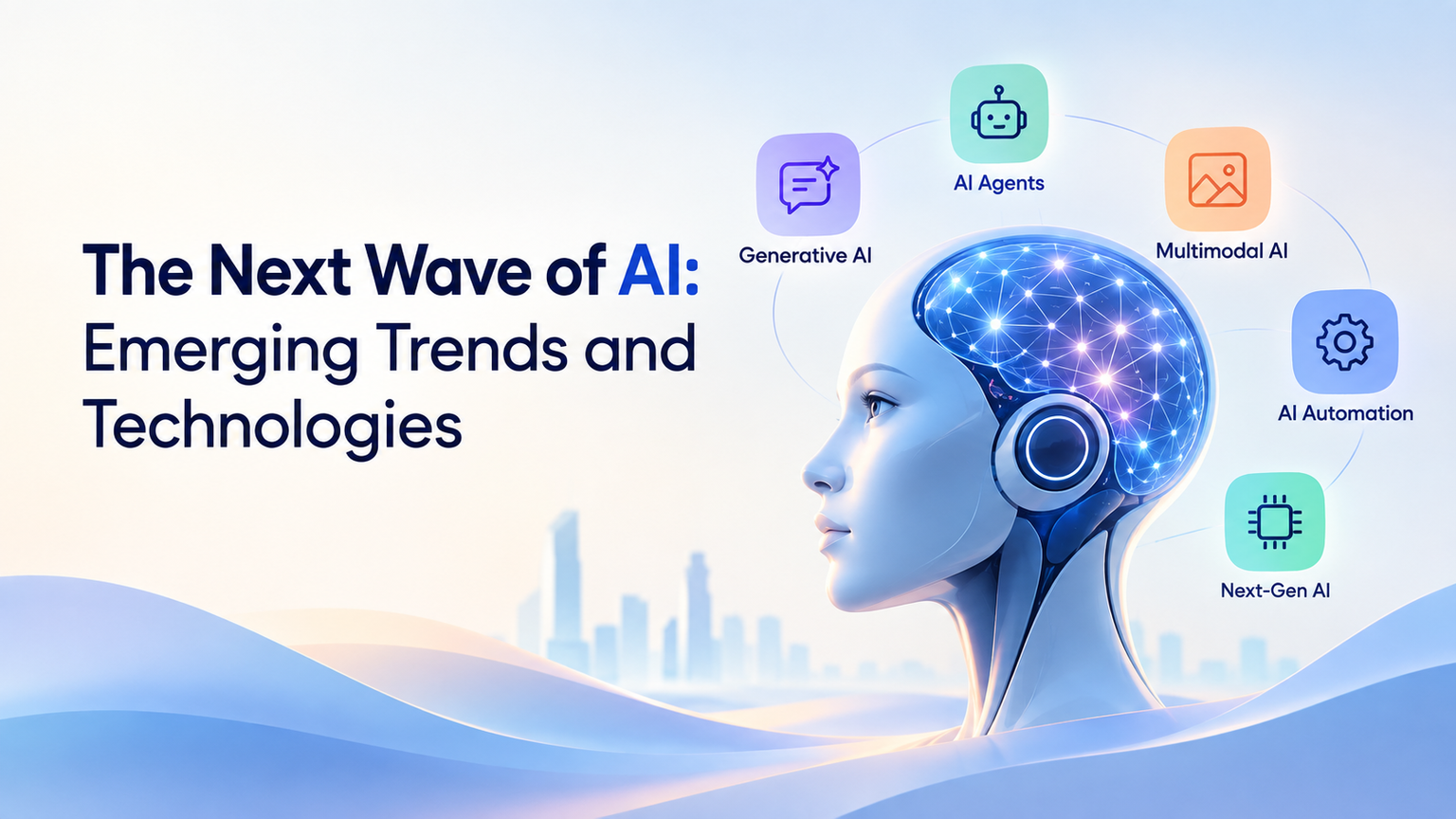
The technology is no longer in its experimental stages. Rather, AI has been integrated into the product development process of businesses, customer service and interaction, interpretation of information, and daily business operations. The future evolution of AI is not going to be dependent on any single discovery but rather on the evolution of multiple AI technologies such as autonomous AI agents and multimodal systems.
Companies looking at the emerging AI technologies worth tracking are asking a different question than they were a year or two ago. It’s no longer “should we adopt AI tools?” but “where does this actually move the needle?” That shift in mindset is a big part of what will define AI trends 2026: more automation, systems with real context awareness, deeper enterprise adoption, and AI that can work across different types of data rather than just text.
1. AI Agents Are Starting to Take Action, Not Just Respond
Among the artificial intelligence trends worth watching, the rise of AI agents stands out. A typical AI assistant answers the prompt in front of it. An agent goes further; it can plan out a task, make decisions along the way, interact with other software, and carry a multi-step workflow through to completion.
Imagine the scenario where the salespeople employ the agent that analyzes incoming leads, brings all necessary information together, saves it into the CRM, composes a personalized message, and contacts the salesperson only when human intervention is required.
The next generation of agents is heading toward:
- Carrying out multi-step tasks on their own
- Working directly inside business applications
- Making decisions in real time
- Coordinating entire workflows
- Looping in a person for anything sensitive
That combination could make AI automation genuinely useful for the kind of repetitive, tangled processes that have always been hard to hand off.
2. Multimodal AI Is Becoming Something You Can Actually Use
AI isn’t limited to reading text anymore. Multimodal AI pulls together text, images, audio, video, and other formats, so an application can understand a situation the way a person would by looking at the whole picture, not just one piece of it.
Take customer support: a system that can read a written complaint, look at a photo of the damaged product, and listen to a voice message all at once has a much better shot at understanding what actually happened than one that only sees the text.
That kind of capability is already starting to shape:
- Healthcare and medical imaging
- Retail and eCommerce
- Manufacturing
- Education
- Financial services
- Customer experience
As the underlying processing gets cheaper and faster, multimodal capability is likely to become a baseline expectation for AI-powered applications, not a nice-to-have.
3. Generative AI Is Getting More Specialized
Generative AI’s first wave was mostly general-purpose chatbots, content generators, tools that could do a bit of everything. The next wave looks different: purpose-built systems designed around a specific business process.
The generative AI trends worth paying attention to include domain-specific models, retrieval-augmented generation, AI that helps write and review code, enterprise knowledge tools, and applications that pair generation with automation rather than treating them as separate things.
Businesses are also getting pickier about how they deploy large language models. The question has shifted from “where can we bolt on a chatbot?” to “which of our processes would actually benefit from contextual AI and measurable automation?”
That distinction matters because an AI model is only as valuable as its connection to real business data and real workflows; the model itself is just one piece.
4. Large Language Models Are Getting Smarter, Not Just Bigger
Large language models are still at the core of most modern AI applications, but the next round of progress won’t come from simply scaling up.
Instead, the real gains are showing up in efficiency, reasoning, how much context a model can hold onto, latency, and cost. Smaller, more focused models are also proving their worth especially for organizations that need AI to run in constrained environments or handle a narrow, well-defined task.
Where this is headed:
- Leaner, more efficient architectures
- Sharper reasoning
- Longer memory of context
- Models built for specific domains
- Smarter orchestration between models
- Cheaper inference
Put together, these changes should make serious AI capability accessible to a much wider range of organizations, not just the ones with the biggest budgets.
5. AI Is Quietly Becoming Part of the Software You Already Use
Another piece of the future of the AI technology puzzle is integration. Rather than making employees open a separate AI app, intelligent features are increasingly showing up inside the CRM, ERP, collaboration, analytics, development, and customer service tools people already work in every day.
That means recommendations, summaries, predictions, and even automated actions can surface right where the work is already happening.
For companies planning this kind of rollout, AI integration is really about connecting intelligent capability to the data and workflows that already exist, instead of bolting AI on as its own separate system.
The net effect: standalone AI tools give way to AI-enabled business ecosystems.
6. Enterprise AI Is Growing Up and That Means Governance
As AI adoption scales, technical performance stops being the only thing that matters. Data privacy, security, transparency, compliance, access control, and human oversight are all becoming core parts of any serious enterprise AI strategy.
This is why the most relevant enterprise AI trends combine innovation with governance by providing a framework for defining what data an AI system can access, how its outputs will be analyzed, and when it requires human involvement.
Things worth building into that framework:
- Data security and privacy
- Model monitoring
- Permissions
- Regulation
- Human oversight
- Evaluation of the quality of AI output
Getting the implementation right is starting to matter just as much as picking the right model in the first place.
7. Machine Learning Keeps Getting More Adaptive
Generative AI gets most of the attention these days, but traditional machine learning hasn’t stood still. Machine learning innovations in predictive analytics, recommendation engines, anomaly detection, forecasting, and personalization are still doing a lot of the heavy lifting for companies.
Pairing machine learning with generative systems opens up new possibilities. A business platform, for example, might use a predictive model to flag a customer at risk of churning, then let generative AI explain why and suggest what to do about it.
That combination pushes companies from simply spotting patterns to actually acting on them.
8. AI Adoption Is Moving From “Let’s Try It” to “Show Me the ROI”
One of the clearest AI adoption trends right now is a shift toward measurable outcomes. Plenty of companies have experimented with AI across different departments but ongoing investment increasingly comes down to whether these projects actually move productivity, revenue, customer satisfaction, or decision-making in the right direction.
Businesses across industries continue to increase how much they invest in artificial intelligence, a clear sign of how central AI has become to overall strategy.
The AI initiatives that hold up tend to start with a real problem, not with the technology itself. The better question isn’t “how do we use AI?” it’s “what process is slow, expensive, repetitive, or hard to scale, and can AI actually fix it?”
What the Next Generation of AI Could Look Like
The next-generation AI landscape won’t be defined by isolated models working alone, it’ll be defined by how well they connect. AI agents will lean on multimodal systems, large language models will sit at the center of enterprise applications, and machine learning will quietly power the predictive intelligence behind it all.
None of that happens without also thinking seriously about responsible implementation alongside innovation.
For more background on how artificial intelligence has developed over time, this is a solid starting point.
It is quite evident where this is all going to lead us: AI will go beyond standalone experiments into contextual, multimodal solutions with a proactive approach and involvement in business operations.
The organizations that will benefit from these AI technology advancements will not be the ones that strive to obtain the latest technological developments. It will be those that know how to implement these solutions in their business processes, using reliable data and infrastructure, for that matter.
