
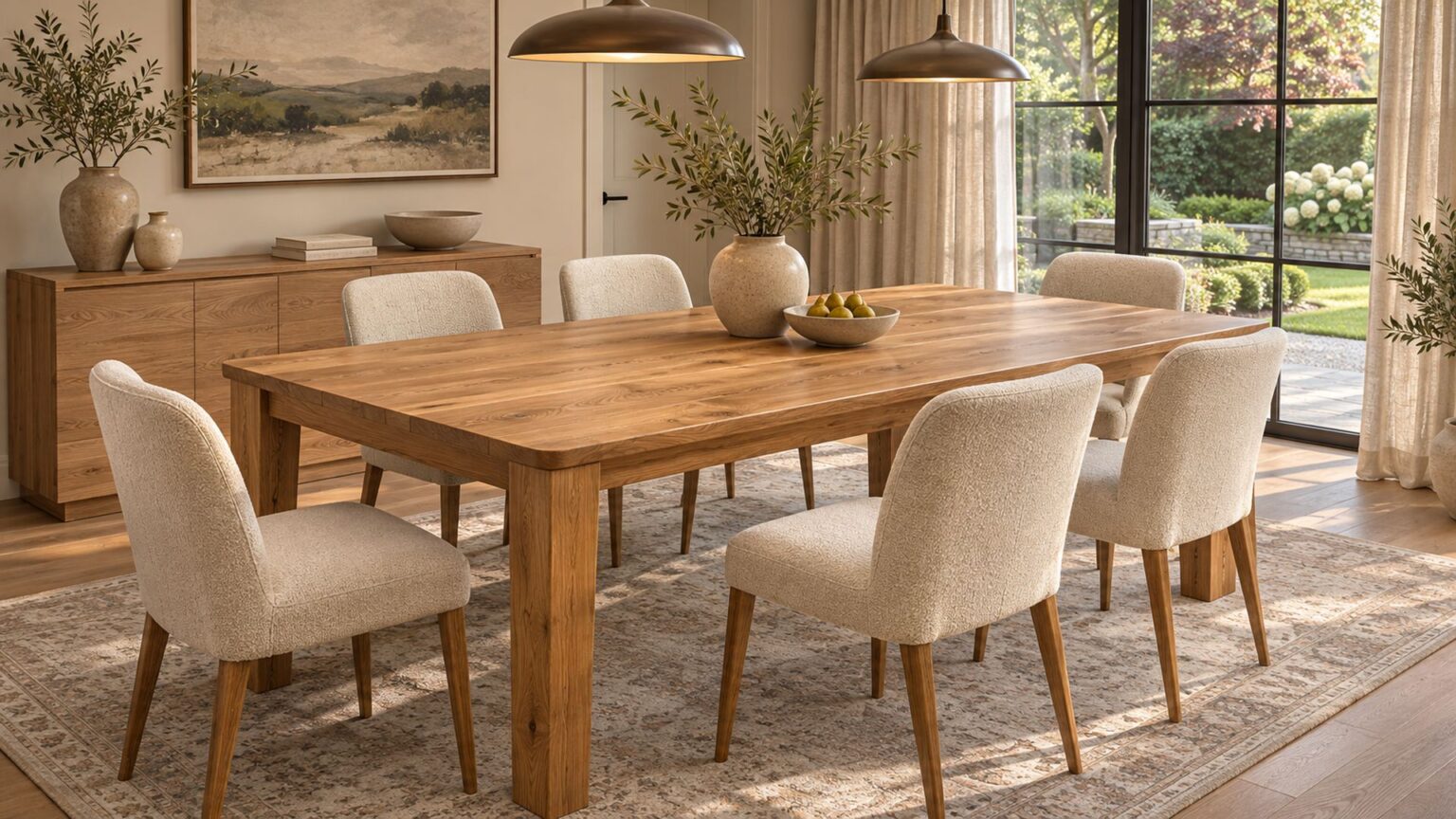
Oak dining tables bring natural grain, a substantial feel, and a choice of designs to everyday dining spaces. Yet two tables with similar photographs can differ significantly in construction, finish, stability, and long term maintenance. Solid oak, oak veneer, and oak look surfaces are not interchangeable, and a beautiful tabletop is only part of a comfortable dining arrangement. The smartest purchase begins with honest room measurements, an understanding of materials, and a close look at the details you will use every day.
A dining table needs to accommodate meals, conversation, working from home, and occasional gatherings without dominating the room. This guide explains how to compare shapes, seating capacity, craftsmanship, finishes, and practical care, with twenty four checks that make the decision easier.
Are Oak Dining Tables a Good Investment?
For many households, oak dining tables are an appealing choice because they combine distinctive wood grain with a wide range of traditional and contemporary styles. A well constructed table can serve for years, particularly when the surface and support system suit its daily use. However, oak is not immune to scratches, water marks, heat damage, or changes in humidity. The quality of joinery, protective finish, and care are as important as the species itself.
The value of oak dining tables should be measured by comfort, usable size, construction, and expected service rather than the largest tabletop or highest price. A properly made veneered table may be a better fit for some budgets, while a solid oak table can appeal to buyers who value repair options and natural material throughout the top.
24 Proven Tips for Choosing Oak Dining Tables
1. Measure the Dining Area Before Shopping
Measure the usable floor space, not only the room’s wall dimensions. Account for cabinets, doors, walkways, and furniture that will remain. Mark the proposed table footprint on the floor with removable tape. Then pull a chair out to see whether people can sit and pass comfortably. A table that technically fits but blocks circulation will quickly become frustrating.
2. Allow Enough Space Behind Chairs
Approximately 36 inches of clearance from the table edge is a useful starting point for pulling out chairs and moving around a dining area. Busy routes may need more. This is planning guidance rather than a universal building requirement. Test your actual chairs, especially if they have arms or wide backs, because furniture dimensions determine whether the arrangement feels generous or cramped.
3. Count Everyday Diners Before Occasional Guests
Choose a size that comfortably serves the people eating there most days. A large table can make a small household’s room feel crowded, even if it is useful twice a year. If gatherings are occasional, an extending design may be more practical. Check seating positions around legs and supports rather than relying entirely on a retailer’s advertised seat count.
4. Choose a Shape That Supports Movement
Rectangular oak dining tables suit many longer rooms and align naturally with walls and kitchen layouts. Round tables can make conversation and circulation easier in some compact spaces. Oval designs soften corners while preserving a long seating edge. Square tables may work well for smaller groups. Match the shape to the room and the movement around it, not just a photograph.
5. Check Table Height and Chair Compatibility
Many standard dining tables are around 28 to 30 inches high, but actual measurements vary. Verify the underside clearance, especially when a thick apron runs beneath the tabletop. Chairs with arms may not slide fully underneath. Try sitting at the intended height if possible, checking where your knees and thighs rest. Comfort matters more than matching a generic furniture category.
6. Understand What Solid Oak Really Means
A solid oak tabletop is made from timber through its thickness, often using several joined boards. That does not mean a table is carved from one piece of wood, or that every hidden component must be oak. Ask which parts are solid oak, which are made from another species, and whether engineered materials appear in the base or supports. Precise material descriptions help you compare fairly.
7. Evaluate Oak Veneer Without Dismissing It
Oak veneer is a real wood layer applied to a supporting core. High quality veneer can offer attractive grain and useful dimensional stability, depending on the core and construction. Its refinishing options are generally more limited than those of a thick solid wood top. Ask about veneer thickness, edge construction, and repair guidance rather than assuming that every veneer table is either poor quality or identical.
8. Recognize Oak Look Surfaces
An oak look finish may be a printed laminate, vinyl film, or other decorative surface with no real oak at the top. Such tables may fit certain budgets and maintenance preferences, but they should not be marketed as solid timber. Read the product specifications carefully. Terms such as oak colour, oak effect, and oak finish describe appearance, not necessarily the material beneath.
9. Compare Red Oak and White Oak Carefully
Both red oak and white oak can be used for furniture, and each includes variations in colour and grain. White oak often appears in pale contemporary designs, while red oak may show warmer tones, but stains and finishes can dramatically change either species. Do not assume species alone determines quality or appearance. Ask to see actual material samples under the lighting in your home.
10. Look at the Grain Across the Whole Surface
Natural oak displays variation in grain direction, colour, and markings. Joined boards may be selected to create a calm, consistent look or a more expressive pattern. Neither is automatically better. Examine full tabletop photographs, not only close ups of one attractive section. If buying in person, check whether visible joints, knots, or colour changes match your preferences.
11. Assess the Frame and Leg Connections
A beautiful top will not compensate for a weak base. Examine where legs connect to rails or other supports, and ask how those connections are secured. Well designed joinery and correctly fitted hardware help the table resist wobbling during normal use. Try applying gentle pressure at different corners while the table is set on a level floor. Excessive movement deserves an explanation before purchase.
12. Confirm the Design Allows Wood Movement
Solid timber expands and contracts as indoor humidity changes, primarily across the grain. A properly designed tabletop needs attachment details that accommodate this movement. Rigidly fixing a wide solid top without allowance can contribute to splitting or distortion. You do not need to understand every fastener, but a knowledgeable seller should explain how the construction accounts for seasonal changes.
13. Decide Whether an Extension Leaf Is Useful
Extendable oak dining tables can provide extra seating without occupying maximum floor space every day. Examine the mechanism, alignment, and how securely the leaves sit when open. Measure the fully extended length and allow clearance at both ends. Ask whether the leaf stores inside the table or separately, and whether one person can operate the mechanism safely.
14. Test Legroom at Every Seating Position
A pedestal base can free up space along the sides, while corner legs may simplify certain seating arrangements. However, wide pedestals can interrupt feet, and thick aprons may limit knee room. Sit at an end seat and a side seat before deciding. If the table is intended for regular family meals, small comfort differences become noticeable over time.
15. Compare Surface Finishes Honestly
Oil, hardwax oil, lacquer, and other protective coatings offer different appearances and care requirements. Some create a natural matte effect, while others form a more protective film. There is no single finish that is both completely maintenance free and resistant to every spill or scratch. Ask what coating is applied, what cleaning products are suitable, and how damaged areas can be treated.
16. Think About Everyday Spills and Heat
Water rings, food stains, and hot serving dishes can affect wood finishes. Use coasters, suitable mats, and trivets, and wipe up spills promptly with a soft cloth. Avoid placing hot cookware directly on the tabletop. A surface described as stain resistant still has limits, particularly if liquid remains on it. The product care guide should take priority over generic cleaning advice.
17. Match Colour to the Room’s Light
Pale oak can brighten a darker dining area, while deeper stains can create contrast against light walls or flooring. Consider natural and artificial lighting at the times you normally eat. A finish seen under showroom lights may appear different at home. Request a physical sample when possible and compare it with existing cabinets, flooring, and chairs before committing.
18. Choose a Style That Will Age Gracefully
Oak works with minimalist, rustic, traditional, and contemporary interiors. Instead of pursuing a fashionable detail simply because it is prominent online, decide which features you will enjoy for years. Simple proportions, comfortable edge shapes, and a balanced base often integrate into changing rooms. A distinctive design is worthwhile when it suits your household rather than a passing trend.
19. Inspect Edges and Corners
Table edges affect comfort, safety, and visual weight. Rounded corners may suit a busy family room, while sharp profiles create a different architectural look. Check the underside of the edge for roughness or poorly finished transitions. If children regularly use the table, assess how exposed corners align with circulation paths. No edge design removes the need for normal supervision.
20. Ask About the Table’s Weight and Delivery
Solid oak dining tables can be heavy, especially when the top is thick. Check the product weight, packaged dimensions, stairs, lift access, and doorway measurements. Clarify whether delivery includes carrying the table into the room, unpacking, and assembly. Confirm who is responsible for inspecting shipping damage. A beautiful piece is not a practical purchase if it cannot reach the intended space safely.
21. Review Assembly and Maintenance Access
Some tables arrive assembled; others require legs or support rails to be fitted on site. Ask which tools and fasteners are provided and whether professional assembly is recommended. Retain the instructions for future moves. Do not over tighten fittings beyond manufacturer guidance, and check accessible hardware periodically if the care manual recommends it. Stability should be verified after assembly on a level surface.
22. Compare Price by Construction and Service
A higher price may reflect thicker solid timber, skilled joinery, a more complex base, or premium delivery and service. It may also reflect branding rather than a meaningful difference. Compare like for like: dimensions, material composition, finish, mechanism, warranty, and delivery terms. Ask what the advertised price excludes. A realistic budget includes chairs and appropriate floor protection, not only the table itself.
23. Investigate Timber Sourcing Claims
If responsible sourcing matters to you, ask for specific information about wood origin and any independently verified certification associated with the product. Broad phrases such as eco friendly or sustainably made are not enough to establish what was verified. Different certifications cover different parts of supply and production. Look for clear evidence without assuming that an expensive table necessarily has better environmental credentials.
24. Check Returns and Warranty Coverage
Before ordering, understand whether the table can be returned after delivery and what happens if a finish or structural problem appears. Custom dimensions and made to order products may have different conditions from stocked furniture. Ask about warranty coverage for joinery, extension mechanisms, and surface finishes. Document the condition on arrival and keep purchase records. Clear after sales terms are part of the overall value.
Choosing the Right Size for Your Dining Room
A useful planning method begins with the room, then works inward. Subtract the space needed for chairs and walkways from the usable dimensions. For example, a 12 foot long room with 36 inches of clearance at each end leaves about 6 feet for the table’s length. This is only an illustration; door swings, sideboards, and traffic may require more space. Measure everything in the same units and test the proposed footprint on the floor.
How Much Seating Edge Does One Person Need?
About 24 inches of table edge per diner is a common starting point for basic planning, but broad chairs, arms, and serving arrangements can increase the requirement. Check whether legs interrupt that usable space. A table advertised for eight people may feel better with six during everyday meals, particularly if everyone needs room for dishes and serving bowls.
Remember the Space Around the Table
The tabletop should not consume every available inch. Allow room to stand up, carry plates, and pass behind a seated person. If someone uses a mobility aid, assess their actual turning and access needs rather than relying on a generic clearance figure. A comfortable dining area is the table and its surrounding movement space together.
Solid Oak Versus Veneer: Which Is Better?
Neither material is automatically the right choice for every home. Solid oak dining tables appeal to buyers who want substantial natural timber and the possibility of refinishing a suitable surface later. It also requires construction that accommodates movement with changing humidity. Veneered panels can provide consistent decorative grain and are often more economical, but the durability of their edges, core, and coating matters greatly.
The most important question is which components are made from which materials. A table may combine a solid top, veneered panels, and metal supports. Ask for a component specific description and the manufacturer’s repair guidance. Purchasing decisions should be based on construction and intended use rather than a single marketing label.
Pairing an Oak Table With Chairs and a Rug
Chair selection can change the usable capacity of oak dining tables as much as tabletop dimensions. Slim chairs may allow more elbow room, while padded armchairs need extra clearance at the sides and beneath the apron. Check the height of the seat against the table, and make sure guests can push their chairs back comfortably. If you use an area rug, choose one large enough for chair legs to remain on it when chairs are pulled out. A rug that is too small can catch chair feet and make everyday movement awkward. Select an easy to clean surface if meals often involve children or frequent entertaining.
How to Care for Oak Dining Tables Without Damaging Them
For oak dining tables, dust regularly with a soft cloth and clean spills promptly using the method recommended for the finish. Avoid saturating joints with water or applying abrasive cleaners. Protect the surface from very hot serving dishes and prolonged direct sunlight where practical. Sudden changes in indoor humidity and temperature can contribute to movement or small checks in solid timber.
When Does the Finish Need Renewal?
Care depends on the product. Some oiled surfaces require periodic maintenance, while other finished tops have different cleaning and repair instructions. Do not sand a veneered top or apply oil to a coated surface without manufacturer approval. If the table develops a loose joint, significant split, or damaged extension mechanism, seek appropriate repair advice rather than hiding the problem under a new coating.
Avoid These Common Buying Mistakes
When shopping for oak dining tables, the most expensive mistake is buying by photograph alone. A table can look proportionate online but block the kitchen doorway or feel uncomfortable with your existing chairs. Another mistake is confusing a wood effect surface with real oak, then expecting solid timber repair options. Overlooking delivery restrictions, return conditions, and a realistic care routine can be equally frustrating. Confirm these details before paying, particularly for custom furniture.
Frequently Asked Questions
1. Are oak dining tables durable enough for everyday use?
Well constructed oak tables can handle regular dining, but finish quality, joinery, cleaning, and humidity management affect durability. No wood surface is completely damage proof.
2. Is solid oak better than oak veneer?
Solid oak offers natural timber through the top and may allow more refinishing. Quality veneer can be a practical alternative with different maintenance and repair limits.
3. What size oak dining table is suitable for six people?
The answer depends on chair width, table shape, leg placement, and serving space. Measure the room and check actual seating clearance before relying on a listed capacity.
4. How do I protect an oak tabletop from stains?
Use coasters and trivets, wipe spills quickly, and follow the finish manufacturer’s cleaning instructions. Avoid abrasive products and prolonged exposure to moisture.
5. Do solid oak tables crack as seasons change?
Wood naturally responds to humidity changes, and poorly accommodated movement can contribute to cracking. Proper construction and stable indoor conditions reduce the risk.
6. Are extendable oak dining tables worth buying?
They can work well when occasional guests need extra seats. Check the mechanism, leaf storage, stability, and fully extended footprint before purchasing.
Conclusion
The best oak dining table is the one that fits your room, accommodates your household, and uses construction suited to everyday life. Evaluate real material specifications, stable joinery, chair clearance, finish care, and delivery details rather than relying on appearance or price alone. Solid oak and quality veneer both have a place when their strengths and limitations are understood. With careful measurements and realistic maintenance expectations, you can choose a table that remains comfortable and attractive for years.
