
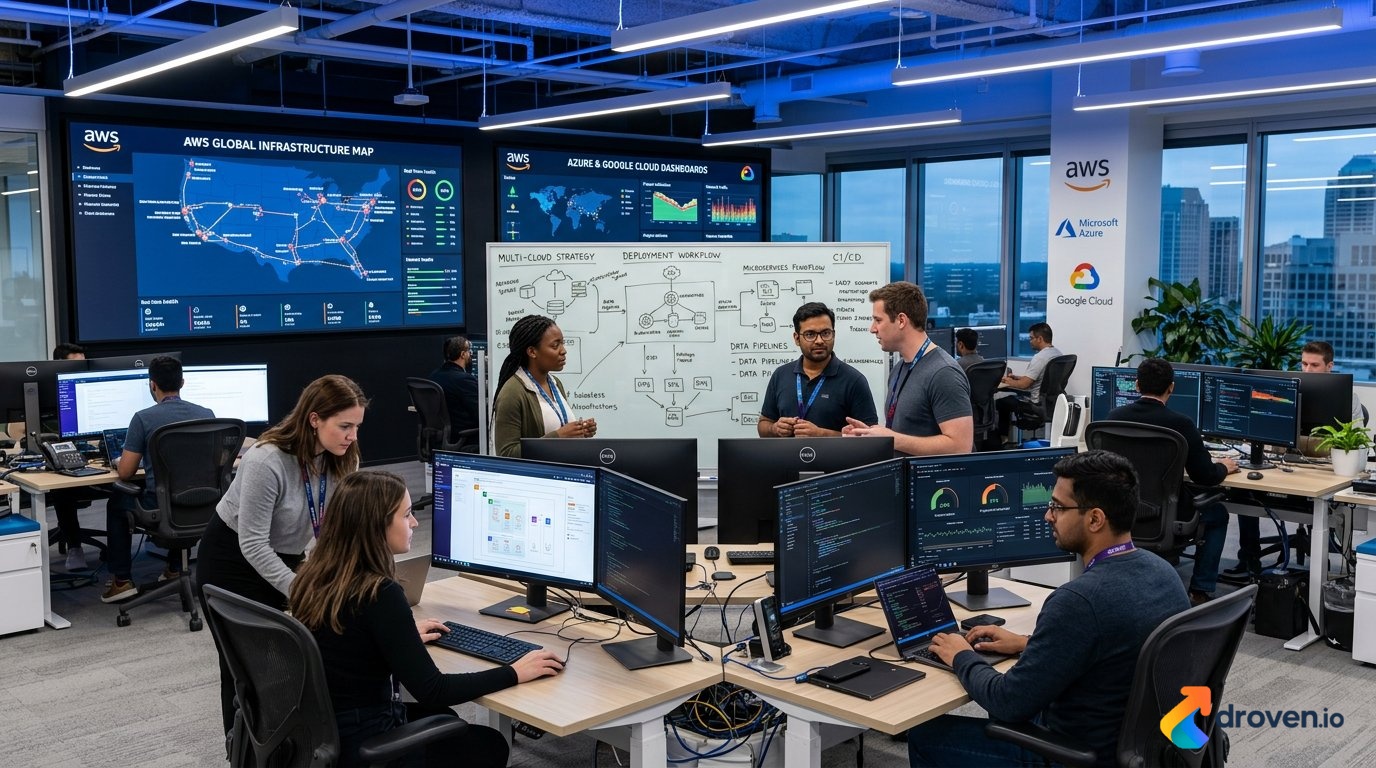
The speed at which American businesses develop and deploy new digital products now determines competitive survival across virtually every industry, and product engineering and cloud capacity sit at the center of this competitive equation.
Behind every successful product launch lies an invisible infrastructure decision that few consumers ever see but every engineering leader obsesses over: how to provision enough computational power to build, test, and scale without wasting budget or bottlenecking development teams. Product engineering and cloud capacity must function as a single integrated discipline to answer this question effectively.
According to Mordor Intelligence, the innovation management software market will grow from 3.57 billion dollars in 2026 to 7.7 billion dollars by 2031, driven substantially by cloud infrastructure demand and the product engineering and cloud capacity integration that makes rapid prototyping possible.
Modern hackathons and innovation workshops depend entirely on the ability to spin up development environments, access elastic compute resources, and deploy prototypes to production-grade infrastructure within hours rather than weeks, and product engineering and cloud capacity have become inseparable as a result. Cloud capacity provisioning must happen in lockstep with engineering execution. The leading product engineering services companies of 2026, including EPAM, N-iX, SoftServe, and ELEKS, have built their delivery models around this recognition.
This comprehensive guide examines the eight proven ways that product engineering and cloud capacity converge in innovation workshops and hackathons, explores what this convergence means for US businesses and consumers, and provides the framework for understanding why cloud-native product development has become the only viable approach for competitive organizations. Mastering this integration is no longer optional for competitive organizations.
Understanding How Product Engineering and Cloud Capacity Became Inseparable

The relationship between product engineering and cloud capacity has transformed from a simple vendor relationship into a deeply integrated operational dependency that defines how quickly any organization turns ideas into deployed features. These two functions today represent two sides of the same operational coin.
The Evolution from On-Premises Infrastructure to Cloud-Native Development
A decade ago, product engineering teams submitted infrastructure requests to IT operations and waited weeks for servers. Product engineering and cloud capacity operated on completely different timelines, with engineers ready to build while infrastructure teams struggled through procurement and setup processes measured in weeks rather than minutes.
The cloud computing revolution, led by Amazon Web Services, Microsoft Azure, and Google Cloud Platform, eliminated this bottleneck entirely by making near-infinite computational resources available through application programming interfaces that engineering teams could access directly. Product engineering and cloud capacity today function as a unified workflow where the decision to build a new feature simultaneously triggers the provisioning of the cloud resources needed to support development, testing, and deployment. This integration has become the baseline expectation for modern development organizations.
Why Hackathons Expose the Critical Connection
Innovation workshops compress the entire product development lifecycle into forty-eight to seventy-two hours, exposing every weakness in infrastructure provisioning. When a hackathon team needs to spin up a Kubernetes cluster, provision a managed database, configure a content delivery network, and deploy microservices within the first morning of the event, any gap between product engineering and cloud capacity becomes immediately visible and catastrophically limiting.
Organizations with tight product engineering and cloud capacity integration enable production-ready prototypes. Those maintaining siloed infrastructure teams produce slide decks instead of working software. This alignment is the dividing line between innovation that ships and innovation that stalls.
8 Proven Ways Product Engineering and Cloud Capacity Converge in Innovation Events

The following patterns represent how leading organizations combine product engineering and cloud capacity to maximize hackathon output. These patterns working together produce measurable competitive advantage for organizations that implement them effectively.
1. Pre-Provisioned Cloud Sandboxes Eliminate Setup Delays
The most successful hackathons prepare cloud environments before participants arrive, provisioning sandbox accounts with pre-approved access, spending caps, and architecture templates. Product engineering and cloud capacity integration before the event allows teams to start building within minutes of receiving their challenge statement.
For consumers, this efficiency means the feature a bank builds during a weekend hackathon reaches their mobile app in months rather than years. Product engineering and cloud capacity convergence is the engine behind this dramatic acceleration in time-to-market.
2. Elastic Scaling Enables Production-Like Load Testing
Cloud capacity allows product engineering teams to stress-test prototypes under realistic load conditions during the hackathon itself. A team building a payment feature can simulate thousands of concurrent transactions, identify bottlenecks, and refine architecture before the final demonstration. Product engineering and cloud capacity working together means prototypes are evaluated under real-world conditions rather than idealized scenarios.
3. Infrastructure-as-Code Accelerates Reproducible Deployment
Modern teams define cloud infrastructure through code using Terraform, Pulumi, AWS CloudFormation, and Azure Resource Manager templates. This approach makes product engineering and cloud capacity configuration a version-controlled engineering discipline rather than a manual operational task.
These definitions make the environment reproducible, auditable, and production-ready without manual reconfiguration. Product engineering and cloud capacity expressed through infrastructure-as-code eliminates the months-long gap between prototype and production deployment.
4. Multi-Cloud Architectures Prevent Vendor Lock-In
Hackathons provide ideal environments for testing multi-cloud architectures because compressed timelines force teams to evaluate which services deliver value. Product engineering and cloud capacity strategies embracing multiple providers give teams flexibility to select AWS Lambda for serverless, Google BigQuery for analytics, and Azure AD for identity within one integrated solution.
Product engineering and cloud capacity diversification protects against provider-specific risks and pricing inefficiencies. This multi-cloud approach directly benefits consumers through more resilient, cost-effective products.
5. Containerization Enables Portable Workloads Across Environments
Docker and Kubernetes have become the standard connection between product engineering and cloud capacity by abstracting applications from underlying infrastructure. A hackathon team packaging their prototype as containerized microservices can deploy identically to local, testing, and production environments without code changes.
Product engineering and cloud capacity integrated through container orchestration means working prototypes promote to production through standardized pipelines. Product engineering and cloud capacity alignment through containers pays immediate dividends in deployment velocity.
6. Serverless Computing Eliminates Capacity Planning
AWS Lambda, Azure Functions, and Google Cloud Functions represent the ultimate convergence of product engineering and cloud capacity by completely abstracting infrastructure management away from development teams. Product engineering and cloud capacity delivered through serverless computing eliminates the traditional gap between code completion and production deployment. Teams focus entirely on code and business logic while the provider handles all provisioning, scaling, and availability.
Product engineering and cloud capacity delivered through serverless platforms dramatically reduces friction between having an idea and deploying working code. This is precisely why serverless architectures dominate leading hackathon entries across financial services, healthcare, and retail sectors. Serverless computing represents the state of the art in cloud-native development.
7. FinOps Integration Controls Cloud Spending
The ease of provisioning cloud resources creates financial risk, as teams focused on building prototypes have little incentive to optimize costs. Forward-thinking organizations integrate FinOps practices providing real-time cost visibility, automated alerts, and resource cleanup.
Product engineering and cloud capacity governed by FinOps principles ensures innovation does not produce unexpected cloud bills. Cost management is a mandatory discipline for sustainable innovation programs.
8. AI-Assisted Optimization Amplifies Productivity
Artificial intelligence has entered the product engineering and cloud capacity equation as both a build tool and an infrastructure optimizer. AI-powered platforms analyze usage patterns during hackathons, right-size instances, identify idle resources, and recommend optimizations human operators would miss.
Product engineering and cloud capacity enhanced by AI means teams spend more time building features and less time managing infrastructure. AI assistance accelerates both the quality and quantity of prototypes produced during each event.
What This Convergence Means for US Consumers

The integration of product engineering and cloud capacity manifests as tangible improvements in the financial products and services Americans use every day.
Faster Feature Delivery
When product engineering and cloud capacity operate as a unified discipline, features including faster payments, real-time fraud detection, and personalized insights reach production in months rather than years. Product engineering and cloud capacity alignment from the first line of code enables next-month pilot testing for hackathon prototypes.
More Reliable Services at Lower Cost
Infrastructure-as-code, containerization, and serverless patterns produce inherently more reliable services because every deployment is automated, tested, and reproducible. For consumers, this means fewer crashes, faster response times, and services that remain available during peak usage because product engineering and cloud capacity scale automatically with demand.
Enhanced Security Through Automated Governance
Infrastructure defined as code can be audited, scanned, and verified for compliance before reaching production. Product engineering and cloud capacity governed by automated security policies means consistent controls across every environment rather than error-prone manual configuration.
What This Convergence Means for US Businesses
For business leaders, product engineering and cloud capacity integration represents both an operational imperative and competitive differentiator.
Reduced Time-to-Market
The traditional model of multi-week infrastructure delays has been replaced by on-demand cloud capacity. Product engineering and cloud capacity working in unison means businesses respond to competitive threats, regulatory changes, and market opportunities with speed legacy organizations cannot match.
Efficient Capital Allocation
Capital expenditure on servers has been replaced by operational expenditure based on actual consumption. Product engineering and cloud capacity aligned through cloud-native architectures means hackathon experimentation costs hundreds or thousands of dollars rather than the millions that on-premises experimentation required.
Access to Global Talent
Cloud-based environments enable product engineering teams to include talent from anywhere in the world. Product engineering and cloud capacity supporting distributed collaboration means the best engineer participates regardless of physical location, improving both quality and diversity of innovation.
Frequently Asked Questions
What is the relationship between product engineering and cloud capacity?
Product engineering and cloud capacity are now inseparable because modern development depends on elastic cloud infrastructure for prototyping, testing, and deployment, with resources provisioned automatically as an integral part of the engineering workflow rather than as a separate operational function.
How do cloud services accelerate product engineering during hackathons?
Cloud services accelerate product engineering by providing instant development environments, elastic compute for load testing, managed databases, serverless platforms, and AI tools enabling production-ready prototypes within forty-eight to seventy-two hours.
Which cloud providers dominate product engineering workshops?
AWS, Microsoft Azure, and Google Cloud Platform dominate product engineering workshops, with multi-cloud architectures increasingly common as teams select best-of-breed services for specific prototype components.
What is infrastructure-as-code and why does it matter?
Infrastructure-as-code defines cloud resources through configuration files rather than manual processes, enabling teams to version, test, and reproduce environments automatically, bridging the gap between prototype and production deployment.
How do businesses control cloud costs during hackathons?
Businesses control costs through FinOps practices including pre-set spending caps, real-time cost visibility dashboards, automated resource cleanup, and AI-powered optimization that terminates idle instances.
What skills do teams need for cloud-native development?
Teams need containerization with Docker and Kubernetes, infrastructure-as-code tools like Terraform, at least one major cloud platform, serverless architecture patterns, and CI/CD pipeline automation.
Conclusion
The convergence of product engineering and cloud capacity represents one of the most significant operational transformations in software development history, fundamentally changing how American businesses conceive, build, and deliver digital products to consumers.
The eight patterns explored here, from pre-provisioned sandboxes and elastic scaling to infrastructure-as-code, multi-cloud architectures, containerization, serverless computing, FinOps governance, and AI-assisted optimization, define the playbook for maximizing innovation workshop output. Product engineering and cloud capacity sit at the foundation of every one of these patterns.
For consumers, the integration of product engineering and cloud capacity means faster access to innovative financial products, more reliable services, and enhanced security at lower operational cost than legacy infrastructure could achieve. Product engineering and cloud capacity working in harmony delivers tangible quality-of-life improvements that millions of Americans experience daily. For businesses, it eliminates bottlenecks that historically slowed development to a crawl.
The organizations mastering product engineering and cloud capacity integration today will define their markets for the decade to come, shipping the products and features consumers increasingly expect as baseline requirements rather than differentiating advantages. Product engineering and cloud capacity mastery is the competitive battleground of the next decade. Mastery of this integration is the competitive battleground of the next decade.
