
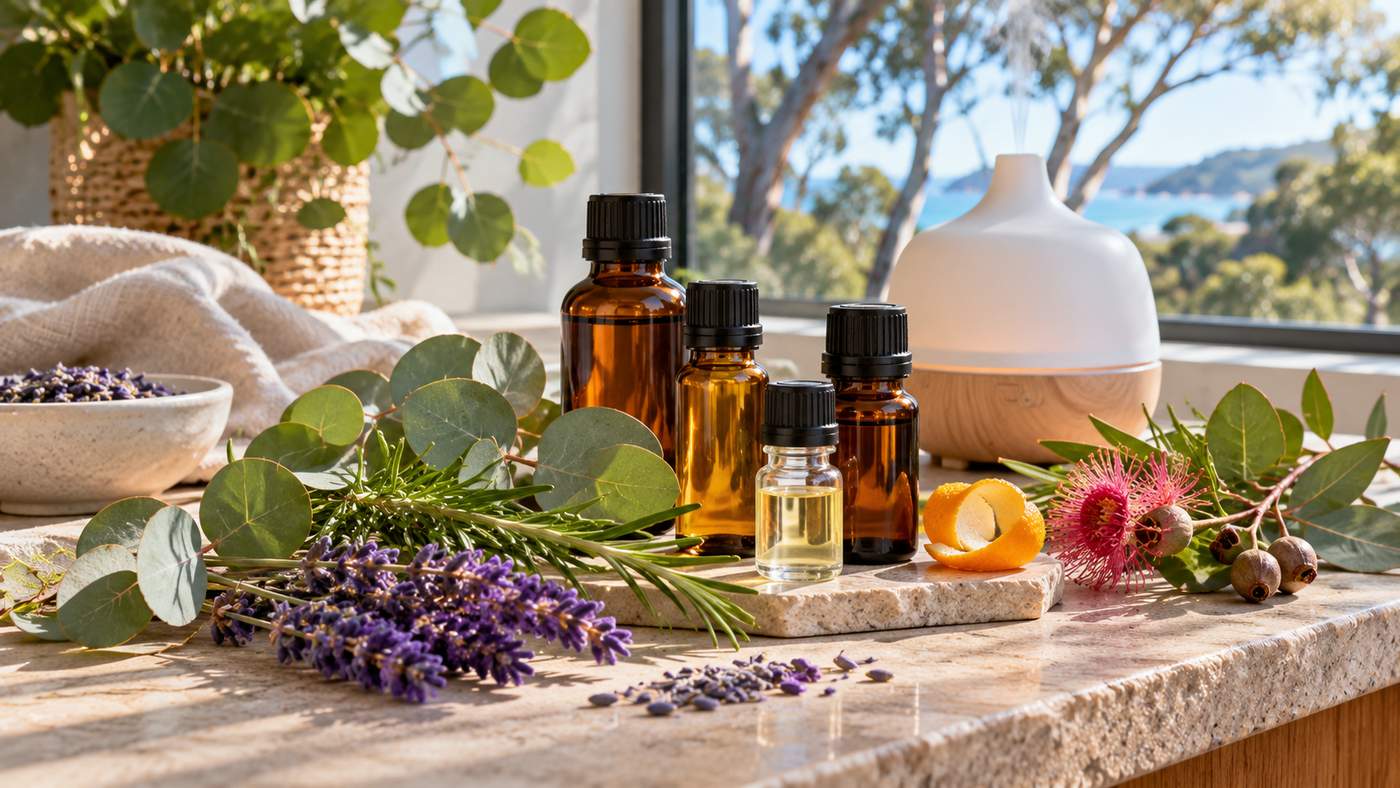
Creating a welcoming home environment often begins with simple details: natural light, comfortable surroundings, and pleasant fragrances. For people who enjoy botanical aromas, essential oils offer a way to introduce distinctive plant scents into daily routines, whether through a diffuser, fragrance accessory, or properly formulated personal-care product.
Choosing pure essential oils in Australia requires more than selecting an attractive bottle or a familiar fragrance. Essential oils are highly concentrated aromatic substances, and their composition, quality, intended use, and safety characteristics can vary significantly.
Australian consumers can choose from traditional botanical oils such as lavender, eucalyptus, tea tree, and peppermint, as well as carefully formulated aromatic blends. However, terms such as natural, pure, therapeutic grade, and organic do not always communicate the same information.
Understanding how essential oils are produced and evaluated helps buyers distinguish useful product details from unsupported marketing claims.
This guide explores seven important considerations when purchasing essential oils, including botanical identity, extraction methods, product testing, safe dilution, diffusion, storage, and supplier transparency.
What Are Pure Essential Oils?
Essential oils are concentrated aromatic materials obtained from suitable plants through methods such as steam distillation, cold pressing, and other specialized extraction processes.
They contain mixtures of naturally occurring chemical compounds responsible for much of a plant’s characteristic aroma.
Different plants produce oils with distinct compositions.
For example, lavender oil has a floral, herbaceous scent, while eucalyptus oil commonly has a fresh, penetrating aroma.
The chemical composition of an oil can vary according to plant species, growing conditions, harvest timing, and extraction techniques.
What Does 100% Pure Essential Oil Mean?
A product described as 100% pure essential oil generally indicates that it has not been intentionally diluted with carrier oil or mixed with synthetic fragrance ingredients.
However, the word pure is not by itself proof of authenticity, safety, or independent testing.
Buyers should examine the manufacturer’s ingredient information, botanical naming, and available quality documentation.
Essential Oils vs. Fragrance Oils
Essential oils originate from botanical materials through appropriate extraction methods.
Fragrance oils may contain synthetic aromatic compounds, natural aromatic ingredients, or combinations of both.
Fragrance oils can be useful for products such as candles and perfumes, but they should not automatically be represented as pure botanical essential oils.
Neither category is inherently safe for every application.
The appropriate choice depends on the intended use and the supplier’s instructions.
1. Check the Botanical Name and Ingredient Information
One of the most important steps when buying essential oils is identifying the actual plant used.
Common names can sometimes refer to different species.
Why Botanical Names Matter
Botanical names provide greater precision.
For example:
| Common name | Botanical name |
|---|---|
| True lavender | Lavandula angustifolia |
| Tea tree | Melaleuca alternifolia |
| Eucalyptus | Eucalyptus globulus |
| Peppermint | Mentha × piperita |
| Sweet orange | Citrus sinensis |
| Rosemary | Salvia rosmarinus |
These examples illustrate species commonly associated with essential oils. The specific plant material and product composition still need to be checked.
Read the Product Label
Useful label information may include the botanical name, ingredients, net volume, batch identification, manufacturer, country of origin, and safety precautions.
An essential oil blend should identify its constituent ingredients rather than implying that it is a single-plant oil.
Look for Transparency
A supplier that clearly explains sourcing and extraction provides buyers with more information for evaluating its products.
However, attractive packaging and detailed marketing descriptions are not substitutes for reliable product documentation.
2. Understand Essential Oil Extraction Methods
The extraction process affects the characteristics and composition of botanical oils.
Different plant materials require different techniques.
Steam Distillation
Steam distillation is widely used for many aromatic herbs, leaves, and flowers.
Steam passes through botanical material, carrying volatile aromatic compounds into a cooling system.
The resulting liquid separates into aromatic water and an essential oil layer.
This technique is used for numerous oils, including certain lavender, eucalyptus, and rosemary products.
Cold Pressing
Cold pressing is commonly associated with citrus peel oils.
Mechanical processing releases aromatic materials from the outer peel.
Cold-pressed oils may retain compounds that influence fragrance and, in some cases, skin sensitivity to sunlight.
Not all citrus oils have identical phototoxicity risks, so users should follow product-specific guidance.
Carbon Dioxide Extraction
Specialized carbon dioxide extraction can recover aromatic plant constituents under controlled conditions.
Depending on the process, the resulting extract may differ from a conventional distilled essential oil.
Product terminology should accurately reflect the extraction method.
Why Extraction Details Are Useful
Understanding extraction methods helps consumers evaluate product descriptions and intended uses.
However, extraction method alone does not establish that a product is superior.
Quality depends on several factors, including raw materials, processing, storage, and testing.
3. Choose Aromas That Suit Your Space and Preferences
Essential oils have different fragrance characteristics.
The best aroma depends largely on personal preference, the environment, and how the product will be used.
Lavender Essential Oil
Lavender is known for its floral, slightly herbal aroma.
Many people associate it with calming evening routines, quiet spaces, and personal relaxation rituals.
However, enjoying lavender fragrance should not be confused with proven treatment for insomnia or anxiety disorders.
Eucalyptus Essential Oil
Eucalyptus has a distinctive fresh, penetrating scent.
It is often selected for home fragrance and spa-style environments.
Because eucalyptus oil can be hazardous when swallowed and may irritate sensitive individuals, careful handling is important.
Sweet Orange Essential Oil
Sweet orange provides a bright citrus fragrance.
It may complement kitchens, living areas, and daytime home-fragrance routines.
Check whether the specific product is appropriate for topical use before applying it to skin.
Peppermint Essential Oil
Peppermint has a strong, cooling aroma.
Its intensity means that even small amounts can noticeably affect the fragrance of a room.
It requires particular caution around young children and people sensitive to strong aromas.
Tea Tree Essential Oil
Tea tree oil comes from a plant native to Australia and is widely recognized in personal-care products.
Its scent is herbal and medicinal.
Tea tree oil should never be swallowed and can cause adverse reactions if used improperly.
Choosing Essential Oil Blends
Blends combine multiple aromatic ingredients to create a particular fragrance profile.
Some emphasize floral notes, while others feature citrus, woody, or herbal characteristics.
Read ingredient details and usage instructions rather than assuming that a blend is automatically suitable for every purpose.
4. Evaluate Suppliers of Pure Essential Oils in Australia
The quality of an essential oil purchase depends partly on the information and support provided by the supplier.
Australian shoppers should look beyond product images and promotional statements.
Review Ingredient Transparency
A trustworthy product listing should clearly identify what is being sold.
For single essential oils, the botanical species and extraction details can be particularly useful.
For blends, consumers should be able to understand the ingredients and intended application.
Consider Sourcing Information
Plants may be sourced from different countries depending on climate, growing conditions, and agricultural availability.
An Australian-owned brand does not necessarily source every botanical ingredient domestically.
Similarly, a product manufactured in Australia may contain imported plant materials.
These distinctions are not inherently negative, but accurate descriptions help consumers make informed decisions.
Explore Australian Aromatherapy Suppliers
Consumers searching for pure essential oils in Australia can explore Amrita Court, an Australian-owned brand offering botanical essential oils, aromatherapy blends, waterless diffusers, and fragrance accessories.
According to its published product information, Amrita Court sources botanical materials from multiple regions and offers oils intended for home fragrance and personal aromatherapy rituals.
Its product range includes aromatic blends alongside waterless diffuser designs and aroma jewellery.
The company also publishes information about its sourcing, extraction methods, and quality-control approach.
These resources can help buyers compare products according to intended use, botanical characteristics, and fragrance preferences.
As with any supplier, shoppers should independently review individual product labels, safety guidance, and available evidence supporting quality claims.
Understand Quality Certifications
Some suppliers reference manufacturing standards or quality-management certifications.
Consumers should distinguish between certification of a facility and independent certification of a particular finished oil.
If a certification materially influences the purchasing decision, ask for its scope and current documentation.
Check Customer Service and Returns
Useful purchasing considerations include shipping arrangements, return policies, product availability, and access to customer support.
A clear response to product questions can make the buying process more convenient.
5. Learn to Use Essential Oils Safely
Pure essential oils are concentrated substances.
Natural origin does not guarantee that an oil is harmless.
Safe use depends on the oil, concentration, application method, individual sensitivities, and surrounding environment.
Avoid Swallowing Essential Oils
Do not ingest essential oils as a routine wellness practice.
Some oils can cause serious poisoning, even in relatively small quantities.
A product should not be swallowed unless its specific use has been directed by an appropriately qualified healthcare professional.
Dilute Before Skin Application
Undiluted essential oils can irritate the skin or cause allergic reactions.
For topical applications, use an appropriate carrier oil and follow reliable, product-specific dilution guidance.
Carrier oils may include jojoba, fractionated coconut oil, or other suitable cosmetic base oils.
A patch test may help identify some sensitivities, but it cannot guarantee the absence of an allergic reaction.
Avoid applying essential oils to broken skin, eyes, or sensitive membranes.
Take Additional Care With Children
Children can be particularly vulnerable to adverse effects from concentrated oils.
Store bottles in locked or otherwise secure locations that children cannot access.
Do not use an adult aromatherapy routine as a safety guide for infants or young children.
Seek qualified medical guidance before using oils around children with respiratory conditions or other health concerns.
Consider Pets
Cats, dogs, birds, and other animals may react differently to aromatic substances.
Some essential oils can be toxic to pets through ingestion, skin exposure, or inhalation.
Do not apply essential oils to animals unless specifically directed by a veterinarian.
When diffusing, ensure animals can leave the area and consult a veterinarian if uncertain about a particular product.
Special Health Considerations
People who are pregnant, breastfeeding, living with asthma, or managing medical conditions should seek appropriate professional advice before using essential oils for health-related purposes.
Essential oils are not substitutes for medical treatment.
What to Do After Accidental Exposure
In Australia, suspected poisoning should be discussed promptly with the Poisons Information Centre on 13 11 26, even if symptoms have not developed.
Do not induce vomiting after swallowing an essential oil.
For severe breathing difficulty or unconsciousness, call 000.
6. Choose the Right Essential Oil Diffuser
Diffusers allow aromatic oils to be dispersed through an indoor environment.
Several designs are available, and each has distinct operating characteristics.
Ultrasonic Diffusers
Ultrasonic diffusers typically combine water and a small amount of compatible essential oil.
Vibration produces a fine mist that carries aromatic droplets into the surrounding air.
These devices require regular cleaning and appropriate water management.
Follow manufacturer instructions to reduce contamination or equipment problems.
Waterless Diffusers
Waterless diffusers disperse oil without mixing it with water.
Some use nebulizing technology to create an aromatic mist directly from suitable oil.
Because the oil is not diluted in a water reservoir, the fragrance may be relatively concentrated.
Start with conservative operating settings and follow the manufacturer’s instructions.
Passive Diffusers
Passive diffusers release fragrance through materials such as ceramic, wood, or absorbent pads.
They may be useful for limited personal spaces.
Their fragrance distribution is generally less active than that of powered diffusers.
Aroma Jewellery
Certain necklaces and bracelets contain materials designed to hold small quantities of fragrance.
These accessories allow users to carry a personal aroma without using a room diffuser.
Avoid direct skin exposure to undiluted oil and ensure the product is used as directed.
Compare Diffuser Options
| Diffuser type | Main characteristic | Important consideration |
|---|---|---|
| Ultrasonic | Uses water and vibration | Requires regular cleaning |
| Waterless nebulizer | Disperses oil without a water reservoir | Can create concentrated fragrance |
| Passive | Releases aroma gradually | Usually limited distribution |
| Aroma jewellery | Provides portable personal fragrance | Avoid skin irritation and spills |
Use Diffusers Responsibly
Ventilate indoor spaces and avoid continuous exposure to strong aromas.
Stop use if anyone experiences headaches, coughing, irritation, or breathing discomfort.
Diffusion should be adapted to the occupants and their sensitivities rather than following a rigid daily schedule.
7. Store Essential Oils Properly to Maintain Quality
Essential oils can change over time.
Heat, light, oxygen, and unsuitable storage conditions may alter their chemical composition and aroma.
Proper storage can help preserve product characteristics.
Use Suitable Containers
Essential oils are commonly supplied in amber or other protective glass bottles.
Dark containers can reduce light exposure.
Keep lids securely closed to limit unnecessary contact with air.
Avoid Excessive Heat
Do not leave essential oils in direct sunlight, hot vehicles, or near radiators.
Storage temperatures should follow the manufacturer’s recommendations.
Check Product Age
Essential oils do not all remain stable for the same length of time.
Some citrus oils may oxidize relatively quickly, while other botanical oils have different stability characteristics.
Look for appropriate batch information and supplier guidance.
Watch for Changes
Noticeable changes in colour, smell, or consistency may indicate deterioration.
However, the absence of visible changes does not prove that an older oil remains suitable for use.
Keep Oils Away From Children and Animals
Store bottles securely in their original labelled containers.
Never transfer oils into unlabelled food or beverage containers.
How to Identify High-Quality Essential Oils
When comparing products, use several indicators rather than relying on one advertising claim.
| Quality indicator | Why it matters |
|---|---|
| Botanical name | Identifies the plant species |
| Ingredient list | Clarifies whether the product is pure or blended |
| Extraction method | Explains how the material was produced |
| Country of origin | Provides sourcing context |
| Batch number | Supports traceability |
| Testing information | May provide evidence about identity and composition |
| Suitable packaging | Helps protect aromatic materials |
| Safety directions | Supports responsible use |
| Supplier transparency | Makes claims easier to evaluate |
What Is GC-MS Testing?
Gas chromatography–mass spectrometry, or GC-MS, is an analytical technique that can identify and measure many volatile compounds in an essential oil.
It may help assess whether a product’s chemical profile is consistent with expectations.
However, a GC-MS report does not independently prove every possible purity, safety, or quality claim.
Its usefulness depends on sampling, testing methods, interpretation, and traceability.
Is Organic Certification Necessary?
Organic certification concerns defined agricultural and production standards.
A product may be a pure botanical essential oil without being certified organic.
Similarly, an organic claim does not guarantee suitability for ingestion, direct skin application, or medical treatment.
Consumers should distinguish verifiable certification from general natural-product descriptions.
Does a Higher Price Mean Better Quality?
Not necessarily.
Prices can reflect botanical availability, extraction yield, production costs, packaging, branding, and other factors.
Expensive oils are not automatically authentic, and inexpensive oils are not automatically adulterated.
Evaluate the complete product information.
Essential Oils for Different Everyday Routines
Essential oils can be incorporated into personal fragrance routines when used appropriately.
Morning Home Fragrance
People who enjoy fresh, bright aromas may choose citrus or herbal blends for daytime diffusion.
Use a comfortable amount of fragrance and avoid excessive exposure.
Evening Relaxation Rituals
A quiet evening routine might combine soft lighting, reading, and a preferred botanical scent.
Aroma can contribute to a pleasant environment, but it should not be promoted as a guaranteed treatment for sleep disorders.
Home Office Atmosphere
A subtle fragrance may help some people create an enjoyable workspace.
However, shared offices should account for colleagues with allergies, asthma, migraine sensitivity, or fragrance preferences.
Guest Rooms and Living Areas
A diffuser can provide a distinctive scent for a room.
Keep the fragrance mild, maintain ventilation, and stop use if anyone reports discomfort.
Travel Fragrance Accessories
Portable fragrance accessories may be convenient for personal use.
Check airline rules and packaging restrictions before travelling with concentrated oils.
Common Mistakes When Buying Essential Oils
Choosing Based Only on the Bottle Design
Attractive packaging does not establish botanical authenticity.
Read the ingredients and product information.
Assuming Natural Means Completely Safe
Natural substances can cause poisoning, irritation, and allergic reactions.
Use every essential oil according to appropriate safety guidance.
Applying Undiluted Oil Directly to Skin
Concentrated oils may irritate or sensitize the skin.
Use suitable dilution guidance and avoid direct exposure.
Believing Every Health Claim
Evidence supporting specific aromatherapy health benefits varies.
Avoid purchasing oils on the assumption that they can cure infections, treat mental health disorders, or replace prescribed treatments.
Using Too Much Oil in a Diffuser
Strong aromas may cause discomfort.
Follow device instructions, ventilate the room, and consider individual sensitivities.
Ignoring Pets and Children
Keep oils and diffusers inaccessible to children and animals.
Seek qualified guidance when unsure about safety.
Choosing Between Single Essential Oils and Blends
Single oils and blended products serve different fragrance preferences.
A single oil provides the aroma associated with a particular botanical source.
Blends combine several aromatic ingredients to achieve a more complex fragrance profile.
For example, a botanical blend may combine floral and woody notes for a balanced aroma.
Neither format is automatically superior.
The correct choice depends on personal preference, ingredient transparency, intended application, and safety considerations.
For new users, a clearly labelled product with straightforward directions may be easier to evaluate than a complicated blend with limited ingredient information.
Buying Pure Essential Oils Online in Australia
Online shopping allows consumers to compare botanical products, diffuser designs, and fragrance accessories from different suppliers.
Before ordering, review the following details.
Product Description
Check the botanical identity, ingredients, volume, and intended use.
Safety Information
Confirm whether the oil is intended for diffusion, suitable diluted topical use, or another clearly specified application.
Shipping and Returns
Understand delivery charges, dispatch expectations, return eligibility, and any restrictions applying to opened products.
Customer Support
Choose suppliers willing to answer reasonable questions about ingredients, testing, and product use.
Independent Research
Compare information from reputable sources rather than relying entirely on testimonials or promotional claims.
A carefully selected oil should match both the fragrance preference and the intended application.
The Future of Natural Aromatherapy Products in Australia
Australian consumers have access to a wide range of botanical fragrances, personal-care products, and diffuser technologies.
Manufacturers are increasingly offering specialized blends, portable aroma accessories, and waterless diffusion systems.
Greater product variety makes clear labelling and responsible safety information especially important.
Consumers should look for transparent sourcing, evidence supporting quality claims, and accurate descriptions of what an oil can and cannot do.
The future of responsible aromatherapy depends on combining enjoyable fragrance experiences with realistic expectations and safe product use.
Frequently Asked Questions
1. How can I identify pure essential oils in Australia?
Check the botanical name, complete ingredient information, extraction method, batch details, and available testing documentation. Avoid relying solely on claims such as therapeutic grade or premium quality.
2. Can pure essential oils be applied directly to skin?
Undiluted essential oils can cause irritation or allergic reactions. Topical use generally requires appropriate dilution and product-specific guidance. Some oils are unsuitable for certain people or applications.
3. Are essential oils safe to use around pets?
Not always. Certain essential oils can be harmful to animals. Consult a veterinarian before using oils around pets, prevent direct exposure, and allow animals to leave areas where fragrances are diffused.
4. Where can I buy natural essential oils in Australia?
Australian buyers can explore specialist aromatherapy retailers, including Amrita Court, and compare botanical information, product testing, fragrance options, diffuser compatibility, and safety instructions before purchasing.
Conclusion
Choosing pure essential oils in Australia involves understanding botanical ingredients, extraction methods, product quality, and safe usage practices.
From individual plant oils to aromatic blends and modern diffusers, consumers have many options for creating enjoyable personal fragrance routines.
By prioritising transparent suppliers, appropriate handling, and realistic expectations, shoppers can make confident and informed aromatherapy purchases.
