
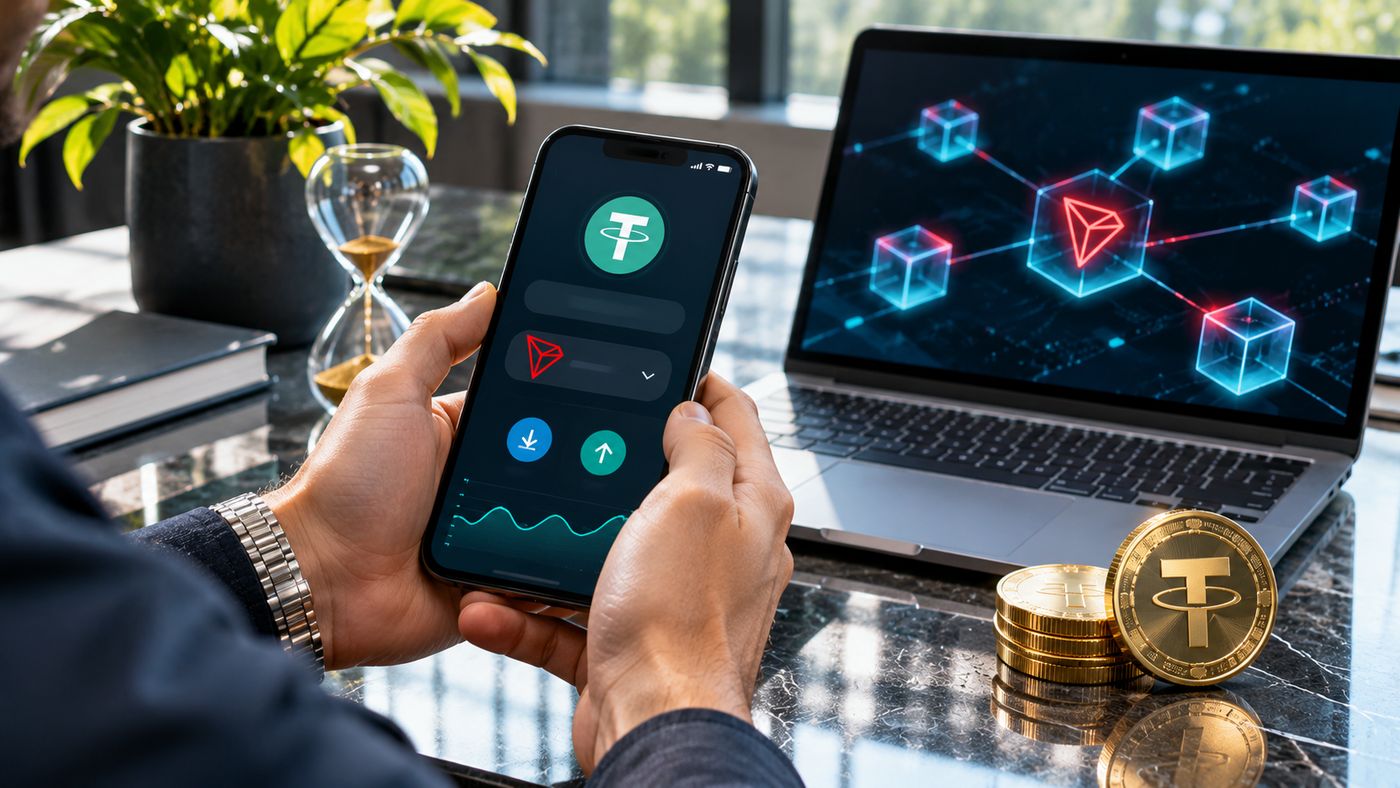
Stablecoins have become an important part of the cryptocurrency ecosystem, allowing users to transfer digital assets through blockchain networks without relying entirely on highly volatile cryptocurrencies. Among the most widely recognized stablecoins is Tether’s USDT, which is designed to maintain a value close to one US dollar.
One popular version is USDT TRC20, a token issued on the TRON blockchain. It is frequently used for cryptocurrency transfers because the network can offer relatively fast transaction confirmation and competitive fees compared with certain alternatives.
However, sending stablecoins requires careful attention to blockchain compatibility, wallet security, transaction costs, and receiving addresses. A transfer made through the wrong network may become difficult or impossible to recover.
For beginners, the terminology can also be confusing. USDT, TRC20, TRON, TRX, and ERC20 refer to related but different concepts.
This guide explains how USDT on TRON works, how to choose a compatible wallet, what determines transaction fees, and seven practical steps for managing stablecoins more safely.
What Is USDT TRC20?
USDT TRC20 refers to Tether’s USDT stablecoin issued on the TRON blockchain using the TRC20 token standard.
USDT is designed to track the value of the US dollar, while TRC20 defines how compatible tokens function within the TRON ecosystem.
The two components serve different purposes.
USDT is the digital asset.
TRC20 is the token standard used to implement that asset on TRON.
TRON is the blockchain that processes the relevant transactions.
TRX is the native cryptocurrency used to pay transaction-related network costs when the account lacks sufficient allocated network resources.
Why Is USDT Available on Different Blockchains?
A stablecoin can be issued on multiple blockchain networks to serve different users and applications.
Tether supports USDT through several blockchain integrations, including TRON and Ethereum.
Although these versions are intended to represent the same underlying stablecoin, they exist on separate networks.
Consequently, users must select the correct network when transferring funds.
How Does USDT Maintain Its Value?
USDT is designed to maintain a reference value of approximately one US dollar through its issuer’s reserve and redemption arrangements.
However, this does not make USDT equivalent to cash held in an insured bank account.
Its price can deviate from the intended value, and users face risks involving the issuer, reserves, redemption eligibility, exchanges, wallet security, and blockchain infrastructure.
Stablecoins should not be considered completely risk-free.
1. Understand How the TRON Network Works
TRON is a blockchain platform designed to support digital assets, smart contracts, and decentralized applications.
TRC20 tokens operate through smart contracts deployed on the network.
When users transfer USDT through TRON, the blockchain processes a token transaction according to the relevant contract rules.
What Happens During a TRC20 Transfer?
A typical transfer follows several stages.
First, the sender opens a compatible cryptocurrency wallet or exchange account.
Next, the sender selects USDT on the TRON network and enters the destination address.
The transaction is signed and submitted to the network.
TRON processes the transaction, updates the relevant token balances, and records the result on the blockchain.
After confirmation, the transaction can be checked using a compatible blockchain explorer.
Are TRC20 Transfers Instant?
TRON transactions may confirm relatively quickly under normal conditions.
However, confirmation times are not guaranteed.
Network conditions, resource availability, wallet processing, and exchange-specific confirmation requirements can affect when a transfer becomes available to the recipient.
For exchanges, a transaction may appear on the blockchain before the platform credits the customer’s account.
What Is the TRC20 Token Standard?
TRC20 specifies common functions and behavior for compatible fungible tokens on TRON.
It enables supported wallets and applications to interact with tokens using consistent interfaces.
This standard supports transfers, balance queries, and other token operations.
2. Choose a Compatible USDT TRC20 Wallet
Selecting a suitable wallet is essential for managing USDT safely.
Not every cryptocurrency wallet supports every blockchain version of USDT.
A wallet that supports USDT on Ethereum does not necessarily support USDT on TRON.
What Is a Cryptocurrency Wallet?
A cryptocurrency wallet is software or hardware that helps users manage cryptographic keys and interact with blockchain assets.
The tokens themselves are recorded on the blockchain rather than physically stored inside the wallet application.
The wallet enables users to view balances, authorize transactions, and access supported services.
Custodial vs. Non-Custodial Wallets
A custodial wallet generally involves a service provider holding or controlling the relevant private keys on behalf of users.
A non-custodial wallet allows the user to control those keys.
| Feature | Custodial wallet | Non-custodial wallet |
|---|---|---|
| Private-key control | Service provider | User |
| Account recovery | Provider-dependent | Depends on recovery credentials |
| Transaction authorization | Provider controls or participates | User signs transactions |
| Main concern | Provider and account risks | Private-key loss and compromise |
| Common example | Exchange account | Self-custody wallet |
Neither approach eliminates every risk.
Custodial services can experience operational or financial problems, while self-custody requires careful credential management.
Choosing a Multi-Currency Wallet
Some users prefer wallets supporting multiple blockchain networks and assets.
For example, Atomic Wallet provides a non-custodial interface for managing various cryptocurrencies and supported tokens.
Its dedicated usdt trc20 resource explains TRON-compatible token management, network selection, and important considerations when sending assets.
Atomic Wallet also describes encrypted private-key storage on the user’s device, along with supported buying and exchange features.
Availability of individual functions may depend on platform version, region, asset, and third-party services.
Questions to Ask Before Choosing a Wallet
Check whether the wallet supports USDT specifically on TRON.
Review its recovery process, software update history, security documentation, and available support channels.
Also determine whether it is suitable for the amounts and transactions you intend to manage.
A familiar brand name is not a guarantee against software vulnerabilities, phishing, or user mistakes.
3. Learn How to Send and Receive USDT TRC20
Sending stablecoins requires attention to the exact token and network.
Blockchain transfers generally cannot be canceled after they are confirmed.
Step 1: Open a Compatible Wallet
Use a wallet that explicitly supports USDT on the TRON network.
If setting up a new non-custodial wallet, follow the official installation and backup instructions.
Never share your recovery phrase.
Step 2: Select USDT on TRON
Find the USDT asset associated with TRON or TRC20.
Do not assume that every USDT balance displayed in a wallet uses the same blockchain.
Step 3: Obtain the Recipient Address
Ask the receiving party to provide a TRON-compatible USDT address.
TRON mainnet addresses commonly begin with the letter T.
However, an address prefix alone is not sufficient proof that the destination platform accepts a particular token deposit.
Step 4: Verify the Network
Confirm that both sending and receiving services support USDT TRC20.
If the recipient is using an exchange, check its current deposit instructions.
Some exchanges may temporarily suspend particular networks.
Step 5: Check Fees and Resources
Before sending, inspect the transaction estimate and ensure the wallet has sufficient resources or TRX to complete the transfer.
Step 6: Review the Details
Check the destination address, asset, amount, and selected network.
Be alert to clipboard malware that can replace copied cryptocurrency addresses.
For unfamiliar recipients or significant amounts, a small test transaction may help verify compatibility, although it also incurs fees.
Step 7: Submit and Confirm
Authorize the transaction only after confirming the details.
Retain the transaction identifier so the transfer can be checked through a blockchain explorer.
A successful onchain transfer does not necessarily mean that an exchange or merchant has completed its internal processing.
4. Understand USDT TRC20 Transfer Fees
Transfer fees are an important consideration when comparing blockchain networks.
TRON uses a resource model involving Bandwidth and Energy.
These resources help determine the cost of blockchain operations.
What Is Bandwidth?
Bandwidth is a TRON network resource used when processing transaction data.
Available Bandwidth may reduce the amount of TRX consumed by certain operations.
What Is Energy?
Energy is associated with smart contract execution.
Because USDT TRC20 transfers interact with a smart contract, Energy requirements are relevant.
If an account lacks sufficient allocated resources, the transaction may consume TRX to cover the necessary network cost.
Why Does a Wallet Need TRX?
Users may have a USDT balance but still be unable to send tokens because they lack sufficient TRX or network resources.
Atomic Wallet’s support documentation explains that its TRON-based USDT transactions require TRX when resources are insufficient.
The wallet cannot automatically use part of the USDT balance to pay these network fees.
Are TRC20 Transfers Always Cheap?
No.
Although TRON is often selected for relatively economical transfers, actual fees can change.
They depend on factors including available resources, contract execution requirements, account conditions, and network parameters.
In some cases, sending USDT to an address without an existing USDT balance may require more Energy than sending it to an address with a balance.
The official TRON developer documentation explains that Energy consumption can vary and recommends estimating requirements close to transaction execution.
Can TRX Resources Reduce Fees?
TRON supports mechanisms for obtaining network resources through staking or resource delegation.
These mechanisms may affect the amount of TRX burned for transactions.
However, they involve technical and financial considerations and are not necessarily economical for every user.
For occasional transfers, comparing the actual fee before sending is often more useful than assuming a fixed network cost.
5. Compare USDT TRC20 vs. ERC20
USDT is issued on different blockchain networks.
Two widely recognized versions are TRC20 on TRON and ERC20 on Ethereum.
The correct choice depends on compatibility, transaction costs, and intended use.
| Feature | USDT TRC20 | USDT ERC20 |
|---|---|---|
| Blockchain | TRON | Ethereum |
| Token standard | TRC20 | ERC20 |
| Network fee asset | TRX | ETH |
| Wallet requirement | TRON-compatible | Ethereum-compatible |
| Fee structure | Bandwidth and Energy | Ethereum gas |
| Transaction time | Depends on TRON confirmation | Depends on Ethereum confirmation |
| Common use | Stablecoin transfers on TRON | Ethereum-based transfers and applications |
Which Network Is Cheaper?
TRON can offer competitive costs for certain stablecoin transfers.
However, there is no universal fee guarantee.
Ethereum transaction costs vary with gas demand and network conditions.
The practical comparison should use current fee estimates from both networks.
Which Network Is Faster?
A TRON transaction may receive confirmation quickly.
Ethereum also processes transactions regularly, but receiving platforms may apply different crediting rules.
A faster blockchain confirmation does not necessarily mean faster availability on every exchange.
Can You Send TRC20 USDT to an ERC20 Address?
You should not send tokens using a network that the receiving wallet or platform does not explicitly support.
TRON and Ethereum operate separately.
A wrong-network transfer can result in inaccessible or permanently lost funds.
Only use a network when the recipient confirms compatibility.
Which Network Should Beginners Choose?
Beginners should prioritize network compatibility and accurate transaction instructions before comparing fees.
The least expensive transfer option is not useful if the destination cannot receive the asset.
6. Protect Your USDT Wallet From Security Threats
Wallet security is essential because cryptocurrency transactions can be irreversible.
A compromised recovery phrase or incorrectly authorized transaction may expose the entire wallet balance.
Protect Recovery Phrases
A recovery phrase can provide access to a non-custodial wallet’s private keys.
Never share it with customer support representatives, strangers, websites, or automated chat services.
Store recovery information offline using a method appropriate for your security needs.
Download From Official Sources
Fraudulent wallet applications and websites may imitate legitimate products.
Use the provider’s official website or verified distribution channels.
Before installing updates, confirm that the download source is authentic.
Watch for Phishing
Scammers may send messages claiming that a wallet requires urgent verification or synchronization.
They may direct users to websites requesting recovery phrases.
Legitimate wallet support should not need a recovery phrase to troubleshoot routine account issues.
Verify Addresses Carefully
Always inspect a destination address before confirming a transfer.
For high-value transactions, consider a verified address-book process and additional checks.
Review Wallet Software Updates
Use supported wallet versions and keep the operating system updated.
Software updates may address performance problems and security vulnerabilities.
Understand Non-Custodial Risk
Self-custody gives users greater control over their keys but also places responsibility for key protection and backup on them.
A software wallet can still be affected by device compromise, malicious extensions, or application vulnerabilities.
For substantial holdings, evaluate whether a compatible hardware wallet or additional security arrangement is appropriate.
7. Verify Transactions and Avoid Common Mistakes
A successful transaction should be verifiable independently of a wallet’s interface.
Blockchain explorers provide a way to review public transaction records.
Using TRONSCAN
TRONSCAN is a blockchain explorer for TRON.
Users can search for a transaction identifier to review information such as status, addresses, transferred token amounts, and network resource consumption.
Do not enter private keys or recovery phrases into a blockchain explorer.
Understand Pending and Confirmed Transfers
A transaction may initially appear pending or may take time to become visible.
If a receiving exchange has not credited funds, first verify the transaction onchain.
Then review the exchange’s deposit requirements and confirmation policy.
Common Mistakes to Avoid
Wrong network selection: Sending USDT through a blockchain not supported by the recipient.
Insufficient TRX: Attempting to send TRC20 USDT without the necessary network resources.
Incorrect address: Copying or typing the wrong destination.
Fake wallet applications: Downloading software from an unverified source.
Ignoring exchange requirements: Missing a required supported network or deposit condition.
Assuming stablecoins are risk-free: Overlooking issuer, market, and custody risks.
What If a Transfer Goes to the Wrong Network?
Recovery depends on the blockchain, destination, and whether a compatible private key or recovery process is available.
Some exchange operators may offer limited recovery services, but many transfers cannot be recovered.
Never trust a stranger who promises guaranteed crypto recovery in exchange for an upfront payment or recovery phrase.
How to Choose the Best USDT TRC20 Wallet
The ideal wallet depends on your priorities.
Some users want convenient access to several cryptocurrencies.
Others need specialized TRON features or stronger separation between everyday transactions and long-term holdings.
Compare Wallet Characteristics
| Feature | Why it matters |
|---|---|
| TRC20 USDT support | Ensures network compatibility |
| Private-key control | Determines custody arrangements |
| Backup and recovery | Helps restore access |
| TRX balance visibility | Supports fee management |
| Transaction history | Makes transfers easier to review |
| Platform availability | Determines device compatibility |
| Security updates | Helps address software problems |
| Support documentation | Assists with troubleshooting |
Atomic Wallet for Multi-Asset Management
Atomic Wallet is designed for people who want to manage multiple supported assets through a non-custodial application.
Its documentation describes TRC20 support, TRX-related transaction requirements, and desktop and mobile wallet options.
However, users should review supported operating systems and current availability before installation.
As of its September 2026 desktop release documentation, the application supports Windows 10 and 11, with Linux and macOS versions also listed.
TRON-Focused Wallets
Some wallets concentrate more specifically on the TRON ecosystem.
These may offer additional capabilities for users who regularly interact with TRON tokens and network resources.
Always compare the exact functions relevant to your intended activities.
Is USDT TRC20 Safe?
USDT TRC20 can be used for legitimate blockchain transactions, but safety depends on multiple layers.
The underlying network must operate reliably.
The token contract and issuer introduce their own risks.
Wallet security depends on software integrity and private-key management.
Exchanges and third-party services can create additional risks.
A correctly confirmed blockchain transfer does not guarantee protection from scams, account compromise, or a decline in the stablecoin’s market value.
Therefore, users should avoid treating a particular token standard as inherently safe simply because transactions are commonly used.
Can USDT TRC20 Be Used for International Payments?
USDT on TRON can facilitate transfers between compatible wallets across geographic locations.
However, practical payment use depends on recipient acceptance, exchange availability, local laws, and the ability to convert assets when necessary.
Businesses should also consider accounting, tax, compliance, and consumer-protection obligations.
Stablecoin payments may be irreversible, which makes refund policies and recipient verification particularly important.
Users should confirm whether cryptocurrency transactions are permitted under the laws applicable to them.
USDT TRC20 Wallet Checklist
Before sending or receiving funds, verify the following:
| Item | Check |
|---|---|
| Token | Genuine USDT on TRON |
| Receiving network | TRC20 supported |
| Address | Correct destination |
| Wallet compatibility | TRON and USDT supported |
| Network resources | Sufficient Energy/Bandwidth or TRX |
| Transaction amount | Reviewed carefully |
| Software | Authentic and updated |
| Recovery phrase | Securely stored offline |
| Recipient | Independently verified |
| Transaction record | Saved for reference |
Frequently Asked Questions
1. What is USDT TRC20?
USDT TRC20 is the version of Tether’s USDT stablecoin issued on the TRON blockchain using the TRC20 token standard. It is commonly used for transfers between compatible wallets and platforms.
2. Do I need TRX to send USDT TRC20?
Usually, a wallet needs sufficient TRON network resources or TRX to cover transaction costs. In Atomic Wallet, users need sufficient TRX when available resources do not cover the transfer.
3. Is USDT TRC20 cheaper than ERC20?
TRC20 transfers can be less expensive in certain conditions, but actual costs depend on current network resources, transaction requirements, and fee levels. Always check the live estimate.
4. Can I use Atomic Wallet for USDT TRC20?
Atomic Wallet advertises support for TRON-based TRC20 tokens, including USDT. Users should confirm the current app version, asset support, recipient network, and transaction fee requirements.
Conclusion
USDT TRC20 provides a way to transfer Tether’s USDT through the TRON blockchain, with fees and transaction behavior determined by the network’s resource system.
Choosing a compatible wallet, verifying recipient addresses, and maintaining sufficient TRX or network resources are essential steps.
By understanding transfer mechanics, stablecoin risks, and wallet security, users can make more informed decisions when managing digital assets.
