
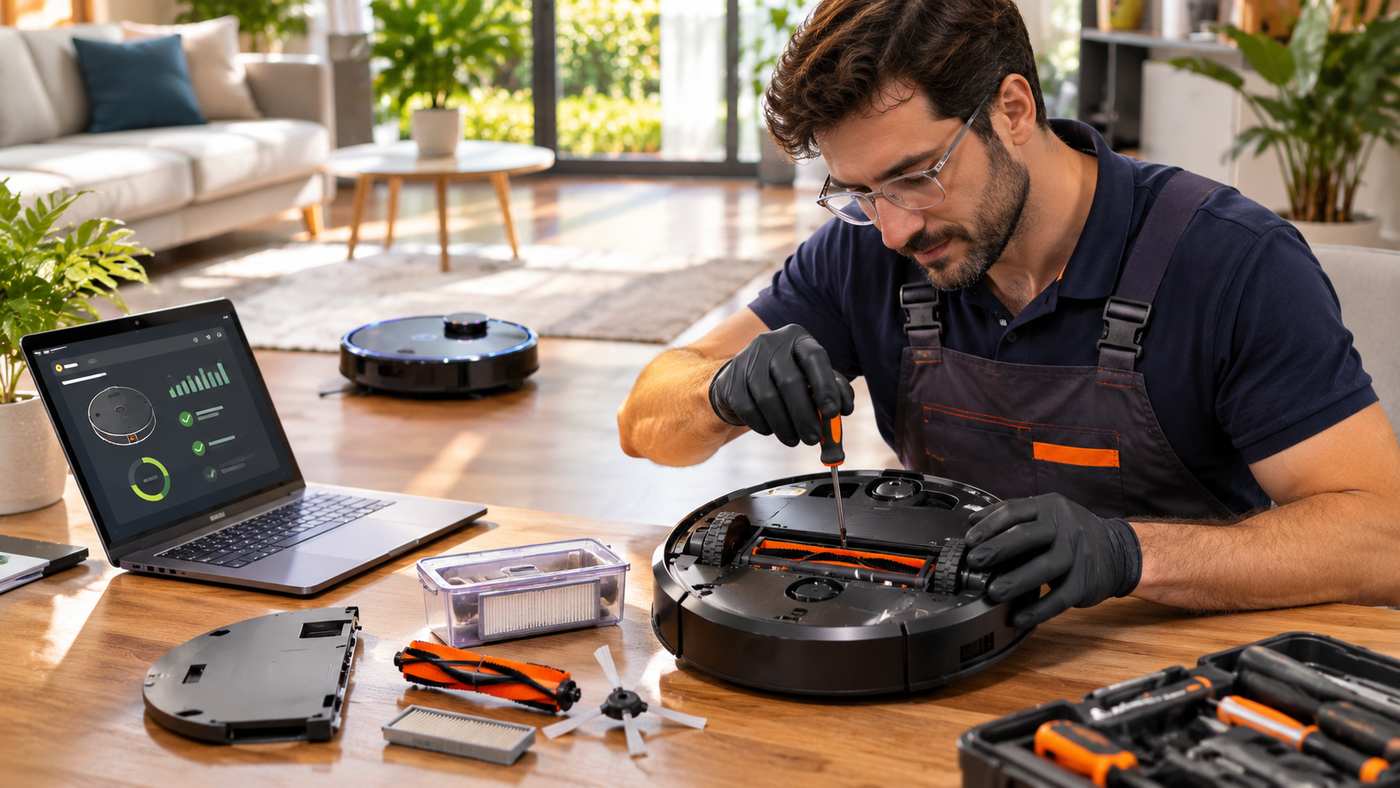
Robot vacuum cleaners have transformed routine household cleaning by combining automated navigation, intelligent sensors, and convenient scheduling features. Whether homeowners want to manage pet hair, maintain hardwood floors, or reduce daily cleaning responsibilities, modern robotic vacuums offer a growing range of possibilities.
However, choosing the right device involves more than comparing suction power, battery capacity, and mapping technology. Robot vacuum customer service can have a major influence on the ownership experience, particularly when buyers encounter technical problems, require replacement parts, or need assistance with software updates.
Engineering quality is equally important. A thoughtfully designed robot vacuum should combine dependable hardware, efficient navigation, practical maintenance, and reliable software. Yet marketing claims about American engineering, local support, or premium construction should be examined carefully rather than accepted without evidence.
This guide explains seven important factors to evaluate when comparing robot vacuum brands, including after-sales support, engineering claims, repair options, warranty conditions, and long-term ownership costs.
Why Customer Service and Engineering Matter When Buying a Robot Vacuum
A robot vacuum is more complicated than a conventional cleaning appliance.
It may contain multiple sensors, electric motors, rechargeable batteries, wireless connectivity, computer processors, and software that controls navigation and cleaning behavior.
When everything works correctly, the device can operate with minimal assistance. However, a problem affecting a wheel, charging station, mapping system, or brush motor may require troubleshooting.
This is why product specifications alone cannot determine whether a robot vacuum represents good value.
Two devices may offer similar advertised features but deliver very different ownership experiences.
One manufacturer might provide accessible troubleshooting documentation, replacement components, and responsive technical support. Another may offer limited assistance after the initial sale.
Similarly, engineering decisions influence how easily components can be cleaned, replaced, and maintained.
Consumers should therefore evaluate both the physical product and the support infrastructure behind it.
1. Evaluate Robot Vacuum Customer Service Before Purchasing
Customer support is often overlooked during product research.
Buyers naturally focus on cleaning performance, obstacle avoidance, and attractive features. They may not consider what happens if the device stops charging or develops a navigation problem several months later.
A reliable support system becomes particularly valuable when problems arise.
Look for Accessible Communication Channels
Before purchasing, investigate how customers can contact the manufacturer.
Depending on the brand, available options may include:
- Telephone support
- Email assistance
- Live chat
- Online troubleshooting resources
- Warranty claim forms
- Authorized service providers
Multiple communication channels can be helpful, but availability alone does not guarantee quality.
Consider whether representatives understand the product and can provide clear instructions.
Examine the Quality of Responses
Good customer support should focus on resolving problems.
For example, if a robot vacuum repeatedly fails to return to its charging dock, an effective support representative might ask about dock placement, charging contacts, mapping settings, and potential obstructions.
The goal is to identify the likely cause without requiring unnecessary repairs.
Consider Post-Purchase Communication
Some companies contact customers after delivery to confirm whether the product is functioning correctly.
This type of communication can help identify setup problems before they become frustrating.
One consumer discussion highlights the importance of this approach. In a Reddit conversation about service and US engineering, a Bobsweep owner described helpful phone conversations before buying and a personal follow-up email approximately two weeks after receiving the product.
The post offers an example of a positive individual customer-service experience, although one testimonial cannot establish a brand’s overall support reliability or engineering location.
Buyers should compare multiple independent experiences before making a decision.
2. Understand What US Engineering Actually Means
The phrase “US engineering” can influence consumer perceptions of product quality.
However, the terminology may describe different business arrangements.
A product can be designed in one country, assembled in another, and manufactured using components sourced from several international suppliers.
Consequently, buyers should avoid assuming that American engineering automatically means American manufacturing.
Engineering, Manufacturing, and Assembly Are Different
These terms describe separate stages of product development.
Engineering refers to activities such as mechanical design, electronics development, software architecture, testing, and performance optimization.
Manufacturing involves producing the physical components or finished device.
Assembly refers to combining components into a completed product.
A company may employ engineers in the United States while outsourcing some or all manufacturing operations.
Neither arrangement automatically determines product quality.
Ask Specific Questions About Product Development
If a brand promotes US engineering, consider asking:
- Which engineering activities take place in the United States?
- Where is the finished product manufactured?
- Does the company conduct reliability testing?
- Who develops and maintains its software?
- Are replacement components available locally?
- Where are warranty repairs performed?
Clear answers help consumers understand the company’s actual capabilities.
Focus on Verifiable Quality
Country-of-origin messaging should not replace product testing.
A well-engineered vacuum should demonstrate reliable navigation, effective cleaning, appropriate battery protection, durable components, and manageable maintenance.
Independent testing and documented specifications provide stronger evidence than broad promotional statements.
3. Examine the Warranty and Repair Process
Warranty coverage is one of the most important aspects of long-term ownership.
Even carefully manufactured electronic devices can develop faults.
A clear warranty explains which problems are covered and what the manufacturer will do when a covered defect occurs.
Review Warranty Terms Carefully
Before making a purchase, investigate:
- Length of warranty coverage
- Included components
- Battery coverage and exclusions
- Requirements for proof of purchase
- Shipping responsibilities
- Repair or replacement procedures
- Limitations involving accidental damage
Do not assume that every component receives identical coverage.
Consumable items such as brushes, filters, and mop pads may be treated differently from motors or electronic components.
Understand How Repairs Are Handled
Manufacturers may provide several possible remedies.
Depending on the issue and applicable terms, a customer might receive troubleshooting assistance, a replacement component, a repair service, or a replacement device.
The process should be clearly explained.
Ask whether repairs require sending the entire vacuum to a service facility and whether shipping costs apply.
Keep Purchase Documentation
Retain the original receipt, order confirmation, model information, and product serial number.
These details can make warranty claims easier to process.
It is also useful to record communication with customer-service representatives, especially when troubleshooting involves several steps.
4. Investigate Replacement Parts and Maintenance Requirements
A robot vacuum requires regular maintenance.
Brushes collect hair, filters trap dust, sensors become dirty, and moving parts experience wear.
The ease of replacing these components directly affects long-term ownership costs.
Identify Common Replacement Components
Frequently maintained or replaced parts include:
- Main roller brushes
- Side brushes
- Air filters
- Mop pads
- Dust bags
- Rechargeable batteries
- Wheels and brush assemblies
The actual replacement schedule depends on the manufacturer, cleaning frequency, floor conditions, and household environment.
Check Parts Availability
A device may perform well initially but become inconvenient if replacement components are difficult to obtain.
Before buying, check whether genuine or manufacturer-approved accessories are available for the exact model.
Also investigate whether the company continues supporting older products.
A low initial purchase price may become less attractive if routine maintenance requires expensive or hard-to-find components.
Understand Repairability
Not all robotic vacuums are equally repairable.
Some allow consumers to replace brushes and batteries with relatively simple procedures.
Other repairs may require specialized tools or professional servicing.
Avoid opening electrical assemblies or modifying battery systems unless the manufacturer explicitly permits the procedure and provides safe instructions.
Repairability is an important engineering consideration because it can influence the useful life of the appliance.
5. Compare Navigation Technology and Cleaning Performance
Customer support matters, but the product must also perform its primary function effectively.
Robot vacuums use different combinations of navigation technologies to move around a home.
These may include cameras, LiDAR, infrared sensors, bump sensors, and other positioning systems.
Consider Mapping Accuracy
Advanced mapping can help a robot understand room boundaries and establish efficient cleaning routes.
Useful features may include:
- Room-specific cleaning
- Scheduled cleaning routines
- No-go zones
- Multiple floor maps
- Obstacle detection
- Automatic return to the charging dock
However, the presence of a sensor or mapping feature does not guarantee reliable performance.
Testing should account for furniture arrangements, clutter, lighting, and household conditions.
Evaluate Cleaning Requirements
Different homes need different cleaning capabilities.
Pet owners may prioritize hair pickup and anti-tangle brush design.
Homes with extensive carpeting may require stronger carpet-cleaning performance.
Households with hard floors may place greater importance on mopping features, edge cleaning, and dust collection.
Consider real-world cleaning results rather than relying exclusively on advertised suction measurements.
Check Docking and Charging Reliability
A robot vacuum that frequently fails to locate its dock can become inconvenient.
Docking performance depends on navigation accuracy, sensor condition, dock placement, and environmental conditions.
A dependable design should support predictable charging behavior under normal household conditions.
6. Review Software Support, Privacy, and Connectivity
Modern robotic vacuums increasingly depend on software.
Mobile applications can control cleaning schedules, manage maps, display maintenance alerts, and provide remote access to device settings.
This convenience introduces additional considerations.
Look for Reliable Software Updates
Manufacturers may release updates that improve stability, address security issues, or refine cleaning behavior.
However, update frequency and long-term support policies vary.
Consumers should investigate whether the brand maintains its application and provides assistance for known software problems.
Understand Data Collection
Some connected robot vacuums process information about room layouts, cleaning history, device location, or account activity.
Camera-equipped models may introduce additional privacy considerations.
Before connecting a device, review the manufacturer’s privacy policy and available data controls.
Important questions include:
- What information is collected?
- Is data processed locally or through cloud services?
- Can stored maps be deleted?
- Are account security features available?
- Does the device require an internet connection for essential functions?
These considerations are particularly relevant for consumers who value connected-home privacy.
Consider Offline Functionality
Some robot vacuums provide basic cleaning controls without continuous internet access, while others depend more heavily on companion applications.
Check whether the device can start, stop, and complete essential cleaning tasks if Wi-Fi connectivity becomes unavailable.
7. Calculate Long-Term Ownership Value
The purchase price is only one part of the overall cost of owning a robot vacuum.
Maintenance supplies, replacement batteries, repairs, and potential subscription features can affect affordability over time.
Estimate Routine Expenses
Consider the cost and expected replacement frequency of brushes, filters, dust bags, and mop accessories.
Battery replacement may eventually become necessary, depending on usage and battery condition.
A product with affordable, readily available components may offer better long-term value than a cheaper model with expensive maintenance requirements.
Factor in Reliability
A reliable vacuum reduces the time spent on troubleshooting and unexpected interruptions.
Although no appliance is completely maintenance-free, sound engineering and accessible support can improve the overall experience.
Compare Total Ownership Costs
When evaluating two models, consider the following:
| Factor | What to examine |
|---|---|
| Purchase price | Initial cost and included accessories |
| Cleaning performance | Suitability for household floors |
| Replacement parts | Availability and recurring costs |
| Battery | Expected maintenance and replacement options |
| Warranty | Coverage, exclusions, and claim process |
| Customer service | Accessibility and problem resolution |
| Software | Updates, app stability, and privacy |
| Repairability | Ease of authorized maintenance |
A balanced comparison can reveal meaningful differences that are not visible in product advertisements.
How to Research Robot Vacuum Customer Reviews Effectively
Online reviews can provide valuable insight into actual ownership experiences.
However, individual opinions should be interpreted carefully.
Read Reviews Across Multiple Sources
Manufacturer websites, retailer listings, independent reviews, and online communities may offer different perspectives.
Look for patterns rather than relying on a single enthusiastic or negative review.
For example, repeated reports of similar charging problems may deserve closer investigation.
Likewise, consistent comments about responsive warranty support can provide useful context.
Distinguish Personal Experience From Technical Evidence
A customer may report that a particular model works perfectly in their home.
That is meaningful feedback, but it does not establish that every unit will perform identically.
Similarly, a positive customer-service experience demonstrates what happened in one interaction, not the complete quality of a company’s operations.
Technical claims should be supported by specifications, testing, or verifiable company information.
Consider the Age of Reviews
Support policies and products can change.
A review written several years ago might describe an older model, different warranty conditions, or a previous software version.
Prioritize recent, model-specific evidence whenever possible.
Look for Detailed Experiences
Useful customer reviews often explain what went wrong, how the company responded, and whether the issue was resolved.
These details are more informative than simple star ratings.
Robot Vacuum Engineering Features That Deserve Attention
Engineering quality involves many interconnected decisions.
Mechanical Durability
Brush mechanisms, wheel assemblies, and moving components should be designed for routine household use.
Materials and component accessibility can influence durability and maintenance requirements.
Battery Management
Rechargeable batteries require appropriate charging and temperature management.
Consumers should follow manufacturer instructions regarding charging conditions, storage, and replacement.
Sensor Reliability
Navigation sensors must function in environments containing furniture, reflections, shadows, and common household obstacles.
Good engineering balances sensor capabilities with dependable software behavior.
Noise and Usability
Cleaning performance is important, but so is the user experience.
Noise levels, maintenance access, dustbin handling, and physical controls can influence daily satisfaction.
Maintainability
A practical design should make routine cleaning and replacement procedures straightforward.
Clear instructions and accessible components help owners maintain their devices correctly.
Common Mistakes Buyers Should Avoid
Choosing Based Only on Suction Ratings
Advertised suction figures do not represent every aspect of real-world cleaning performance.
Brush design, floor contact, navigation, and debris handling are also important.
Assuming Premium Pricing Guarantees Better Support
An expensive device does not automatically come with excellent customer service.
Investigate actual support channels, warranty terms, and repair policies.
Confusing US Engineering With US Manufacturing
These are different claims.
Verify the manufacturer’s descriptions before drawing conclusions about product origin.
Overlooking Replacement Parts
A model without readily available filters or brushes can become difficult to maintain.
Check accessory availability before purchasing.
Ignoring Privacy Settings
Connected appliances can collect operational data.
Review available privacy controls and understand how the companion application handles information.
A Practical Checklist Before Buying
Use this checklist when comparing robot vacuum brands.
| Question | Why it matters |
|---|---|
| Can I contact customer support easily? | Helps resolve setup and repair problems |
| Are warranty terms clearly explained? | Reduces uncertainty about coverage |
| Are replacement parts available? | Supports routine maintenance |
| Are engineering claims verifiable? | Helps distinguish facts from marketing |
| Does the vacuum suit my flooring? | Improves cleaning suitability |
| Are navigation features reliable? | Reduces unnecessary intervention |
| Does the company maintain its software? | Supports ongoing usability and security |
| Can the product be repaired? | May extend useful product life |
| Are reviews consistent across sources? | Provides broader ownership context |
The Future of Robot Vacuum Engineering and Customer Support
Robotic cleaning technology continues to evolve.
Manufacturers are developing improved navigation systems, obstacle recognition, automated maintenance stations, and smarter cleaning routines.
These improvements may reduce the amount of manual intervention required from homeowners.
However, increasingly sophisticated technology can also introduce additional maintenance and software dependencies.
For this reason, dependable customer support will remain important.
Consumers should expect manufacturers to explain product limitations, provide maintenance guidance, and communicate repair options clearly.
Engineering improvements are most valuable when they contribute to reliable everyday performance.
The ideal robot vacuum is not necessarily the one with the longest feature list. It is the one that consistently meets household cleaning needs and remains practical to maintain.
Frequently Asked Questions
1. Why is robot vacuum customer service important?
Robot vacuum customer service helps owners troubleshoot charging issues, navigation errors, software problems, and warranty concerns. Accessible technical support can improve the long-term ownership experience.
2. Does US engineering mean a robot vacuum is made in America?
Not necessarily. Engineering, component manufacturing, and final assembly may occur in different countries. Buyers should verify specific claims with the manufacturer.
3. What should I check before purchasing a robot vacuum?
Evaluate cleaning performance, navigation reliability, warranty coverage, replacement-part availability, software support, privacy policies, and customer reviews.
4. Are customer reviews reliable for evaluating robot vacuums?
Customer reviews provide useful individual experiences, but they should not be treated as definitive proof of overall reliability. Compare multiple sources and look for consistent patterns.
Conclusion
Strong robot vacuum customer service and thoughtful engineering can make a significant difference in long-term appliance ownership.
Before purchasing, examine the manufacturer’s support process, warranty conditions, repair options, software maintenance, and replacement-part availability.
By combining verified product information with independent customer experiences, buyers can make more informed decisions and select a robot vacuum suited to their household needs.
