
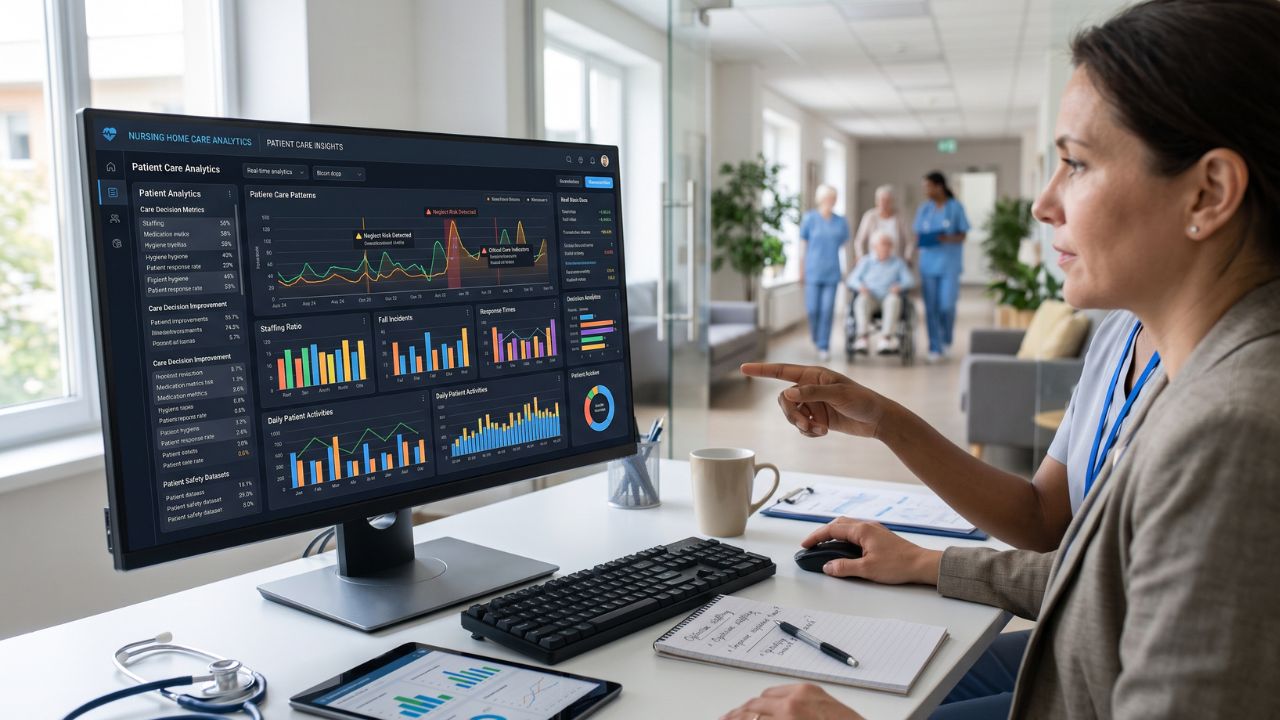
Nursing home neglect rarely arrives as a single event. It builds through thin weekend shifts, missed repositioning, unreported falls, and medication shortcuts, and some of those warning signs may appear in staffing and care records before a state surveyor walks through the door. Standard federal inspections can be up to 15 months apart. Analytics can read the signals every day.
Three public datasets from the Centers for Medicare & Medicaid Services (CMS) make that possible: Payroll-Based Journal (PBJ) staffing records, Minimum Data Set (MDS) resident assessments, and the health inspection citations published on Care Compare. Combined with a facility’s own EHR, incident, and call-light records, they can surface neglect risk weeks or months before an annual survey would.
The limitation is honesty of input. The HHS Office of Inspector General (OIG) found that nursing homes failed to report 43% of falls with major injury and hospitalization in their MDS assessments. Useful analytics treats self-reported numbers with skepticism and checks them against independent sources.
Why Do Periodic Inspections Miss Neglect That Data Can Catch?
An inspection is a snapshot, and facilities know roughly when the camera is coming. When researchers from Harvard and Vanderbilt analyzed 2017–2018 PBJ data from more than 15,000 nursing homes, they found that staffing rose in the weeks before the survey, peaked during survey week, and fell afterward. The same Health Affairs study found that 54% of facilities met CMS’s expected total staffing level on fewer than 20% of days, and 91% met expected registered nurse (RN) levels less than 60% of the time.
A surveyor sees the peak week. A payroll-based dashboard sees all 52.
That is the core case for analytics in long-term care: it supplements point-in-time inspections with records gathered throughout the year, and it makes the gaps between inspections visible to administrators, regulators, and families.
What Do CMS Star Ratings Miss About Resident Safety?
The Five-Star Quality Rating System on Care Compare blends health inspections, staffing, and quality measures into one score. It is a reasonable starting point and a poor finishing point.
Nursing Home Abuse Center, a national resource that helps families across all 50 states recognize and respond to abuse and neglect in long-term care facilities, has published research comparing CMS star ratings with published federal safety findings. The findings show why a headline rating does not provide a complete inspection history. Using a CMS data snapshot from August 1, 2026, its analysis found that 566 of 5,766 four- and five-star nursing homes (9.8%) had a CMS Abuse Icon or a current or historical Immediate Jeopardy-level citation in their published inspection history. Among one- to three-star homes, the figure was 49.8%. Historical citations do not necessarily indicate an ongoing safety problem.
Part of the gap is structural. Since July 2025, CMS has scored health inspections using only a facility’s two most recent standard surveys, while older serious citations from a third standard survey may remain visible in a facility’s published history without counting toward its current inspection rating. The lesson for analysts: pull the full deficiency history, sort by scope and severity, and read the rating as one input rather than a verdict.
What Staffing Data Reveals About Neglect Risk
Staffing is an important upstream indicator of neglect risk. PBJ submissions provide auditable daily staffing information based on payroll records, though facilities still submit the data to CMS and errors remain possible.
Why daily variation matters more than averages
A quarterly average of hours per resident day can look healthy while individual shifts fall apart. Researchers have argued that CMS should add a staffing instability measure to its Five-Star staffing rating, and a simulation covering 13,641 nursing homes using third-quarter 2023 data showed how that change would reshape ratings. The measure captures day-to-day swings that averages hide, and those swings are associated with resident outcomes.
For operators, this means tracking staffing by shift and by day of week, not just by quarter. Weekend RN coverage, night-shift aide ratios, and the share of hours filled by agency staff are the three views that most often reveal trouble.
How understaffing becomes neglect
Nursing Home Abuse Center also identifies understaffing as a recurring risk in its guide to Nursing Home Neglect. That guidance explains how short staffing can affect residents: longer waits after a call light is pressed, meals that arrive late or go uneaten, hurried bathing and toileting, and fewer eyes on residents at risk of falling.
Each of those failures leaves a trace. Call-light systems log response times, and dietary records show meal intake. MDS assessments record weight loss and new pressure injuries. When a facility lines those traces up against PBJ shift data, a weekend staffing dip followed by signs of skin breakdown warrants investigation, though timing alone does not prove causation. Retention matters too, which is why software aimed at reducing burnout in people-centric industries is drawing attention from long-term care operators.
Where Does Self-Reported Nursing Home Data Break Down?
Most clinical quality measures on Care Compare come from the MDS, which facilities complete themselves. That creates an obvious incentive problem, and federal auditors have documented it.
Unreported falls
In its September 2025 review, the OIG compared MDS assessments with Medicare hospital claims and found that nursing homes left 43% of falls with major injury and hospitalization off their assessments. The facilities with the lowest fall rates on Care Compare were the least likely to report the falls that occurred. In other words, the homes that looked safest on this measure were partly the ones reporting least.
Diagnoses that hide sedation
Antipsychotic use is a Care Compare quality measure, but residents with schizophrenia are excluded from it. In March 2026, the OIG reported that some nursing homes assigned inappropriate schizophrenia diagnoses to mask antipsychotic misuse and inflate their star ratings. Inappropriate use of antipsychotics as chemical restraints can put residents at serious risk.
The analytics response is cross-validation. Compare MDS fall coding against emergency department transfers and hospital claims. Flag new schizophrenia diagnoses recorded after admission, especially in residents with dementia. Documentation accuracy is a wider healthcare problem, too: the same tension is now appearing with AI scribes and the medical coding errors they can introduce.
How Can Analytics Combine These Data Sources?
Read alone, any one of these datasets can mislead. The value comes from layering them so that one source checks another.
| Data source | What it measures | Neglect signal it can surface |
| Payroll-Based Journal (PBJ) | Daily paid hours by job category, plus turnover | Weekend and night staffing dips, post-inspection drops, heavy agency reliance |
| Minimum Data Set (MDS) | Resident assessments: falls, pressure injuries, weight, medications | Clinical decline, new stage 2+ pressure injuries, unplanned weight loss |
| Care Compare inspection data | Deficiencies by scope and severity, Abuse Icon, penalties | Repeat citations, Immediate Jeopardy history, complaint-driven findings |
| Medicare hospital claims | Inpatient and emergency visits with diagnoses | Injuries and falls missing from the MDS |
| Facility incident and call-light logs | Response times, unwitnessed falls, elopement attempts | Real-time supervision gaps by shift and unit |
A practical order of operations
Start with staffing, because it moves first. Flag any unit where weekend RN hours fall well below weekday levels or where agency hours are climbing. Next, overlay MDS outcomes on the same timeline and look for new pressure injuries, falls, or unplanned weight loss (the MDS flags loss of 5% or more in the last month or 10% or more in the last six months) that cluster after staffing dips. Then cross-check those MDS counts against hospital and emergency transfers to catch underreporting. Last comes the facility’s full inspection history. Has the pattern been cited before?
Teams building these pipelines can borrow from general data analytics practice for business decisions, but the stakes differ. A false negative here means a resident is hurt.
Where Do Sensors and Predictive Models Fit?
Falls are the clearest test case. OIG’s companion analysis counted 42,864 falls with major injury and hospitalization among Medicare-enrolled nursing home residents between July 2022 and June 2023. Of those residents, 1,911 died while hospitalized, and Medicare and enrollees paid more than $800 million for the hospital care.
Long-term care EHR platforms, including PointClickCare and MatrixCare, hold information about mobility, medication, cognition, and prior falls. Predictive models can use factors from MDS assessments and care notes to estimate risk, while sensor systems can add bed-exit alerts, door alarms, and wearable location tags. These tools only help when alerts reach a staff member who has time to respond.
Federal inspection findings show how monitoring can fail when staff do not respond to alerts. In a September 2026 Pennsylvania inspection, a resident left a facility after a wander-guard alarm sounded, but a staff member silenced it without conducting the required search. Staff learned of the exit from campus police. Monitoring whether alarms are working, acknowledged, and escalated can help identify that kind of supervision gap.
Frequently Asked Questions
How can families use public data to check a nursing home for signs of neglect?
Start with CMS Care Compare, which shows a facility’s star ratings, staffing levels, and inspection citations. Then look past the headline rating: health-inspection deficiencies and staffing trends often say more than the overall score. In person, watch for warning signs such as sudden weight loss, unexplained injuries, and poor hygiene.
What is Payroll-Based Journal data, and why does it matter for neglect?
PBJ is the CMS system that collects daily staffing hours from nursing home payroll records. Facilities submit PBJ records based on payroll and staffing systems, making them more auditable than older survey-period reports and useful for tracking daily and weekend staffing patterns. Sustained dips are an early warning sign for missed care.
How accurate is Minimum Data Set (MDS) data?
It is useful but self-reported, and federal audits show gaps. The HHS Office of Inspector General found that nursing homes omitted 43% of falls with major injury and hospitalization from their MDS assessments. Analysts should cross-check MDS data against hospital claims and transfer records.
What staffing patterns should prompt a closer look?
Watch for weekend RN hours well below weekday levels, rising reliance on agency staff, and high turnover. Any of these combined with new pressure injuries, falls, or weight loss in MDS data is worth investigating.
Who should families contact if they suspect neglect?
Call 911 in an emergency. For other concerns, file a complaint with the state survey agency that inspects nursing homes, and contact the Long-Term Care Ombudsman Program, which advocates for residents.
How do predictive fall-risk models work in nursing homes?
These models may use MDS and EHR data to score resident risk such as mobility, medications, cognition, and fall history, then flag high-risk residents for interventions like bed alarms, supervision changes, or medication review. Their value depends on staff having time to act on the alerts.
What does a high CMS star rating guarantee?
Not a clean safety record. One analysis of August 2026 CMS data found that 9.8% of four- and five-star nursing homes had an Abuse Icon or an Immediate Jeopardy-level citation in their published inspection history, including past citations that do not necessarily reflect current conditions. Read the full inspection reports alongside the rating.
