
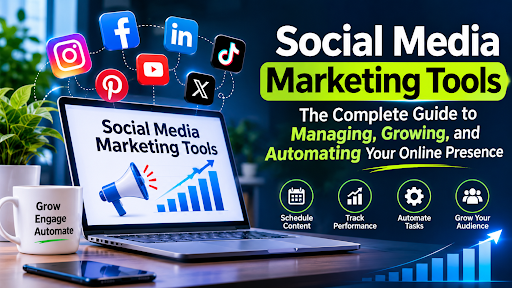
Social media has become an essential part of modern business growth. Brands use platforms such as Facebook, Instagram, LinkedIn, TikTok, Pinterest, and X to connect with audiences, promote products, build trust, and generate leads. However, managing multiple social media accounts consistently can be challenging without the right resources.
This is where social media marketing tools become valuable. These platforms help businesses plan content, schedule posts, analyze performance, manage customer interactions, and improve marketing campaigns. Whether you are a small business owner, digital marketer, content creator, or marketing agency, choosing the right tools can make your social media strategy more effective.
What Are Social Media Marketing Tools?
Social media marketing tools are digital platforms and applications designed to simplify and improve social media activities. They help businesses manage their online presence, create engaging content, monitor audience behavior, and measure campaign results through centralized dashboards.
Many modern platforms also integrate artificial intelligence (AI) to improve content creation, recommend publishing times, analyze engagement patterns, and automate repetitive marketing tasks.
Instead of manually managing every social media account, marketers can use these solutions to save time, maintain consistency, and make informed decisions based on performance data.
Why Are Social Media Marketing Tools Important?
Managing social media without an organized system can consume valuable time and resources. Businesses often struggle with inconsistent publishing schedules, delayed responses, limited performance tracking, and difficulties maintaining a consistent brand identity.
Social media marketing tools address these challenges by bringing important marketing activities together. They allow teams to plan campaigns in advance, coordinate content across different platforms, and understand which strategies generate meaningful results.
These tools are also useful for improving audience engagement. Businesses can monitor comments, respond to customer questions, and identify conversations related to their products or services.
For growing companies, automation and analytics provide opportunities to increase productivity without significantly expanding marketing teams.
Best Social Media Marketing Tools to Consider
The market offers numerous social media management platforms, each designed to support different marketing needs. Selecting the right solution depends on your business goals, budget, preferred platforms, and team requirements.
Hootsuite
Hootsuite is a popular social media management platform that helps businesses organize and manage multiple social accounts. It provides scheduling, content planning, monitoring, and analytics features.
Marketing teams can use its centralized dashboard to coordinate campaigns and track audience engagement. It is particularly useful for businesses managing several social media channels simultaneously.
Buffer
Buffer is known for its straightforward interface and content scheduling capabilities. It allows users to prepare posts, organize publishing calendars, and monitor social media performance.
Small businesses, freelancers, and individual content creators can benefit from its simple workflow. It helps maintain a consistent publishing schedule without requiring extensive technical knowledge.
Sprout Social
Sprout Social offers social media management, engagement, reporting, and analytics capabilities. Its features help businesses understand audience interactions and evaluate campaign performance.
Companies with larger marketing teams can use its collaboration and reporting options to improve communication and organize social media activities.
Canva
Canva is a popular graphic design platform that helps marketers create professional social media visuals. Users can design promotional graphics, Instagram posts, presentations, banners, and short-form video content.
Its templates and AI-powered features make content creation easier for people without professional graphic design experience. Canva is especially useful for maintaining a consistent visual identity across different platforms.
Later
Later focuses on social media scheduling and visual content planning. It is particularly useful for Instagram, Pinterest, and other platforms where visual presentation plays an important role.
Businesses can organize their content calendars, prepare posts, and plan publishing activities. This makes it easier to maintain a visually consistent social media presence.
SocialBee
SocialBee helps businesses organize, schedule, and manage social media content. Its content categorization features allow marketers to arrange different types of posts and maintain a balanced publishing strategy.
It can be useful for businesses that regularly publish educational content, promotional updates, industry news, and engaging social media posts.
How AI Is Transforming Social Media Marketing
Artificial intelligence is changing how businesses approach digital marketing. AI-powered tools can help marketers generate content ideas, write captions, create visual assets, analyze audience behavior, and improve campaign planning.
For example, AI writing assistants can suggest social media captions based on specific topics and brand requirements. Image-generation platforms can support creative campaigns, while analytics solutions can identify engagement patterns and highlight content opportunities.
AI tools can also help marketers understand which content formats perform better with particular audiences. This information makes it easier to refine marketing strategies and allocate resources effectively.
However, AI-generated content should always be reviewed before publishing. Maintaining originality, accuracy, brand consistency, and a natural communication style remains important for building audience trust.
Key Features to Look for in Social Media Marketing Tools
Choosing the right platform requires understanding your marketing requirements. Content scheduling is an important feature because it allows businesses to prepare posts in advance and maintain a regular publishing calendar.
Analytics and reporting are equally valuable. They help marketers evaluate reach, impressions, engagement, follower growth, and other performance indicators. These insights support better decisions and help identify opportunities for improvement.
Another important consideration is account integration. A useful platform should support the social networks your business actively uses.
Collaboration features can also improve productivity by allowing team members to review content, coordinate campaigns, and manage publishing responsibilities. Automation, customer engagement monitoring, and content organization can further simplify everyday marketing activities.
How to Choose the Right Social Media Marketing Tools
The best platform depends on your business size, marketing objectives, and available resources. Small businesses may prefer affordable solutions with simple scheduling and basic analytics, while larger organizations may require advanced reporting, collaboration, and account management capabilities.
Before selecting a tool, consider which social media platforms are most important to your audience. There is little benefit in paying for features that your marketing team rarely uses.
It is also worth exploring free trials and available pricing plans. Testing a platform helps you understand its interface, features, and compatibility with your existing workflow.
Finally, consider whether the tool can support your future growth. A scalable solution can make it easier to manage additional accounts, expand campaigns, and handle increasing content requirements.
Common Mistakes to Avoid When Using Social Media Marketing Tools
One common mistake is relying entirely on automation. Although scheduling tools save time, businesses still need authentic conversations and timely responses to audience questions.
Another mistake is focusing only on follower numbers. A large audience does not automatically translate into meaningful engagement, website traffic, or sales. Marketers should evaluate performance according to their actual business objectives.
Using too many tools can also create unnecessary complexity. Multiple subscriptions, disconnected dashboards, and overlapping features may increase costs without improving productivity.
Businesses should focus on selecting a practical combination of platforms that supports their complete marketing workflow.
Conclusion
Social media marketing tools play an important role in building, managing, and growing a successful online presence. From content scheduling and graphic design to audience engagement and performance analytics, these platforms help businesses manage marketing activities more efficiently.
Solutions such as Hootsuite, Buffer, Sprout Social, Canva, Later, and SocialBee offer different capabilities for businesses with varying requirements. AI-powered features are also creating new opportunities to improve content creation, automate repetitive tasks, and understand audience behavior.
Choosing the right tools requires evaluating your goals, budget, preferred platforms, and long-term marketing needs. With a well-planned strategy and the right technology, businesses can strengthen their digital presence, improve customer relationships, and achieve sustainable social media growth.
