
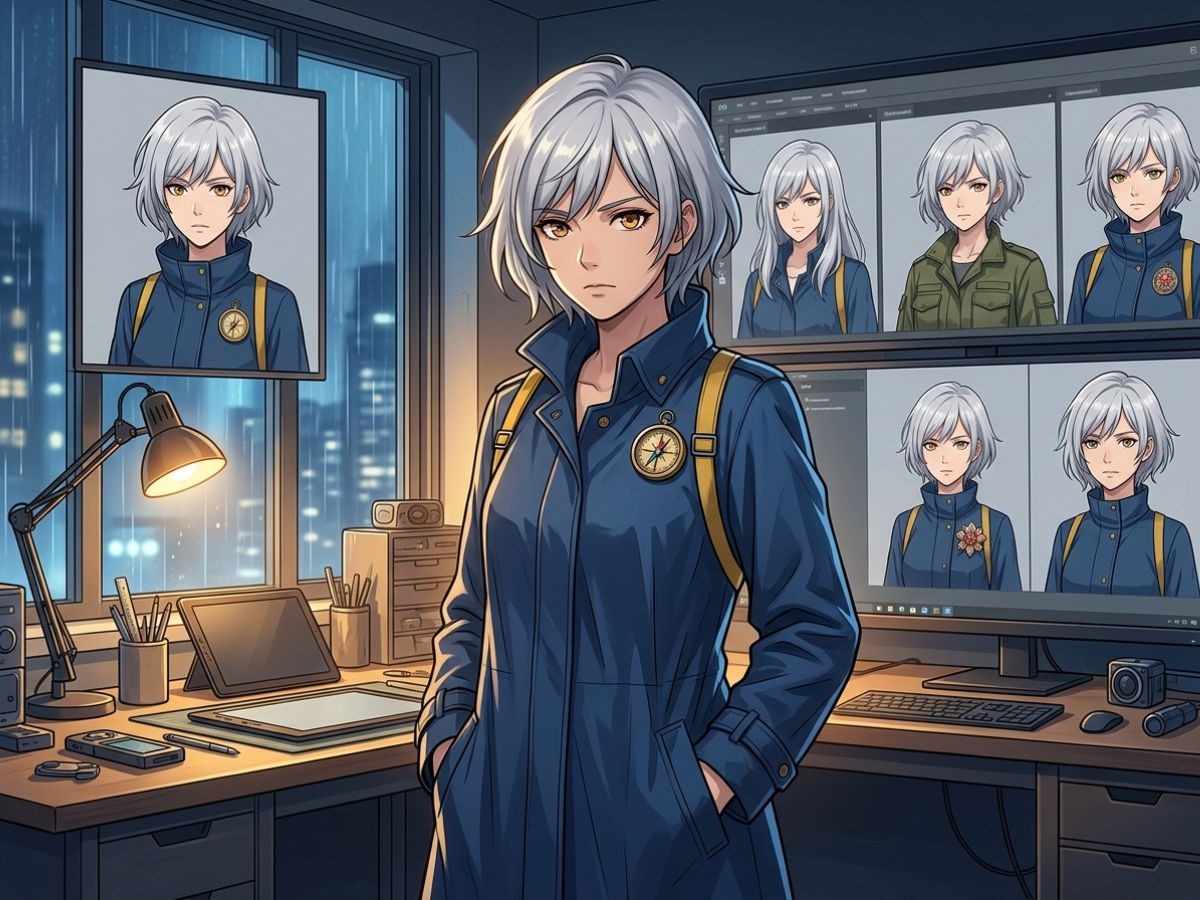
The first image was exactly what I wanted.
The character had short silver hair, a dark blue coat and a small brass compass pinned near the collar. She looked like someone who delivered messages through a city where it never quite stopped raining. The design felt specific without being overloaded.
When I tried to create her again, she came back with long hair and a military jacket. The compass was gone. In another version, it had become a brooch shaped like a flower. All three images were good on their own, but only one belonged to the character I had started building.
That is the awkward truth about AI character generation: making a striking character can be quick; making the same character twice is where the real work begins.
I Was Saving Pictures, Not Building a Character
My early character folders were full of unrelated successes. Each image had something I liked—a face, an outfit, a color combination—but the files did not add up to a usable cast.
The problem became obvious as soon as I needed more than a portrait. A social post required a wider scene. A profile needed a close-up. Another idea called for a different outfit. Every new request reopened decisions I thought had already been made.
I had not written down which details mattered. I knew the character had silver hair, but not its exact length or shape. I remembered a blue coat, but not the collar, material or yellow stitching that made it distinctive.
A free AI anime generator is useful for exploring those early possibilities. I can compare several visual directions much faster than I could sketch them from scratch. Still, the generator cannot decide which details deserve to survive into the next image. I have to make that call.
Once I understood that, I stopped treating the first good result as the end of the process.
A Short Note Worked Better Than a Giant Prompt
My first response to inconsistency was to write longer prompts. I added more adjectives, more clothing details and more background information. The prompts became impressive little walls of text. The results did not become equally precise.
Some instructions competed with each other. Important details disappeared among decorative ones. I was describing the atmosphere of the entire fictional world when what I actually needed was the shape of a coat.
Now I keep a short character note beside the reference image.
For the silver-haired courier, it might say:
Short uneven silver hair, amber eyes, navy raincoat, narrow yellow shoulder strap, circular brass compass at the left collar. Reserved expression. Slim build. No military uniform, no hat, no long hair.
That note is not elegant, but it works. It tells me what must stay and what has already been rejected.
I keep personality in a separate paragraph. She is observant, impatient with delays and uncomfortable when praised. Those details matter when I choose expressions and poses, but they should not bury the visual instructions.
The Strange Ways a Character Starts to Drift
Character drift is not always dramatic. Often it happens one harmless change at a time.
The hairstyle becomes slightly longer in one image. The next image copies that version. Someone changes the coat because the scene is indoors. The new outfit introduces a red accent, which later replaces the original yellow. A few rounds later, the character still has the same name but no longer has the same identity.
Faces drift in the same way. If I approve every image based only on whether it looks attractive, the character slowly moves toward whatever face the model produces most comfortably.
I now compare new generations with the original reference at thumbnail size. This is a crude test, but a useful one. If the character is recognizable only after I zoom in and inspect the eye color, the silhouette may not be strong enough.
Hair shape, posture, color blocking and one signature item usually do more work than tiny facial details.
Not Every Variation Deserves to Be Kept
The ease of generation creates another problem: too many acceptable images.
When a team can produce twenty variations in an afternoon, saving everything feels sensible. It is not. A folder full of near-duplicates makes later decisions harder, especially when nobody remembers which version was approved.
I prefer a much smaller set: one main full-body image, one close portrait, a few expressions and perhaps two poses that reveal how the character carries herself. If an outfit variation becomes part of the story, it gets its own approved reference.
The rejected images are not useless. I move them into an exploration folder and keep them away from the working references. That small separation prevents an abandoned design from quietly returning six weeks later.
A Character Starts Becoming Useful When It Can Leave the Portrait
A portrait can hide a weak design. The face gets most of the attention, while the clothing, posture and proportions remain vague.
I learn much more when I place the character in an ordinary scene. Can she sit at a café table without losing the details that identify her? Does the coat still make sense when she is running? What does she look like next to a taller, more brightly dressed character?
These situations reveal whether the design can carry a story.
They also expose details that were never decided. If the character wears a long coat, what is underneath it? Does the compass pin stay on every outfit? Is the shoulder strap practical or purely decorative? Questions like these may feel minor, but repeated content turns them into continuity problems.
This is where an AI OC maker becomes more relevant than a one-off image tool. I am no longer asking for an attractive anime figure. I am working around one identity and testing whether it survives new poses, scenes and relationships.
I Keep a Character Folder That Someone Else Can Understand
A reusable OC should not depend entirely on the memory of its creator.
My working folder contains the approved images, the short identity note and a plain text file with decisions that are easy to forget. I include the character’s approximate age, role, usual expression and main colors. I also record what should not appear.
The “do not” section has saved more time than I expected. It may say no hat, no heavy armor, no bright red clothing and no cheerful open-mouth smile. These are not universal rules for good design. They are boundaries for this particular character.
File names matter too. “final2_new_REAL.png” tells the next person nothing. I use names that identify the view and status, such as mira-fullbody-approved or mira-raincoat-side-test.
It is not glamorous work. It is also the reason I can return to a character months later without rebuilding her from memory.
The Value Appears Later
When people discuss AI art, the conversation often stops at the cost of generating the first image. That is not where I see the largest saving.
The benefit appears when the character is needed again.
A small game team can reuse an established character for a dialogue portrait, store artwork and an announcement image. A creator can build a series of posts without inventing a new visual identity each week. A brand mascot can appear in a tutorial, a seasonal campaign and a customer email while remaining recognizable.
None of this requires the character to become a famous intellectual property. Repetition itself has value. Familiar characters give scattered pieces of content a shared visual thread.
For a small creative team, reuse also makes planning easier. Instead of searching for a new visual concept for every campaign, the team can build on an existing identity and spend more time on the message.
There is a cost as well. Someone must review the images, maintain the references and reject variations that pull the design off course. AI speeds up production, but it does not remove art direction.
I Still Check for the Uncomfortable Stuff
Consistency is not the only concern.
A generated character can resemble an existing one more closely than intended. A costume may include a familiar emblem. The overall design may lean too heavily on a recognizable franchise or living artist’s style.
I do not assume that changing the character’s name solves those problems. If a result feels suspiciously familiar, I revise it.
Commercial use needs the same caution. Before using generated artwork in a paid product or campaign, I check the platform’s current terms and keep a record of the references, prompts and edits involved. I also expect a human to inspect every image before publication.
A character may look excellent at first glance but contain a broken accessory, an unreadable emblem or a detail that changes from frame to frame. The more important the character is to the project, the more carefully I review those files.
Where Human Judgment Still Matters
AI is good at giving me options quickly. It can help me discover a better outfit, a stronger silhouette or an unexpected color combination.
It cannot decide whether the character belongs in the story. It cannot determine whether the design is original enough for the project. It cannot replace the judgment involved in choosing what the audience should remember.
That part remains human.
My preferred process is fairly simple: write the brief, generate alternatives, choose the strongest direction, refine the identity, document it and check every later image against the reference.
It takes slightly more discipline at the beginning. It saves a lot of confusion later.
Final Thoughts
The easiest way to waste time with AI character tools is to treat every image as an isolated result.
The more useful approach is to ask what the character needs to do after the image is created. Will the character return in another post? Appear in a game? Wear a different outfit? Interact with another character? Represent a brand?
Those questions change the workflow.
I no longer measure success by how impressive one generated image looks. I look at whether the character can remain recognizable as the project develops. When that happens, AI becomes more than a way to make pictures. It becomes part of a repeatable system for building visual identity.
