
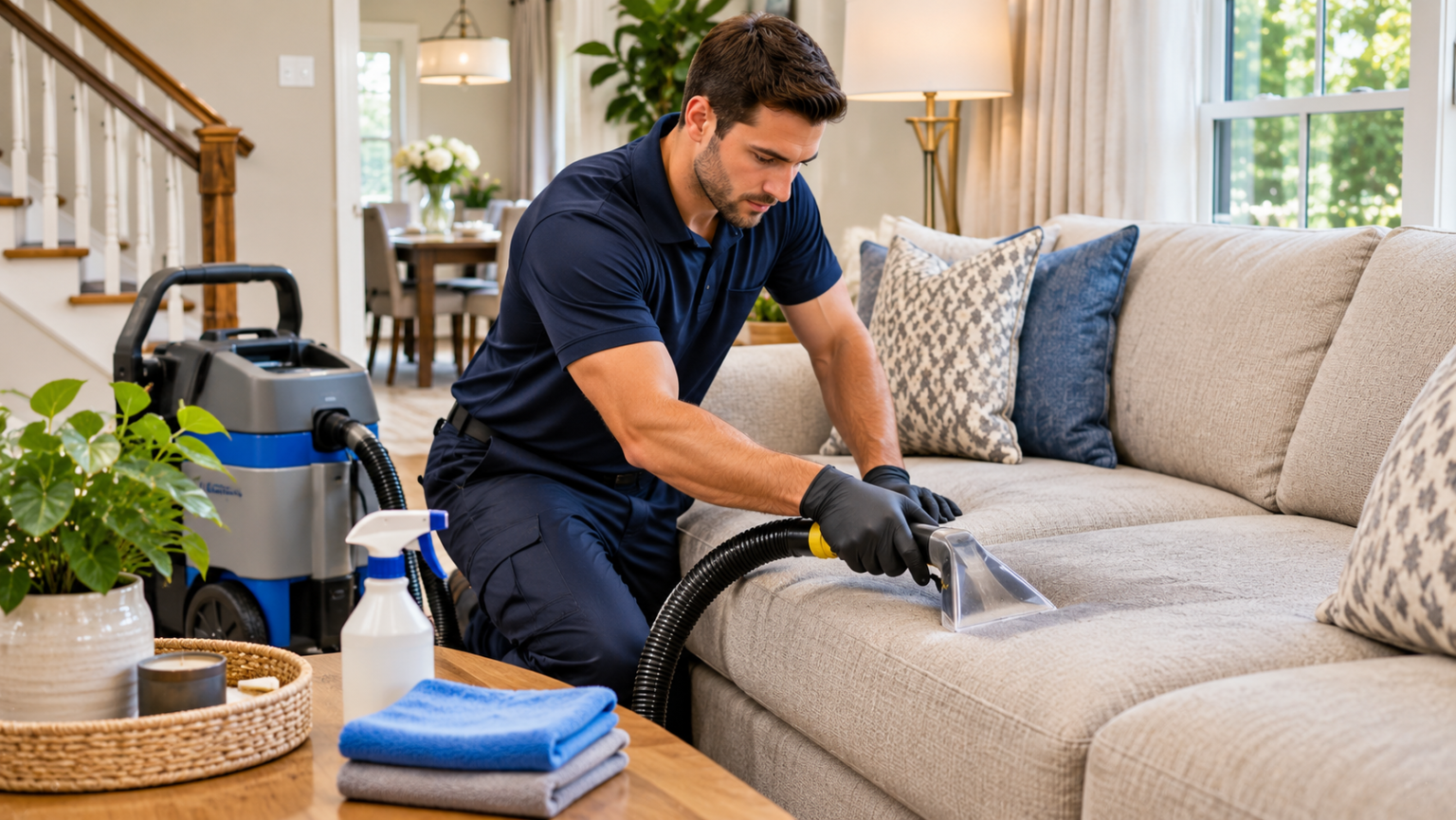
A beautiful fabric sofa brings comfort, warmth, and style to a living room. However, everyday activities can gradually leave dust, food particles, body oils, pet hair, and unwanted marks on the upholstery. Without proper maintenance, these substances can affect the appearance and condition of the furniture. Fabric sofa cleaning helps homeowners maintain cleaner upholstery, address stains, and preserve the sofa’s appearance. Nevertheless, safe cleaning requires understanding the fabric type, following manufacturer instructions, and choosing appropriate methods instead of applying random household products.
Fortunately, maintaining a fabric couch does not always require expensive equipment. Regular vacuuming, careful stain treatment, and suitable cleaning products can help address many common problems.
However, different upholstery materials respond differently to moisture, heat, and cleaning solutions. Therefore, the most effective approach begins with identifying the sofa’s cleaning requirements.
This guide explains the essential cleaning steps, common fabric care codes, safe stain removal techniques, and situations where professional upholstery cleaning may be appropriate.
Why Is Regular Fabric Sofa Cleaning Important?
Sofas experience frequent contact with clothing, skin, food, and household dust. Over time, these materials can accumulate on the fabric surface and in the spaces between cushions.
Consequently, a sofa may appear dull or develop visible marks even when it receives careful everyday use.
Regular maintenance helps remove loose debris before it becomes trapped in the upholstery. It also creates opportunities to identify spills and damaged areas early.
Maintaining the Appearance of Upholstery
Dust and surface soil can affect how fabric looks, particularly on lighter coloured furniture.
Routine vacuuming and appropriate spot treatment help maintain a more consistent appearance.
Additionally, quickly addressing spills may reduce the likelihood of certain substances becoming difficult to remove.
Supporting Better Furniture Maintenance
Accumulated debris may contribute to abrasion in frequently used areas.
Therefore, cleaning should be part of a broader furniture care routine that includes checking seams, rotating cushions where permitted, and following manufacturer recommendations.
However, excessive washing or aggressive scrubbing can damage upholstery. The goal is suitable maintenance rather than cleaning as frequently as possible.
Understand Fabric Sofa Cleaning Codes Before You Begin
Before applying any cleaning product, locate the sofa’s care label.
Manufacturers often attach these labels beneath cushions, under the frame, or along an internal seam.
The label may include a cleaning code that identifies suitable cleaning methods.
Code W: Water Based Cleaning
Code W generally indicates that the fabric allows an approved water based upholstery cleaning product.
However, this does not mean the sofa can be soaked, machine washed, or steam cleaned.
Use the specific cleaning method recommended by the manufacturer.
Code S: Solvent Based Cleaning
Code S indicates that the material requires an appropriate water free cleaning solvent.
Water may cause staining, changes in texture, or other damage.
Therefore, homeowners unfamiliar with suitable solvents should consider a qualified upholstery cleaning professional.
Code WS or SW: Approved Water or Solvent Methods
These codes generally permit certain water based or solvent based cleaning methods.
Nevertheless, the complete manufacturer instructions still apply.
Always test the selected cleaner on an inconspicuous area before treating visible upholstery.
Code X: Vacuuming or Light Brushing Only
Code X generally means liquid cleaning products should not be applied.
Routine maintenance should involve gentle vacuuming or brushing according to the manufacturer’s directions.
For significant stains, seek professional advice rather than experimenting with household cleaning solutions.
What If the Sofa Has No Care Label?
If the cleaning code is unavailable, contact the manufacturer or retailer for guidance.
Avoid assuming that a fabric can tolerate water because it appears durable.
The upholstery covering, backing, dyes, and internal construction can all influence cleaning suitability.
What Do You Need Before Cleaning a Fabric Sofa?
Preparing suitable supplies makes the cleaning process more organised.
Depending on the sofa’s care instructions, useful equipment may include:
- A vacuum cleaner with a suitable upholstery attachment
- Clean white microfiber cloths
- A soft upholstery brush
- An approved fabric cleaning product
- A small container for permitted cleaning solutions
- A fan or dehumidifier to support drying
- Protective coverings for nearby furniture or flooring
However, not every item is suitable for every sofa.
For example, an upholstery extraction machine should only be used when the manufacturer specifically permits that method.
Always read product directions before beginning.
7 Essential Steps for Safe and Effective Fabric Sofa Cleaning
A careful approach helps prevent unnecessary fabric damage. Follow these steps while respecting the sofa’s specific care requirements.
1. Inspect the Sofa and Identify Problem Areas
Begin by examining the entire sofa.
Look for visible stains, loose threads, damaged seams, worn areas, and colour differences.
Pay particular attention to armrests, seating surfaces, and the spaces between cushions.
These areas often experience more frequent contact during everyday use.
Next, identify whether the problem involves surface dust, a recent spill, an old stain, or an unusual smell.
Different problems may require different treatment methods.
For instance, loose crumbs can usually be vacuumed, while an unknown chemical stain may require professional assessment.
Finally, check the cleaning code before selecting any liquid product.
2. Vacuum the Upholstery Thoroughly
Vacuuming removes loose particles that could interfere with later cleaning.
Use an upholstery attachment suitable for the fabric and select an appropriate suction setting.
Begin with the seating surfaces. Then, clean the backrests, armrests, and cushion edges.
Pay attention to crevices where crumbs and dust accumulate.
If cushions can be lifted, vacuum beneath them as well.
However, avoid forceful brushing on delicate woven materials or surfaces with loose fibres.
Why Vacuuming Should Come First
Applying moisture to dusty upholstery can spread surface soil and make cleaning more difficult.
Therefore, removing loose material beforehand provides a better starting point.
Vacuuming also allows homeowners to examine the fabric more closely.
3. Test the Cleaning Product in a Hidden Area
Even when a sofa permits a particular cleaning method, the product should be tested before wider application.
Choose a small area that is not easily visible.
Apply the cleaner exactly as directed and allow the test area to dry completely.
Then, inspect the fabric for colour transfer, fading, shrinkage, staining, or changes in texture.
If any unwanted reaction appears, stop using the product.
A successful test does not guarantee that every section will respond identically. Nevertheless, it can help identify obvious compatibility problems.
For valuable or delicate furniture, professional advice may be preferable.
4. Treat Fresh Stains Gently
Fresh spills should be addressed promptly when it is safe to do so.
First, remove excess material with a clean white absorbent cloth.
For liquid spills, blot gently rather than rubbing.
Work from the outside of the affected area toward the centre to reduce spreading.
Next, apply only a cleaning product permitted by the care instructions.
Avoid pouring large quantities of solution directly onto the upholstery.
Instead, use the manufacturer’s recommended application method.
Repeat gentle treatment only when appropriate.
If the stain remains, avoid increasingly aggressive cleaning attempts.
5. Clean Larger Areas Only When the Fabric Allows It
Some upholstery products and cleaning methods are intended for broader surface cleaning.
However, a sofa marked for spot cleaning only should not automatically receive a full wet cleaning treatment.
Check whether the manufacturer permits overall cleaning, extraction, or another specific method.
If approved, work systematically to maintain even coverage.
Avoid excessive moisture and unnecessary scrubbing.
In addition, follow the cleaning equipment manufacturer’s instructions regarding solution concentration and extraction.
The aim is to remove suitable surface soil without damaging the fabric or saturating the internal padding.
6. Remove Cleaning Residue as Directed
Remaining detergent can sometimes leave visible marks or attract additional soil.
Therefore, follow the cleaning product’s instructions for removing any residue.
Where a suitable water based method is permitted, this may involve gently blotting with a lightly dampened cloth.
However, do not introduce water to fabrics that prohibit it.
Some upholstery cleaners are designed for specific application and removal procedures.
Consequently, use the recommended process rather than improvising with additional products.
Avoid mixing different cleaning chemicals.
Unapproved combinations may damage the material or create other safety concerns.
7. Allow the Sofa to Dry Completely
Drying is an essential part of upholstery maintenance.
A surface that feels dry may still contain moisture beneath the fabric.
Therefore, avoid using the sofa until the cleaned areas are completely dry.
Improve ventilation where appropriate.
A fan or dehumidifier may help support drying without exposing the upholstery to excessive heat.
Actual drying time depends on the cleaning method, fabric construction, moisture level, and room conditions.
If the sofa remains unusually damp, consider professional assistance.
How to Remove Common Stains From Fabric Sofas
Different stains behave differently. Therefore, using one cleaning method for every problem is not always effective.
Coffee and Tea Stains
Coffee and tea can leave noticeable discolouration, particularly on light upholstery.
Begin by blotting fresh liquid with a clean absorbent cloth.
Next, inspect the care label and select an approved cleaning product.
Use gentle application and avoid spreading the liquid across a larger area.
If the stain has dried or caused discolouration, professional treatment may be necessary.
Food and Grease Stains
Food stains may contain oils, colouring agents, and other substances.
First, remove loose food carefully without pressing it deeper into the upholstery.
Then, determine whether the fabric permits treatment with an appropriate cleaner.
Grease may require a product specifically formulated for oily residue.
However, do not apply strong degreasers or general household solvents unless the upholstery manufacturer permits them.
Pet Accidents and Odours
Pet accidents require prompt attention because liquid can penetrate the fabric and padding.
Blot the affected area and review the sofa’s cleaning instructions.
Some enzyme based cleaning products are designed to break down organic residues.
However, an enzyme cleaner must be suitable for the particular upholstery and type of stain.
Always follow its directions and test compatibility first.
If contamination has reached the internal cushioning, surface cleaning alone may not resolve the problem.
Ink and Makeup Marks
Ink and cosmetic products can contain pigments and oils that are difficult to remove.
Avoid rubbing the stain or applying an unfamiliar chemical.
Some common household methods can spread colour or damage fabric dyes.
Instead, identify the stain and choose a compatible product based on the manufacturer’s directions.
For delicate upholstery, professional cleaning is often the safer option.
Cleaning Different Types of Sofa Fabric
The name of a fabric does not determine its cleaning method by itself.
Different manufacturing processes, dyes, finishes, and backing materials can affect how upholstery responds.
Polyester and Synthetic Blends
Polyester is commonly used in upholstered furniture because it can offer durability and a wide range of textures.
However, polyester sofas may have different cleaning requirements depending on their construction.
Check the manufacturer’s code before applying moisture or cleaning chemicals.
Cotton and Linen Upholstery
Cotton and linen can provide a comfortable, natural appearance.
Nevertheless, some constructions may be more susceptible to shrinkage, colour changes, or water marks.
Therefore, avoid assuming that ordinary laundry methods are suitable for fixed upholstery.
Follow the furniture manufacturer’s instructions rather than relying solely on the fibre name.
Velvet and Textured Fabrics
Velvet and other pile fabrics require particular attention because aggressive cleaning can affect the surface appearance.
Brushing direction, pressure, and moisture may influence the final texture.
Consequently, a professional assessment may be appropriate for delicate or expensive pieces.
Is Steam Cleaning Safe for Fabric Sofas?
Steam cleaning is frequently discussed as an upholstery maintenance method. However, it is not suitable for every fabric sofa.
Some manufacturers explicitly advise against steam cleaning and hot water extraction, even for upholstery carrying a W cleaning code.
Therefore, the cleaning code alone is not sufficient permission to use a steam machine.
High temperatures, excess moisture, and unsuitable equipment may affect dyes, adhesives, fabric finishes, or internal padding.
Before using any machine, confirm that the sofa manufacturer approves the exact cleaning method.
Additionally, distinguish between steam treatment and water extraction. These processes are not identical.
Professional upholstery cleaners can assess the fabric and recommend an appropriate approach.
How to Prevent Water Marks and Unwanted Odours
Water marks can develop when moisture moves through upholstery and carries soil or other substances toward the edge of a cleaned area.
Overwetting can also create problems inside the cushion.
Therefore, use the minimum moisture required by the approved cleaning method.
Improve Drying Conditions
Keep air moving around the cleaned upholstery and avoid placing damp cushions against surfaces that prevent ventilation.
When the manufacturer permits, reposition cushions to support even drying.
Do not use intense heat unless specifically recommended.
The United States Environmental Protection Agency advises drying water damaged materials within 24 to 48 hours to help prevent mould growth.
If a sofa has experienced significant flooding, sewage exposure, or persistent internal dampness, a restoration specialist may be necessary.
Surface cleaning should not be treated as a guaranteed solution for contaminated cushioning.
How Often Should You Clean a Fabric Sofa?
The ideal cleaning schedule depends on household activity, fabric type, pets, and the manufacturer’s recommendations.
A sofa used daily by a large family may need more frequent attention than furniture in an occasional guest room.
Weekly Maintenance
Consider gentle vacuuming about once a week, or at an interval suitable for the household.
Focus on frequently used seats, armrests, and spaces between cushions.
Remove visible crumbs and loose debris before they accumulate.
Immediate Spot Care
Address spills promptly when the material and circumstances allow.
Quick blotting may prevent some stains from spreading or becoming more difficult to treat.
However, never use an unsuitable cleaning solution simply because a spill is fresh.
Periodic Deep Cleaning
Deep cleaning frequency varies according to usage and manufacturer instructions.
Some households may benefit from periodic professional cleaning, while others may only need routine maintenance and occasional spot treatment.
Avoid choosing a fixed deep cleaning interval without considering the fabric and its actual condition.
DIY Fabric Sofa Cleaning vs Professional Upholstery Cleaning
Homeowners can often manage light dust, loose debris, and minor stains using approved methods.
However, professional assistance may be appropriate for difficult stains or sensitive materials.
When Home Cleaning Makes Sense
DIY cleaning is generally more practical when the fabric care instructions are clear and the problem is limited.
Routine vacuuming and carefully approved spot treatment can help maintain appearance.
Nevertheless, the process should remain gentle and controlled.
When to Hire a Professional
Consider professional assistance when the sofa has extensive staining, delicate upholstery, persistent odours, or unclear cleaning instructions.
A professional may also be appropriate when previous cleaning attempts have created rings or colour changes.
Before hiring, ask about the proposed cleaning method, experience with similar fabrics, drying procedures, and how the provider handles potential damage.
No cleaning company can guarantee complete removal of every stain.
Common Fabric Sofa Cleaning Mistakes to Avoid
Some common cleaning habits can cause more problems than they solve.
Using excessive water may allow moisture to reach internal padding.
Similarly, vigorous scrubbing can damage the upholstery texture or spread staining.
Applying household bleach or an unsuitable solvent can also affect dyes and finishes.
Another mistake is removing cushion covers simply because they have zippers. Removable covers are not necessarily machine washable.
Additionally, avoid relying on vinegar, baking soda, or scented sprays as universal cleaning solutions.
These products may leave residue, create marks, or conflict with the manufacturer’s care instructions.
Finally, do not use the sofa before it dries completely.
A careful approach is more valuable than an aggressive attempt to remove every visible mark immediately.
How to Maintain a Cleaner Sofa for Longer
Preventive maintenance can reduce the need for intensive cleaning.
Start by removing loose dust regularly and addressing accidental spills appropriately.
Where the furniture design permits, rotate cushions to distribute everyday wear more evenly.
Keep food and drinks away from delicate upholstery when practical.
In households with pets, washable protective throws may help reduce direct contact with the sofa fabric.
However, covers and protectors should be chosen carefully to avoid colour transfer or other damage.
Above all, keep the manufacturer’s cleaning instructions available for future reference.
Consistent, gentle care can help preserve the furniture’s appearance without unnecessary chemical treatments.
Frequently Asked Questions
What is the safest way to clean a fabric sofa?
Check the care label, vacuum gently, test an approved cleaner in a hidden area, and avoid excessive moisture. Always follow manufacturer instructions.
Can I clean a fabric sofa with water?
Only if its care instructions permit an appropriate water based method. Code S and X upholstery generally should not receive water cleaning.
How do I remove stains from a fabric couch?
Blot fresh spills, identify the stain, and use a suitable upholstery cleaner. Avoid aggressive rubbing and test products before treating visible areas.
Is steam cleaning suitable for all fabric sofas?
No. Some upholstery manufacturers prohibit steam or hot water extraction. Confirm the approved cleaning method before using equipment.
How often should a fabric sofa be professionally cleaned?
There is no universal interval. Consider the fabric instructions, frequency of use, visible soiling, and whether ordinary maintenance is sufficient.
How long does a fabric sofa take to dry after cleaning?
Drying time varies with fabric, moisture, ventilation, and cleaning technique. Do not use the sofa until both the cleaned upholstery and affected cushioning are completely dry.
Conclusion
Fabric sofa cleaning is most effective when the methods match the upholstery material and its manufacturer instructions. Regular vacuuming, prompt stain care, suitable products, and thorough drying can help maintain a sofa’s appearance without unnecessary damage. However, delicate fabrics, persistent stains, and moisture problems may require professional attention. By choosing careful cleaning practices and maintaining a consistent routine, homeowners can keep their upholstered furniture looking cleaner and more inviting for everyday living.
