
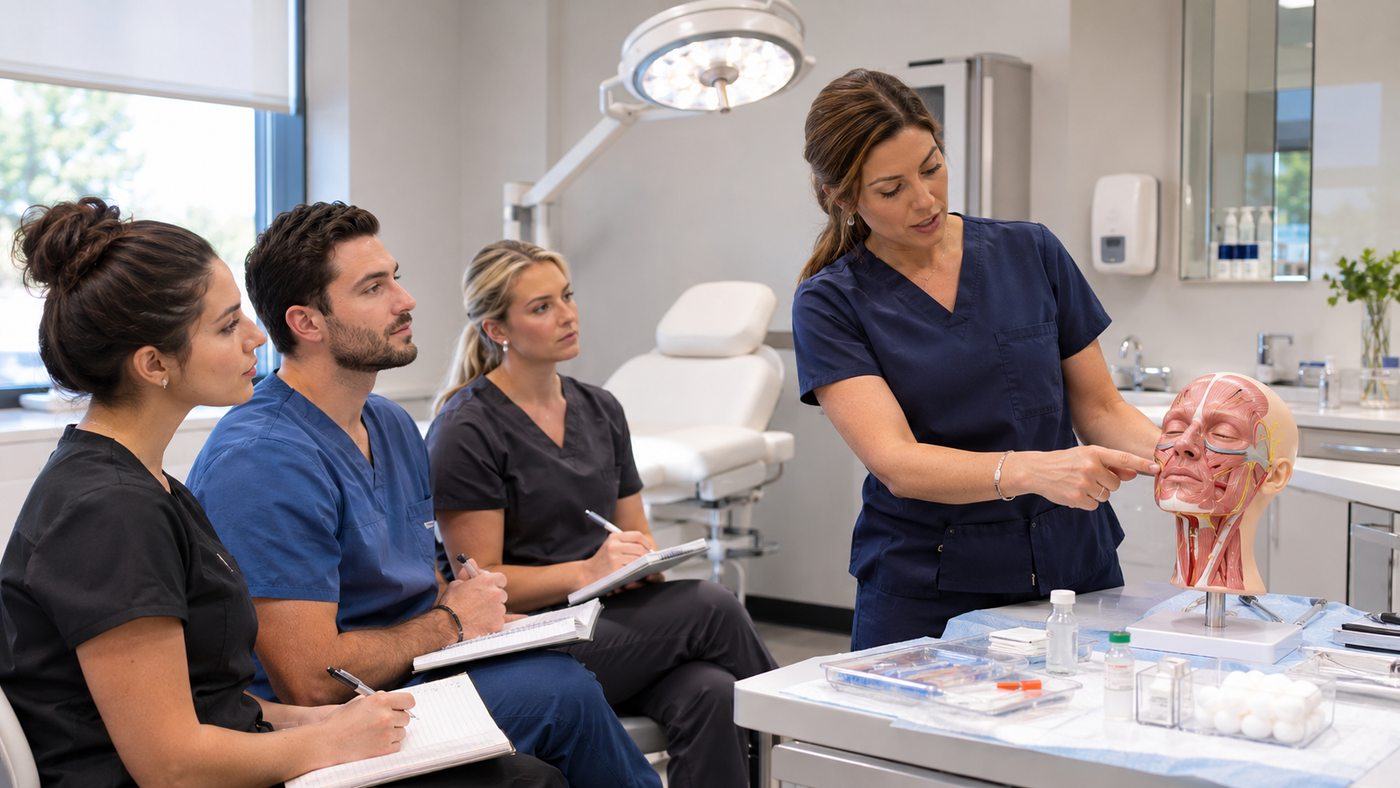
Aesthetic medicine attracts healthcare professionals who want to expand their clinical knowledge, explore new career options, or understand how minimally invasive cosmetic treatments are delivered responsibly. Injector Training Academy is a U.S.-based training provider that advertises online education, in-person Botox and dermal filler courses, and extended mentorship for eligible medical professionals. Its programs emphasize facial anatomy, practical experience, and the operational realities of aesthetic practice. However, choosing a course should begin with patient safety and legal eligibility rather than promises of rapid income or instant independence.
Learning to work with botulinum toxin and dermal fillers is not the same as obtaining legal authority to administer them. Professional licensure, prescribing authority, medical orders, delegation, supervision, and facility requirements depend on the practitioner’s state and professional role. A certificate of course completion may document education but does not automatically create a new clinical scope of practice.
This guide explains what the academy advertises, how its training paths compare, what students should verify before enrolling, and 19 practical criteria for evaluating injector education. It also covers tuition, supervised practice, complication readiness, Texas medical regulations, professional insurance, and realistic career development. All published program details should be confirmed directly before payment because schedules, locations, prices, and course inclusions can change.
What Is Injector Training Academy?
Injector Training Academy, also known as ITA, describes itself as a medical aesthetics education provider with a strong clinical base in Texas. Its official website promotes training for licensed healthcare professionals interested in neuromodulators, dermal fillers, and related aesthetic services. The academy advertises both self-paced online education and in-person instruction with experienced clinicians, including a longer injector internship or placement-style mentorship.
The company’s published material identifies Kiara DeWitt, BSN, RN, CPN, as its founder and describes a faculty of practicing aesthetic clinicians. Its training information lists multiple Texas sites, including Dallas, Fort Worth, Austin, Plano, Colleyville, Waxahachie, the Argyle/Bartonville area, and The Woodlands/Shenandoah area. Different academy pages describe eight or nine locations, so prospective students should verify the currently active teaching sites and the exact address of their selected session.
Who Is the Training Designed For?
The academy principally markets its clinical training to healthcare professionals such as registered nurses, nurse practitioners, physician assistants, physicians, and, for appropriate curricula, dentists. Eligibility is more complicated than holding any healthcare-related certificate. The student’s original license, competence, legally authorized scope, medical oversight, and state requirements determine which procedures may be performed in practice.
Some pages use broad language about additional professions or national availability. That is a reason to ask the admissions team for written, profession-specific eligibility information instead of assuming every course allows every enrollee to perform injections.
What Does the Academy Say Makes Its Approach Different?
Injector Training Academy highlights hands-on instruction, exposure to functioning med spa environments, small-group or individual mentorship, and support for transitioning into aesthetic practice. These are claims about the educational experience. Applicants should request the actual clinical schedule, model requirements, instructor-to-student ratio, assessment method, and certificate wording to evaluate how they apply to the chosen course.
Injector Training Academy Programs and Learning Paths
There is no single training pathway that fits every applicant. A licensed clinician with substantial procedural experience may need focused skills development, while someone new to aesthetic medicine may benefit from a broader programme with anatomy, patient assessment, documentation, and close supervision.
| Learning path | What it generally offers | Questions to ask |
|---|---|---|
| Self-paced online education | Foundational concepts and flexible study | What is assessed, and is hands-on training separate? |
| Botox and filler course | Structured theory and practical exposure | How many supervised sessions and models are included? |
| Group workshop | Scheduled learning with other eligible clinicians | What is the ratio of instructors to learners? |
| One-on-one clinical training | Individual feedback in a training setting | Who supervises, and what competencies are documented? |
| Extended injector internship | Longer clinical observation, mentorship, and practice | How many actual hours and supervised experiences are guaranteed? |
| Advanced or specialized modules | Topic-specific education for appropriately qualified practitioners | What prerequisites and legal authorizations apply? |
Online Botox and Filler Education
Injector Training Academy advertises self-paced modules for students who need to study around clinical shifts or family responsibilities. Online lessons can be useful for reviewing anatomy, consultation principles, professional obligations, and theoretical concepts. They cannot by themselves establish practical competence in invasive procedures. If a learner wants to provide treatments after the course, they should identify how supervised hands-on evaluation and legally required oversight will be arranged.
Hands-On Clinical Workshops
Injector Training Academy promotes practical classes with live clinical supervision. Applicants should confirm what happens during the workshop and distinguish observing a procedure from performing an appropriately authorized, supervised task. A strong practical course includes patient selection, informed consent, infection prevention, documentation, recognition of adverse events, and structured feedback rather than focusing only on the number of treatment demonstrations.
Nurse Injector Internship and Mentorship
Injector Training Academy also advertises a longer internship pathway. A recent comparison on its site describes an internship of approximately 12 weeks and more than 80 hours of one-on-one involvement, although published offerings can change. Candidates should ask whether hours refer to direct clinical participation, shadowing, classroom activity, or a combination. Mentorship is especially valuable when learners can discuss clinical decisions, review cases, and receive constructive supervision over time.
19 Smart Tips for Choosing Injector Training Academy Courses
1. Verify Your Professional License and Scope First
Before enrolling with Injector Training Academy, confirm that your existing license and state rules permit the intended professional activity. The Texas Board of Nursing explains that nurses must evaluate their own competence and scope before accepting a cosmetic procedure. A course certificate does not authorize a registered nurse to diagnose independently, prescribe treatment, or perform procedures outside their legal scope. Similar questions should be directed to the appropriate board in every other state.
2. Ask What the Certificate Actually Represents
Terms such as certification, completion, qualification, and licensure are often used loosely in advertising. Ask who issues the document, what performance is assessed, and whether any professional regulator recognizes it for a specific purpose. A private educational certificate may be useful evidence of training, but it is not automatically a government-issued license or a promise that an employer will authorize independent practice.
3. Review the Instructors’ Clinical Credentials
An effective aesthetic training programme should have qualified instructors working within their own scopes of practice. Ask who will lead your particular session, what healthcare licenses they hold, and whether credentials can be verified with the relevant boards. Injector Training Academy publishes information about its faculty, but the assigned instructor and supervision arrangements should still be confirmed for the scheduled course.
4. Prioritize Facial Anatomy and Clinical Assessment
Facial anatomy is a foundational subject because injectable treatments involve structures with meaningful clinical risks. Good teaching also considers patient history, suitability, contraindications, realistic outcomes, and when treatment should be declined. Students should be taught to recognize the limits of their competence and escalate complex cases. Memorizing product names or aesthetic trends is not a substitute for clinical judgment.
5. Look for Meaningful Supervised Clinical Exposure
An educational programme should distinguish demonstration, observation, simulation, and actual supervised clinical participation. Ask how many opportunities are included, whether models or patients must be supplied, and whether participation depends on professional eligibility. The academy advertises hands-on experience; prospective learners should obtain the exact written inclusions rather than relying on a general statement that training is practical.
6. Evaluate Infection Prevention and Product Handling
Injectable treatments require appropriate infection control, safe sharps disposal, preparation areas, storage processes, and reliable product sourcing. The U.S. Centers for Disease Control and Prevention has warned about injuries linked to counterfeit or mishandled botulinum toxin products. A reputable course should explain regulated supply chains, documentation, and safe clinical systems, without encouraging students to source products through unauthorized sellers.
7. Check Training on Complication Recognition
The U.S. Food and Drug Administration identifies rare but serious dermal filler complications, including injury to blood supply, tissue death, blindness, and stroke. Effective training should cover appropriate screening, warning signs, immediate escalation, and an established emergency response plan. Students must not be taught that cosmetic procedures are risk-free or that a short workshop eliminates the possibility of serious adverse events.
8. Confirm Medical Oversight Requirements
Texas treats nonsurgical medical cosmetic procedures as the practice of medicine, subject to the rules governing appropriately delegated medical acts. The Texas Medical Board describes physician oversight and specified availability for emergency consultation. Students who intend to work in Texas should review current board guidance for their role; those practicing elsewhere must check their own jurisdictions. The academy’s assistance with medical director connections does not replace compliance.
9. Compare Theory With Demonstrated Competence
Knowing terminology and completing an online quiz are different from being evaluated in a clinical setting. Ask how the course tests decision-making, informed consent, medical documentation, complication recognition, and professional boundaries. The best Injector Training Academy pathway for a new practitioner may be the one with more observed feedback rather than the quickest certificate.
10. Review Actual Student-to-Instructor Ratios
Small groups can create more opportunities for questions and feedback, but only if practical time is allocated meaningfully. Confirm the maximum group size, the number of supervising clinicians, and whether multiple students share a limited number of cases. A claimed small-class experience should be supported by the session’s published schedule and enrollment limit.
11. Understand Who Supplies Clinical Models and Products
Some hands-on programs include training models and approved products, while others may require separate arrangements. Ask whether consent, medical assessment, documentation, supplies, follow-up, and adverse-event coverage are handled through the training facility. Do not recruit or arrange treatment for a model until the academy confirms that all clinical and legal prerequisites are met.
12. Compare the Full Tuition and Travel Budget
Do not evaluate Injector Training Academy solely by the published course price. Ask about deposits, refund terms, optional mentoring, required materials, transport, accommodation, and time away from work. Its published comparison describes a $3,000 training programme and a $9,000 internship option, but these are programme-specific advertised prices, not guaranteed quotations. Request a current, itemized enrollment agreement.
13. Ask About Refunds, Transfers, and Cancellations
Before making a deposit, clarify what happens if the class is rescheduled, your professional eligibility cannot be verified, a clinical date changes, or you need to withdraw. Request the refund policy in writing. Distinguish an application fee from tuition and ask whether the training provider can transfer enrollment to another location or cohort without additional charges.
14. Confirm the Actual Training Location
Injector Training Academy lists multiple Texas training addresses and advertises some sessions outside its principal sites. Published pages are not completely consistent about the number of locations. Verify the city, building, clinical environment, accessibility, parking, and start times directly. Out-of-state students should not purchase nonrefundable travel before receiving written confirmation of the location and class date.
15. Review Patient Consent and Documentation Training
Aesthetic medicine involves sensitive patient information, consent discussions, treatment records, follow-up communication, and privacy obligations. Learners should understand the relevant documentation responsibilities for their clinical role. If a course advertises med spa operations or startup guidance, ask whether it explains when legal, privacy, and regulatory professionals must be consulted rather than offering universal templates as a complete compliance solution.
16. Check Whether Mentorship Continues After Class
One-day instruction may introduce concepts without providing ongoing feedback during a career transition. Ask whether graduates can contact faculty, observe supervised practice, participate in additional training, or receive case-review support. Injector Training Academy promotes mentoring and career resources, but the length, cost, availability, and limitations of those services should appear in the enrollment terms.
17. Verify Career Support Claims
Resume guidance, employer introductions, med spa business education, and networking can be helpful. They are not equivalent to a guaranteed job, defined income, or permission to open a medical practice. Ask how employment support works and whether any placement claims are documented. Career outcomes depend on existing licensure, local hiring conditions, competency, experience, and professional oversight.
18. Examine Insurance and Employer Requirements
A clinician may need appropriate professional liability insurance before delivering aesthetic treatments. Coverage can vary by procedure, professional role, location, and employer arrangement. Ask the insurer about exclusions and prerequisites. A training certificate alone does not prove that a policy covers the planned procedures. If you intend to operate a med spa, obtain advice on the separate legal and business responsibilities.
19. Make Patient Safety the Final Decision Criterion
The strongest reason to choose an academy is not a promotional discount or a fast completion date. It is an educational process that prepares an eligible clinician to recognize limits, practice within legal authority, communicate honestly, and respond appropriately when something goes wrong. The right Injector Training Academy course should withstand close questions about anatomy education, practical supervision, medical oversight, and transparent assessment.
What Do Botox and Dermal Filler Courses Usually Cover?
Injectable aesthetics courses often introduce neuromodulators, hyaluronic acid fillers, patient assessment, treatment planning principles, facial anatomy, adverse-event awareness, and clinical documentation. However, not every course includes the same level of practice or qualifies the learner for the same professional activities.
Neuromodulator Education
Botulinum toxin products are prescription medicines that temporarily affect muscle activity in designated clinical contexts. Courses may discuss relevant indications, eligibility, patient communication, medicine handling, and responsible follow-up. The FDA requires product-specific labeling and safety information. Students should learn to use approved information and qualified medical supervision rather than treating brands or doses as interchangeable.
Dermal Filler Education
Dermal fillers are regulated medical products used for certain cosmetic indications. Training should address approved uses, contraindications, realistic outcomes, possible adverse events, and escalation procedures. FDA guidance emphasizes that accidental injection into blood vessels may have severe consequences. An educational article is not an appropriate substitute for supervised procedural instruction.
Advanced Modules
Injector Training Academy’s programme pages also list additional subjects such as platelet-rich plasma, microneedling, semaglutide-related care, and other specialized services. These are distinct clinical areas with different evidence, product rules, prescribing restrictions, and practitioner requirements. Learners should verify the specific curriculum and their legal eligibility before combining several services under one aesthetic business plan.
Injector Training Academy Tuition and Course Duration
Published prices and program lengths can be useful for comparison, but they are not a substitute for a current written quote. The academy’s own materials have described different formats at different times, including introductory workshops and longer training pathways.
| Published example | Academy-described format | Important qualification |
|---|---|---|
| Online/certification pathway | Self-paced learning with hands-on components in some packages | Confirm which clinical sessions are included |
| Injector certification comparison | Approximately $3,000 on a recent programme page | Verify current price and eligibility |
| Extended aesthetic injector internship | Approximately $9,000 on a recent programme page | Verify hours, location, mentorship, and payment terms |
| Workshops and specialized classes | Dates and duration vary | Confirm prerequisites and whether fees cover supplies |
These amounts are advertised examples in U.S. dollars and may change. Do not infer that the lowest-cost programme provides the same clinical experience as the longer option. Students should also consider transport, accommodation, liability coverage, continuing education, and possible time away from work.
Is a Short Course Enough?
A short course can introduce foundational knowledge or supplement an experienced clinician’s existing skills. It cannot guarantee readiness for independent practice. Actual competence requires appropriate prior training, supervision, assessment, and continuing professional development. Texas regulatory expectations and other states’ laws still apply after the course is completed.
Is Online Injector Training Sufficient?
Online education is valuable for theoretical learning and professional development. It cannot recreate all the judgments, feedback, and supervised experience involved in caring for real patients. For medical professionals evaluating Injector Training Academy, the key question is not whether online learning is legitimate but whether the whole educational pathway matches the learner’s experience and the legally permitted practice setting.
Texas Injector Licensing, Medical Delegation, and Scope of Practice
One of the most important questions about aesthetic education is who may legally provide a service. Texas provides a useful example because Injector Training Academy maintains significant training activity there.
Texas Board of Nursing Guidance
The Texas Board of Nursing says registered nurses must individually assess competence, appropriate orders, supervision, and their scope of practice when considering cosmetic procedures. It cautions that an RN should not perform a procedure without necessary preparation and appropriate medical authorization. Advanced practice registered nurses have additional responsibilities and do not have unrestricted independent medical practice authority in Texas.
Texas Medical Board Oversight
The Texas Medical Board identifies nonsurgical medical cosmetic procedures as medical acts that may be delegated appropriately. Its current public guidance addresses physician, physician assistant, or advanced practice nurse availability for supervision and emergency consultation under relevant circumstances. The rules are technical and should be checked directly before a clinic establishes a service model.
Other States Have Different Rules
Nurses and other clinicians traveling from outside Texas should consult their home-state professional boards and legal advisers. Training in Texas does not make an individual authorized to provide the same procedures in California, Florida, New York, or another jurisdiction. Dental and physician-assistant scopes may also differ substantially from nursing scopes.
Why Safety Education Matters More Than Fast Certification
The FDA warns that dermal filler injections can lead to vascular injury and, in rare cases, serious outcomes such as blindness or stroke. The CDC has also documented harmful reactions linked to counterfeit or mishandled botulinum toxin products and care delivered outside appropriate licensing requirements. These are important reasons for students to demand comprehensive safety instruction rather than a course that only advertises attractive cosmetic results.
Responsible Patient Selection
Qualified clinical teams must assess patient goals, relevant history, contraindications, alternatives, and suitability. Not every requested treatment is appropriate. A responsible injector should be prepared to delay or decline care when necessary.
Consent and Realistic Expectations
Before treatment, patients should receive an honest explanation of potential benefits, limitations, expected recovery, and known adverse events. An educational programme should train participants to communicate respectfully and avoid promising results that cannot be guaranteed.
Emergency Escalation and Follow-Up
Clinicians should know their workplace’s escalation procedures, how to obtain qualified medical assistance, and how to document and communicate about unexpected symptoms. A course should make these responsibilities explicit. Marketing that minimizes risks or suggests supervision is optional deserves careful scrutiny.
How to Choose Between an Online Course and a Clinical Internship
The right learning format depends on prior healthcare experience and the level of supervised exposure available. Consider the following broad comparison.
| Decision factor | Online-focused pathway | Extended clinical mentorship |
|---|---|---|
| Scheduling flexibility | Generally high | Requires committed clinical time |
| Theory and foundational review | Often the central strength | Integrated with observed practice |
| Real-patient exposure | May be separate or limited | Potentially more extensive; confirm details |
| Direct instructor feedback | Varies by course | Typically more frequent if promised sessions occur |
| Cost and travel | May be lower | Often greater expense and time commitment |
| Legal authorization afterward | Not automatically provided | Not automatically provided |
An experienced clinician pursuing a narrowly defined refresher course may not need the same instruction as a nurse with no prior aesthetic exposure. When evaluating Injector Training Academy, compare the learning objectives with your specific professional gaps and confirm how competence will be assessed.
From Training to a Responsible Aesthetic Career
Completion of a course is a starting point rather than the end of a professional development plan. New aesthetic clinicians should seek appropriate employment or supervised practice environments, clarify prescribing and delegation arrangements, understand documentation and safety requirements, and obtain suitable insurance. Professional development also includes ongoing education and learning to recognize when a patient’s needs exceed one’s competence.
Working in an Established Med Spa
A supervised clinical workplace may provide exposure to consultations, follow-up procedures, inventory controls, and interdisciplinary decision-making. Applicants should ask about onboarding, support for newer clinicians, clinical governance, and incident reporting. A polished social media presence is not sufficient evidence of a safe clinical culture.
Exploring a Med Spa Business
Owning a clinic involves business and legal responsibilities beyond learning aesthetic techniques. Depending on the state and structure, these may include medical ownership rules, professional delegation, records, privacy, facility obligations, medicine purchasing, and insurance. Injector Training Academy advertises business-development resources; prospective owners should still obtain jurisdiction-specific legal and financial advice.
Continuing Professional Education
Products, clinical evidence, manufacturer labeling, and state regulations change. Clinicians should maintain a continuing education plan and periodically reassess skills and protocols. Experienced colleagues and medical supervisors can offer valuable feedback, especially after difficult or unexpected clinical situations.
Common Mistakes Students Make When Choosing Injector Training
A frequent mistake is equating a private training certificate with a license. Another is assuming that a high number of injections observed guarantees competence. Students may also focus on course discounts while overlooking clinical supervision, insurance, product authenticity, and the cost of ongoing development.
Some learners believe that training at an academy in Texas gives them identical authority in their home state. Others expect employment or medical director placement simply because a school advertises career support. The safer approach is to distinguish promotional claims, contractual inclusions, regulatory requirements, and individual professional responsibilities.
When considering Injector Training Academy, obtain written answers to the practical questions rather than enrolling solely on the strength of before-and-after photographs or testimonials.
Questions to Ask Injector Training Academy Before Enrolling
Prepare a short admissions checklist and request a response that refers to the specific programme you want.
- Is my current healthcare license eligible for this course and the planned activities?
- Which instructor will supervise the hands-on training, and how can I verify credentials?
- How many hours are theory, observation, simulation, and supervised clinical participation?
- Does tuition include patient models, supplies, assessments, and any repeat sessions?
- What certificate is awarded, and what does it legally represent?
- What are the exact class address, dates, travel requirements, and refund terms?
- How are consent, medical oversight, privacy, and emergency care handled in training?
- What mentorship or career resources continue after the course, and at what cost?
- Does the programme help students understand rules in the state where they intend to practice?
Frequently Asked Questions
1. What courses does Injector Training Academy offer?
The academy advertises online aesthetic education, Botox and dermal filler courses, supervised hands-on workshops, and an extended injector internship or mentorship pathway. Its wider curriculum also lists certain specialized aesthetic and medical topics. Course availability depends on schedule, location, and eligibility.
2. Can a nurse inject Botox after finishing an academy course?
A course certificate alone does not grant legal authority. A nurse must work within their license, demonstrated competence, applicable orders, medical delegation or supervision rules, and the requirements of the jurisdiction where treatment occurs. The Texas Board of Nursing specifically emphasizes individual scope-of-practice evaluation.
3. How much does injector training cost at ITA?
The academy has published examples of approximately $3,000 for one certification pathway and $9,000 for an extended internship. These are advertised programme prices, not guaranteed current quotes. Students should verify tuition, clinical inclusions, travel expenses, refund rules, and any extra fees before enrolling.
4. Is hands-on training better than online-only education?
Hands-on supervised experience is important for assessing clinical competence in invasive procedures, while online learning can effectively support theoretical preparation. The appropriate combination depends on the learner’s prior skills and legal role. Neither format automatically grants a professional license or independent prescribing authority.
Conclusion
Injector Training Academy advertises several pathways for eligible healthcare professionals exploring aesthetic medicine, from flexible online education to extended clinical mentorship. The most meaningful comparison involves verified eligibility, instructor credentials, genuine supervised experience, transparent tuition, and strong preparation for patient safety. Training certificates should never be confused with professional licensure or permission to practice beyond an authorized scope. By evaluating these details carefully, prospective students can choose education that supports responsible, sustainable career development.
