
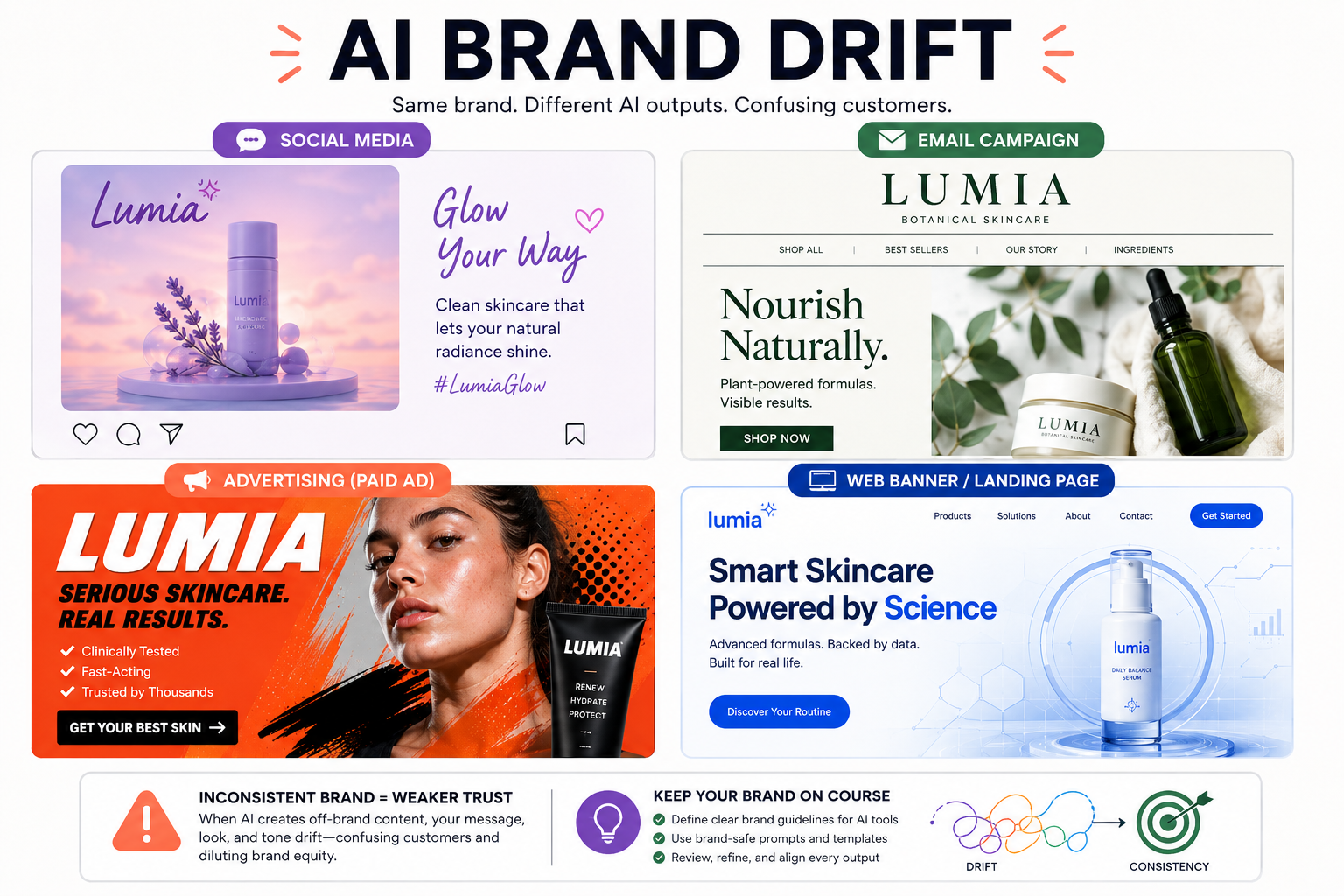
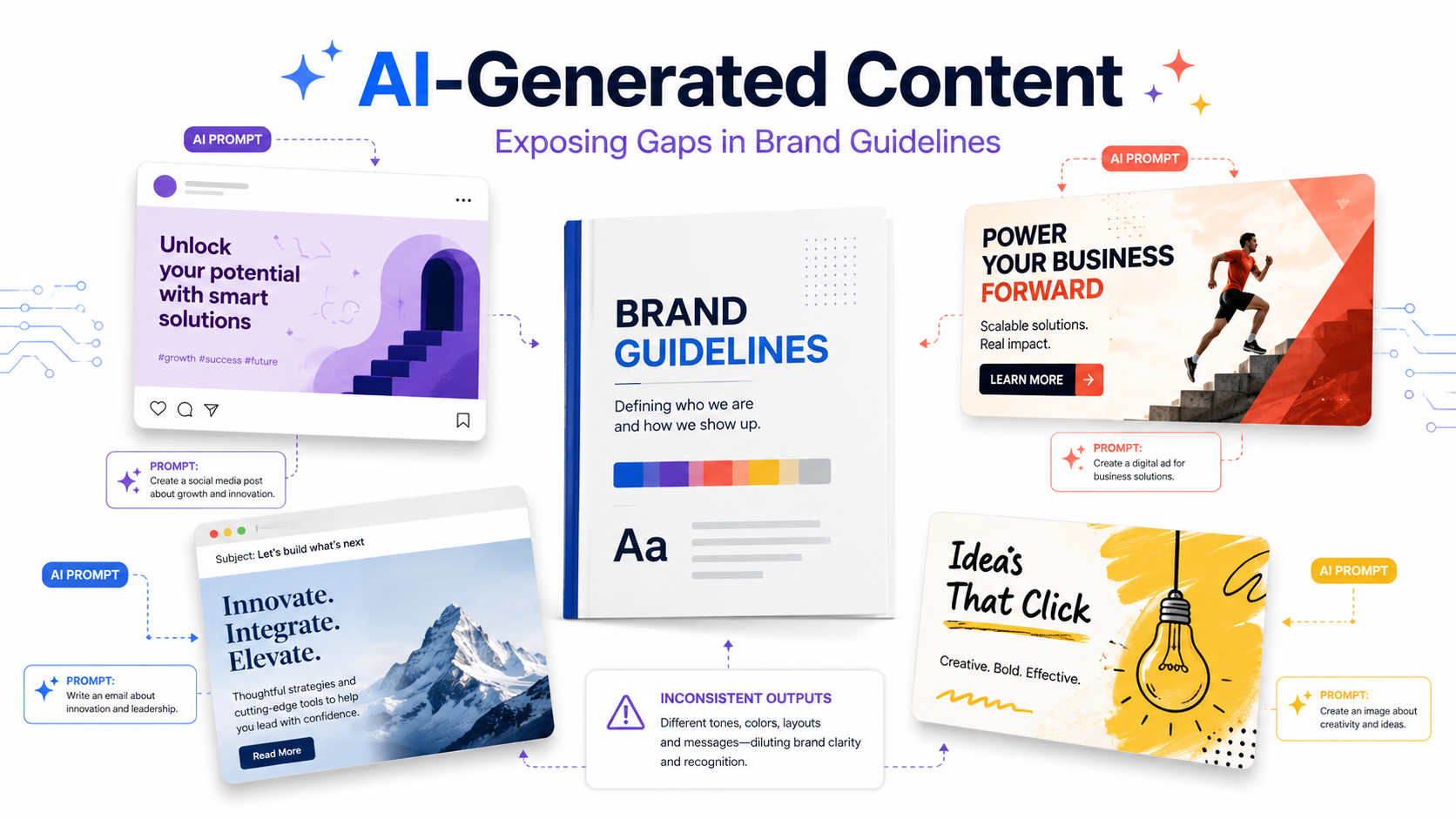
AI-generated content is exposing weaknesses in brand guidelines because most guidelines were written for people, not machines producing content at scale. When the rules around voice, messaging, visuals, claims, and approvals are vague, AI fills in the blanks—and the results often look polished while feeling noticeably off-brand.
Generative AI has changed the pace of marketing.
Teams can now produce blog drafts, social posts, email campaigns, advertisements, images, and video concepts in a fraction of the time these tasks once required.
That speed is useful, but it has also created a problem many brands did not see coming.
They are publishing more content while becoming less recognizable.
The issue is not always the AI tool itself. Quite often, the technology is simply revealing that the company’s existing brand guidelines are too broad, too old, or too difficult to apply in day-to-day marketing.
What Are Brand Guidelines?
Definition: Brand guidelines are the practical rules that explain how a brand should look, sound, communicate, and behave across different channels.
Traditional guidelines usually cover:
- Logo usage
- Brand colours
- Typography
- Photography
- Graphic styles
- Taglines
- Tone of voice
- Core messaging
These elements still matter.
But modern marketing teams now need more.
They also need guidance on AI-generated copy, synthetic imagery, factual verification, data privacy, approval processes, and content governance.
A static PDF with colour codes and logo spacing rules is no longer enough for a team producing dozens of AI-assisted assets every week.
Why Does AI-Generated Content Reveal Brand Problems?
AI tools respond to the instructions they are given.
When those instructions are clear, the output is usually more focused. When they are vague, contradictory, or incomplete, the AI has to make assumptions.
Those assumptions create inconsistency.
For example, a company might describe its tone as:
- Friendly
- Professional
- Confident
- Human
- Bold
At first glance, that sounds useful.
In practice, each word can be interpreted differently.
One person may read “bold” as direct and decisive. Another may read it as provocative. An AI tool may turn it into loud, exaggerated, or overly promotional copy.
As more businesses gain access to the same generative tools, producing content is becoming easier while creating something distinctive is becoming harder. Agency Squid explores how AI-driven speed and volume can weaken differentiation when content production is not guided by a clear brand strategy.
The more content the brand produces, the more obvious those differences become.
Key Takeaway
AI does not automatically understand what makes a brand distinctive. It needs specific rules, examples, boundaries, and context.
Which Brand Guideline Gaps Does AI Expose Most Often?
1. Vague Brand Voice Guidelines
Many brand voice documents rely on broad personality words rather than usable writing direction.
A typical guideline might say:
“Our voice is authentic, energetic, and innovative.”
The problem is that it does not explain what any of those qualities look like in an actual sentence.
It may not answer questions such as:
- Should sentences be short or detailed?
- Can the brand use contractions?
- Is humour appropriate?
- How technical should the language be?
- Is slang allowed?
- Which words should never be used?
- Should calls to action feel urgent or calm?
- How should the tone change across platforms?
AI tools need more than adjectives.
They need clear writing rules.
Weak voice guideline
Sound friendly and professional.
Stronger voice guideline
Use clear, conversational English. Address the reader directly, keep sentences concise, and explain technical language when it appears. Avoid corporate jargon, sarcasm, exaggerated claims, and overly casual slang.
The stronger version gives both people and AI a standard they can actually follow.
2. No Channel-Specific Direction
A brand should feel consistent across channels, but that does not mean every piece of content should sound identical.
A LinkedIn post may need an informed, professional tone.
An Instagram caption may be shorter and more relaxed.
A landing page may need clear benefits and supporting evidence.
A customer-support message may need empathy, reassurance, and a direct next step.
Weak guidelines often define one universal tone and leave teams to figure out the rest.
Useful brand guidelines for AI should explain how the brand adapts by channel.
| Channel | Recommended tone | Typical structure | Important restrictions |
| Website | Clear and authoritative | Detailed but easy to scan | Avoid unsupported claims |
| Professional and insightful | Strong opening with short paragraphs | Avoid clickbait | |
| Conversational and concise | Hook, value, and CTA | Avoid excessive hashtags | |
| Personal and action-focused | Context followed by a next step | Avoid generic AI phrasing | |
| Customer support | Calm and helpful | Acknowledge, explain, resolve | Never blame the customer |
| Paid advertising | Direct and benefit-led | Short headline with a clear offer | Follow legal and platform rules |
Without this level of direction, AI-generated content often becomes generic or inappropriate for the platform.
Droven’s guide to AI content writing tools also highlights the importance of brand voice controls and human editing when businesses scale content production.
3. No Approved Brand Vocabulary
Most strong brands use certain words consistently.
They have preferred language for describing:
- Their products
- Their services
- Their customers
- Their industry
- Their features
- Their processes
- Their benefits
- Their competitors
- Their values
They also have words they avoid.
A premium financial company may prefer “clients” instead of “users.”
A healthcare brand may avoid wording that implies guaranteed outcomes.
A software company may describe its product as a “platform” rather than a “tool.”
When no approved vocabulary exists, AI may describe the same offer differently across a website, campaign, sales deck, and social media post.
That inconsistency weakens clarity and recognition.
4. An Unclear Messaging Hierarchy
Many brand documents focus heavily on visual design while giving little attention to message priority.
AI needs to understand:
- What the brand stands for
- Who it serves
- Which problem it solves
- Why it is different
- Which benefits matter most
- What proof supports those benefits
- What action the audience should take
Without a clear hierarchy, AI may focus on the wrong product feature, invent a new positioning angle, or emphasise a benefit the company does not consider important.
A practical messaging framework should include:
- Brand purpose
- Positioning statement
- Core value proposition
- Audience segments
- Customer pain points
- Primary benefits
- Supporting evidence
- Common objections
- Approved calls to action
5. Incomplete Visual Identity Rules
AI image tools can create a large amount of visual content quickly.
They can also create visual inconsistency just as quickly.
Traditional guidelines may define logos, colours, and typography while saying very little about:
- Image composition
- Lighting
- Camera angles
- Subject selection
- Illustration style
- Textures
- Background treatments
- Levels of realism
- Diversity and representation
- Product accuracy
- Artificial people
- Prohibited visual themes
This is where brand drift begins.
One campaign may look soft and minimal. Another may feel futuristic. A third may use bold commercial photography. Even when every image looks professional, the collection may not look like it belongs to the same company.
Droven has discussed how high-volume AI image production can create brand drift through inconsistent colours, treatments, typography, and quality. A reusable visual system helps teams increase output without losing consistency.
A useful visual rule might say:
Use natural lighting, realistic proportions, uncluttered settings, and warm neutral backgrounds. Avoid glossy science-fiction effects, generic office scenes, exaggerated expressions, and AI-generated text inside images.
That instruction is far more useful than saying:
Keep the visuals modern and premium.
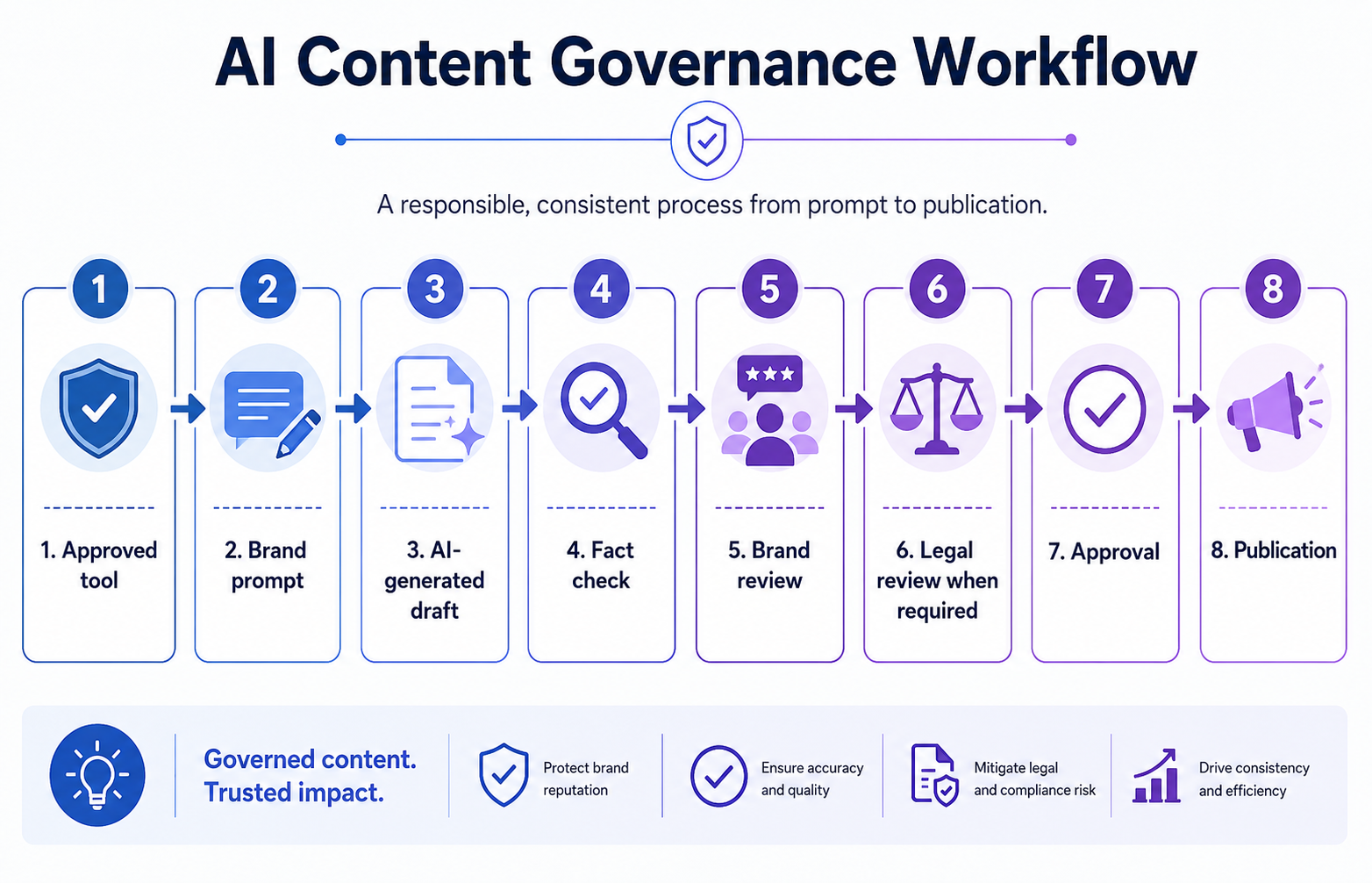
6. No AI Content Governance
AI content governance explains how a company is allowed to use AI.
It defines which tools are approved, what information may be entered, who reviews the output, and what happens before content is published.
Without governance, different employees often create their own rules.
One team may carefully review every AI-assisted draft.
Another may publish the first response it receives.
Someone else may unknowingly enter confidential customer information into an unapproved platform.
A practical governance policy should answer:
- Which AI tools are approved?
- What tasks may use AI?
- What information must never be entered?
- Who is responsible for the final output?
- Which claims require verification?
- When is disclosure required?
- Who approves public content?
- How should prompts and versions be stored?
- What is the correction process when AI makes an error?
Governance should not be treated as paperwork.
It is part of protecting the brand.
7. No Fact-Checking Rules
AI can produce information that sounds confident while being wrong, outdated, or unsupported.
This becomes especially risky when content includes:
- Statistics
- Prices
- Product specifications
- Regulations
- Medical claims
- Financial information
- Competitor comparisons
- Customer results
- Performance claims
- Technical instructions
Brand guidelines should separate:
- Approved facts
- Claims requiring a source
- Claims requiring legal review
- Statements that must never be published
A strong rule might say:
Any statistic, quotation, legal claim, product specification, or performance result generated by AI must be verified using a reliable primary source before publication.
Human review matters because audiences do not blame the AI tool when something is wrong.
They blame the brand that published it.
8. No Examples of Good and Bad Content
Examples make guidelines easier to understand.
Instead of simply describing the brand voice, show what it looks like.
Acceptable example
Managing a growing content workload should not require sacrificing quality. Our platform helps marketing teams plan, review, and publish content from one workspace.
Unacceptable example
Revolutionize your marketing game with our cutting-edge, world-class solution that guarantees incredible results!
The second example may be inappropriate because it uses:
- Hype
- Generic marketing language
- Unsupported superlatives
- A guarantee
- An overly aggressive tone
Examples help employees, freelancers, agencies, and AI systems make more consistent decisions.
Are AI Brand Guidelines Different From Traditional Guidelines?
Yes.
Traditional brand guidelines explain the identity of the brand.
AI brand guidelines also explain how that identity should be used inside prompts, workflows, content systems, and approval processes.
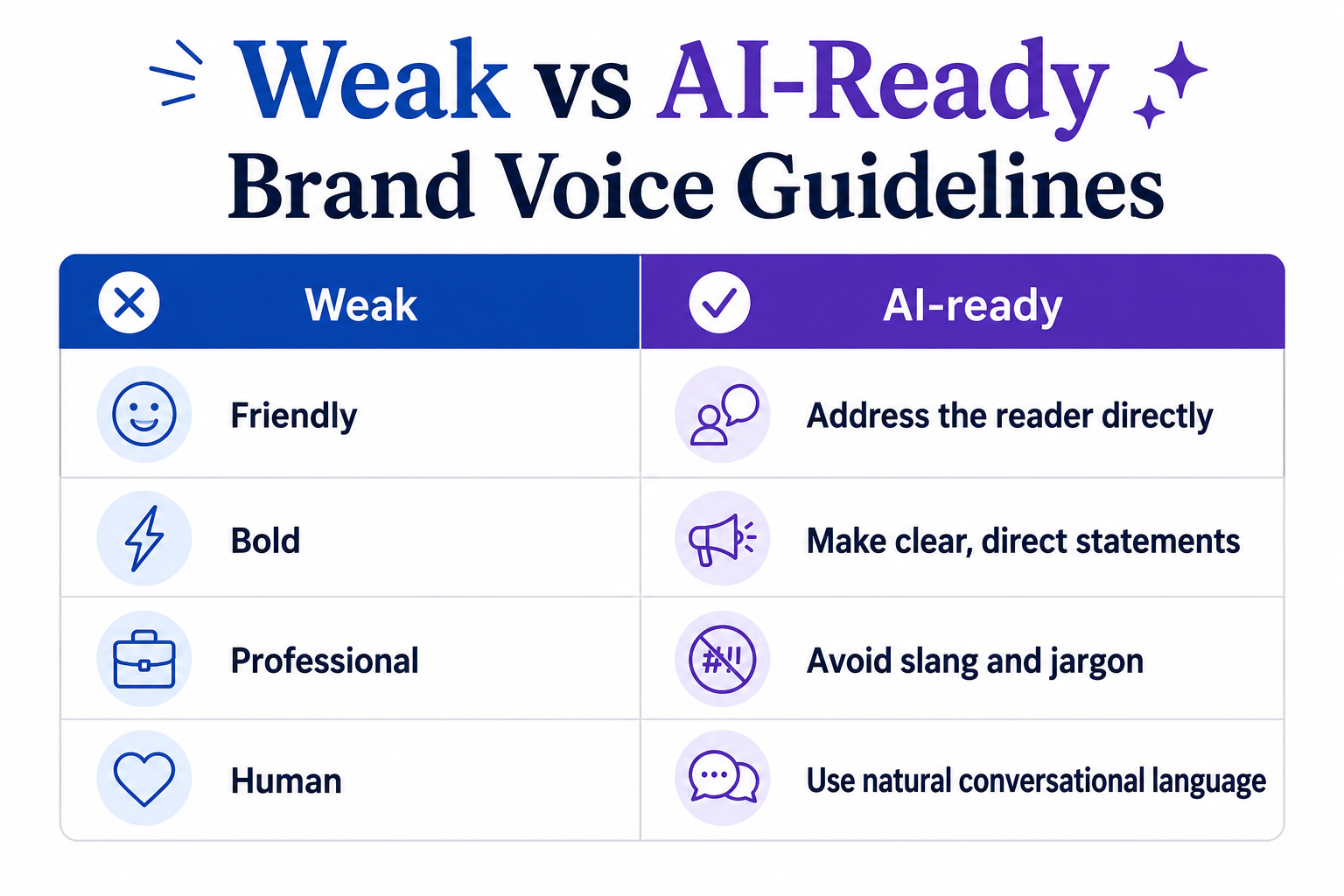
Traditional vs AI-Ready Brand Guidelines
| Traditional guidelines | AI-ready guidelines |
| Logo usage | Logo rules plus AI image restrictions |
| Colour palette | Colour rules plus prompt-ready values |
| Tone adjectives | Detailed language rules and examples |
| Typography | Typography plus template rules |
| Photography direction | Approved prompts and prohibited styles |
| Core messaging | Messaging hierarchy and reusable brand context |
| Manual approvals | Risk-based AI review process |
| Static PDF | Searchable and regularly updated system |
| Written for employees | Written for employees, partners, and AI tools |
| Focused on consistency | Focused on consistency, accuracy, safety, and governance |
Traditional guidelines are still the foundation.
AI-ready guidelines simply make that foundation more useful in a faster, more automated environment.
How Can You Create AI-Ready Brand Guidelines?
1. Audit Recent AI-Generated Content
Start by reviewing content produced during the last three to six months.
Include:
- Blog posts
- Social media posts
- Advertisements
- Email campaigns
- Product descriptions
- Images
- Videos
- Sales material
- Customer-service replies
Look for repeated issues such as:
- Inconsistent tone
- Generic wording
- Different product descriptions
- Unsupported claims
- Visual inconsistency
- Incorrect terminology
- Weak calls to action
- Missing audience context
The goal is not merely to evaluate the quality of the AI.
The goal is to identify which brand rules are missing.
2. Turn Subjective Ideas Into Clear Instructions
Replace abstract guidance with observable rules.
Instead of:
Be confident.
Use:
Make direct statements, lead with the customer benefit, and remove unnecessary qualifiers. Do not use guarantees or unsupported superlatives.
Instead of:
Keep visuals authentic.
Use:
Use realistic settings, natural body proportions, believable lighting, and products that accurately match their real-world appearance.
The clearer the rule, the easier it is to apply.
3. Create a Structured Brand Context Document
Build a document that writers, designers, freelancers, agencies, and AI tools can all use.
It should include:
- Brand overview
- Mission and purpose
- Target audiences
- Positioning
- Value proposition
- Key messages
- Brand personality
- Voice rules
- Preferred vocabulary
- Prohibited claims
- Visual direction
- AI restrictions
- Approval steps
- Examples
Agency Squid’s brand guidelines framework offers a useful strategic reference for building guidelines that go beyond logo usage and support consistent brand execution.
4. Build Reusable Prompt Templates
Do not expect every team member to create prompts from scratch.
Provide approved templates for common tasks.
Example prompt
Create a blog section for [AUDIENCE] about [TOPIC].
Brand position:
[POSITIONING]
Voice:
[VOICE RULES]
Preferred terms:
[PREFERRED TERMS]
Avoid:
[PROHIBITED TERMS]
Required evidence:
[SOURCES OR APPROVED FACTS]
Format:
[HEADING, LENGTH, PARAGRAPH, AND LIST RULES]
Do not invent statistics, customer results, quotations, or product features.
This improves AI brand consistency because every user begins with the same brand context.
5. Define Different Levels of Human Review
Not every AI-assisted task carries the same risk.
A headline brainstorm does not require the same review as a medical claim or paid advertisement.
| Risk level | Example | Review needed |
| Low | Internal ideas or headline options | Creator review |
| Medium | Blog drafts and social posts | Editorial or marketing review |
| High | Paid campaigns and product claims | Senior marketing and legal review |
| Critical | Medical, legal, financial, or safety content | Qualified specialist approval |
The greater the risk, the stronger the review process should be.
6. Keep a Human Creative Owner
AI can generate options.
It should not be responsible for defining the brand.
A human owner should remain responsible for:
- Positioning
- Cultural sensitivity
- Emotional relevance
- Creative judgement
- Final messaging
- Ethical decisions
- Brand evolution
Droven’s article on AI and modern vibe marketing also stresses the importance of using AI to support experimentation while keeping human direction at the centre.
7. Update Guidelines Regularly
Brand guidelines should evolve.
Update them when:
- A new AI tool is introduced
- The brand enters another market
- A new product launches
- Legal requirements change
- The same content mistakes keep appearing
- Customer language shifts
- Positioning changes
- A new channel is added
For active marketing teams, a quarterly review is sensible.
Major brand or technology changes should trigger an earlier update.
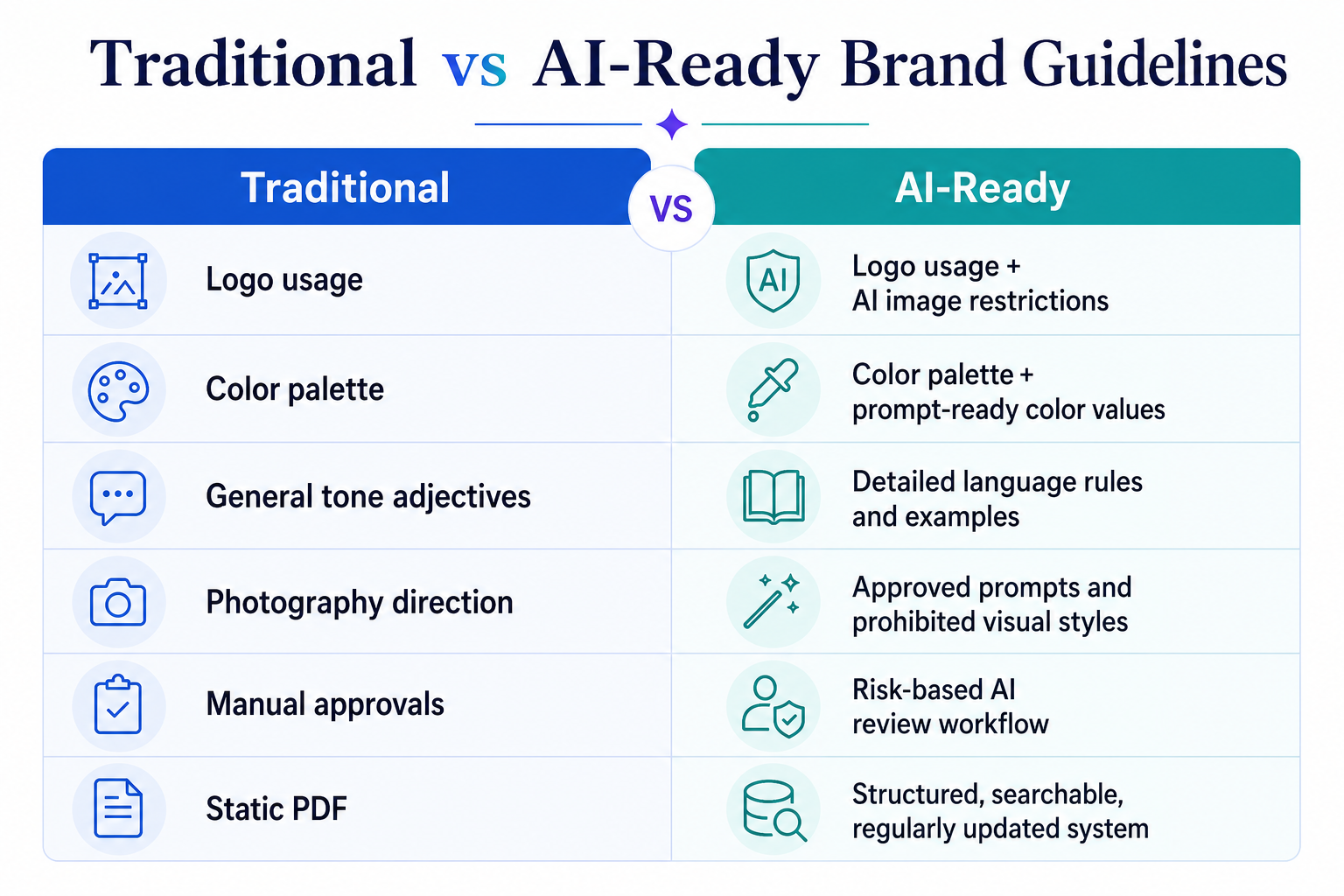
What Should an AI Content Governance Policy Include?
A useful policy should cover four areas.
Approved uses
Examples include:
- Brainstorming
- Summarising internal notes
- Creating first drafts
- Generating variations
- Repurposing approved content
- Producing image concepts
Restricted uses
Examples include:
- Entering confidential customer data
- Publishing without review
- Creating fake testimonials
- Impersonating employees
- Inventing statistics
- Producing regulated advice
- Copying protected creative work
- Misrepresenting real people
Review requirements
The policy should explain:
- Who reviews each content type
- Which tools may be used
- Which sources must be checked
- When legal approval is required
- How errors are corrected
- Whether AI involvement should be disclosed
Record keeping
For higher-risk content, save:
- The prompt
- The AI tool used
- The generated draft
- Human edits
- Supporting sources
- Reviewer details
- Approval date
- Final published version
What Are the Benefits of AI-Ready Guidelines?
Benefits
- Faster content creation
- More consistent messaging
- Clearer approval processes
- Fewer factual errors
- Easier collaboration
- Better employee onboarding
- Safer AI adoption
- More reliable outsourced content
- Stronger brand recognition
- Less time spent rewriting generic drafts
Limitations
- Human judgement is still required
- AI output can remain unpredictable
- Guidelines need regular updates
- Strict rules may limit experimentation
- Different tools interpret prompts differently
- Governance creates additional review work
- Consistency cannot be completely automated
Key Takeaway
AI-ready guidelines are not meant to remove creativity. They create boundaries that help teams move faster without weakening the brand.
Example: How AI Reveals Weak Positioning
Imagine a software company asks five employees to generate a launch announcement using different AI tools.
The product is described as:
- A revolutionary platform
- A simple productivity tool
- An enterprise automation solution
- A creative collaboration app
- A next-generation digital ecosystem
Each description may sound reasonable on its own.
Together, they reveal a deeper issue.
The company has not clearly defined what the product is.
The solution is not to keep rewriting AI drafts.
The company needs to decide:
- Which category it belongs to
- Who it serves
- Which problem it solves
- Which benefits matter most
- How the product should be described consistently
Once those decisions are clear, AI becomes easier to control.
AI Brand Guidelines Checklist
Before using AI-generated content publicly, confirm that your guidelines define:
- Brand purpose
- Audience segments
- Positioning
- Value proposition
- Key messages
- Tone of voice
- Preferred vocabulary
- Prohibited phrases
- Approved claims
- Evidence requirements
- Channel-specific tone
- Visual style
- Image-generation restrictions
- AI disclosure rules
- Data privacy rules
- Approved AI tools
- Human reviewers
- Legal escalation process
- Prompt templates
- Good and bad examples
- Review schedule
Frequently Asked Questions
Why is AI-generated content often inconsistent with brand guidelines?
This usually happens when the guidelines are too vague, lack examples, or do not explain the brand’s audience, positioning, vocabulary, tone, and visual rules in enough detail.
What are AI brand guidelines?
AI brand guidelines are practical rules for using generative AI without losing the company’s voice, identity, accuracy, safety, or consistency. They combine traditional brand standards with prompt rules, governance, review, and data policies.
Can AI follow brand guidelines?
AI can follow detailed instructions and examples, but it cannot guarantee perfect compliance. Important claims, campaigns, regulated content, and sensitive material still require human review.
What should brand voice guidelines include?
They should define sentence style, reading level, vocabulary, level of formality, humour, emotional tone, prohibited language, channel variation, calls to action, and real examples.
How does AI affect brand consistency in marketing?
AI increases the speed and volume of production. That improves efficiency, but it can also multiply inconsistency when teams use different prompts, tools, terminology, and review standards.
What is AI content governance?
AI content governance is the collection of policies, roles, tools, controls, and approval steps used to manage how AI-generated content is created, checked, approved, published, and stored.
Should brands disclose AI-generated content?
That depends on the platform, content type, local laws, audience expectations, and how AI was used. Brands should create an internal disclosure policy and obtain legal advice where necessary.
Can generative AI replace brand strategists?
No. It can support research, drafting, ideation, and variation, but it cannot reliably make decisions about positioning, culture, audience emotion, ethics, or long-term brand meaning.
How often should AI brand guidelines be updated?
Active marketing teams should review them at least quarterly. They should also be updated whenever new tools, channels, products, recurring errors, legal requirements, or major brand changes appear.
Conclusion
AI-generated content is not making brand guidelines less relevant.
It is making strong guidelines more necessary.
When AI produces generic language, inconsistent visuals, inaccurate claims, or confused messaging, the underlying problem may not be the tool.
It may be the brand system behind it.
Modern guidelines need to go beyond logos, fonts, colours, and a few tone adjectives.
They should include:
- Clear messaging priorities
- Specific voice rules
- Channel-level guidance
- Prompt-ready visual standards
- Approved terminology
- Fact-checking requirements
- AI governance
- Human review processes
- Practical examples
Brands that build these systems will be better positioned to use generative AI without losing their identity.
A good place to begin is with an audit.
Review the AI-generated content your company has already produced. Every repeated mistake, awkward phrase, visual mismatch, or incorrect claim points to a rule that needs to become clearer.
